
The Five Legendary Culture Heroes of Ancient China
Long before written records began, ancient Chinese traditions told stories about legendary figures who taught people how to live, work, create, and survive.
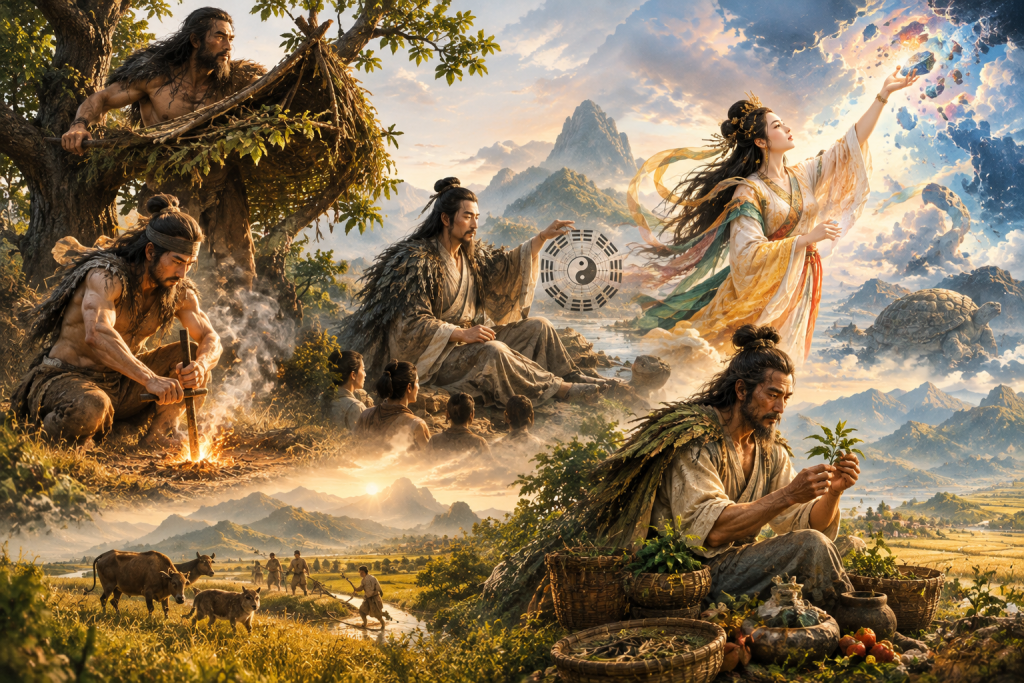
Among these stories are the legends of Youchao, Suiren, Fuxi, Nuwa, and Shennong, sometimes referred to collectively as the Five Culture Heroes.
These figures belong to Chinese mythology and legendary history rather than documented historical records. Yet the stories surrounding them offer an interesting glimpse into how ancient Chinese people imagined the origins of housing, fire, cooking, fishing, agriculture, medicine, marriage, and social organization.
In these legends, early human communities lived without formal social hierarchies and depended on cooperation and shared labor. Such descriptions should be understood as later cultural memories and mythological interpretations of humanity’s distant past, rather than as literal historical accounts.
Youchao and the First Shelters
The first of the legendary culture heroes was Youchao.
According to tradition, early humans once lived directly on the ground, where they were exposed to wild animals, floods, and the dangers of the natural environment.
Youchao is said to have taught people to build shelters above the ground.
He used branches and leaves to construct simple shelters in trees, creating a basic form of housing that could protect people from animals and rising water.
Others followed his example and gradually improved their building techniques. Eventually, similar structures could be constructed closer to the ground while still providing protection from the surrounding environment.
The legend of Youchao therefore represents one of humanity’s earliest imagined steps toward organized shelter and architecture.
Although there is no historical evidence that a single individual named Youchao actually invented houses, the story reflects an important idea: human survival depended not only on adapting to nature, but also on learning how to reshape the environment.
In this sense, Youchao became a symbolic figure representing the beginning of human shelter.
Suiren and the Discovery of Fire
The second legendary figure was Suiren, traditionally remembered for teaching people how to make fire.
Fire already existed in nature, but according to the legend, humans did not yet know how to create it whenever they needed it.
Suiren is said to have discovered how to produce fire by drilling into wood.
This legendary invention transformed human life.
With fire, people could cook food, stay warm, illuminate their surroundings, and protect themselves from wild animals. Cooking also changed the way people consumed food and became an important step in the development of human society.
The story of Suiren making fire by drilling wood therefore represents more than a simple invention story. It symbolizes humanity’s growing ability to understand and control natural forces.
Unlike other animals, humans could preserve and deliberately produce fire, turning it into an essential part of everyday life.
The legend of Suiren thus became a traditional Chinese explanation for one of the most important technological breakthroughs in early human history.
Fuxi and the Eight Trigrams
The third figure was Fuxi, one of the most important culture heroes in Chinese mythology.
Fuxi is traditionally credited with teaching people many skills that were essential to early society.
According to legend, he taught people how to cook food with fire and helped transform raw ingredients into cooked meals. He was also associated with fishing, hunting, animal domestication, music, marriage, and other aspects of social life. Traditional accounts also credit him with creating fishing nets and teaching people how to catch fish and wild animals.
Another important achievement attributed to Fuxi was the creation of the Eight Trigrams, or Bagua.
According to traditional accounts, Fuxi observed patterns in nature and created a system of symbolic lines representing different aspects of the natural world. The Eight Trigrams later became closely associated with divination, cosmology, and Chinese philosophy.
The traditional stories also describe Fuxi as establishing social institutions, including marriage. By creating rules governing relationships between men and women, he is said to have helped establish a more organized family structure.
Fuxi was also associated with music and the development of musical instruments. Some Chinese traditions even credit him or other legendary culture heroes with creating instruments such as the qin, although these accounts belong to the realm of mythology rather than documented history.
Through these stories, Fuxi became a symbol of the transition from a simple existence based primarily on survival toward a more organized human society.
Nuwa and the Repair of Heaven
The fourth legendary figure was Nuwa, one of the most important goddesses in ancient Chinese mythology.
Nuwa also appeared in the previous story of China’s legendary age, where she was described as the creator of humanity. In another famous myth, she became the protector of the human world.
According to the legend, the powerful deity Gonggong collided with Mount Buzhou, causing the structure of heaven to collapse and bringing disaster to the world.
The sky cracked open, and humanity faced a devastating catastrophe.
Nuwa could not bear to see the world destroyed.
She gathered five-colored stones from the mountains and melted them together. Using these magical stones, she repaired the cracks in the sky and restored the damaged heavens.
The colorful glow sometimes seen across the sky was later imagined as the light of these five-colored stones.
Nuwa then killed a giant turtle and used its four legs as pillars to support the heavens and stabilize the earth.
The floods caused by the disaster continued to threaten humanity. According to the myth, Nuwa used burned reeds and their ashes to absorb the floodwaters and restore the land.
The story was also traditionally connected with the fertile plains of northern China. This was a mythological explanation for the landscape rather than a scientific account of geological formation.
The legend of Nuwa repairing heaven presents her as a protector of humanity. While Pangu represents the creation and separation of heaven and earth, Nuwa represents restoration: when the world is damaged, she acts to save it.
Shennong and the Taste of a Hundred Herbs
The fifth legendary figure was Shennong, often known as the Divine Farmer.
Shennong is one of the most important figures in traditional Chinese stories about agriculture, medicine, and early human civilization.
According to legend, Shennong personally tasted hundreds of plants in order to discover their properties.
Some plants were edible, while others could be harmful. By examining and tasting them, Shennong gradually learned about their different qualities and medicinal uses.
This legendary story is reflected in the famous image of Shennong tasting a hundred herbs, which became one of the best-known stories in Chinese traditional culture.
Later Chinese tradition associated Shennong with the development of herbal medicine. The famous Shennong Bencao Jing, or Divine Farmer’s Classic of Materia Medica, bears his name, but the surviving work was compiled much later, during the Eastern Han period, rather than being a book personally written by the legendary Shennong.
Shennong was also traditionally credited with teaching people how to cultivate crops and develop agriculture.
Stories associated with him describe the cultivation of important food plants such as millet and rice and the domestication of useful animals.
These traditions should not be understood as evidence that a single historical individual invented agriculture. Instead, Shennong represents the accumulated agricultural knowledge of early farming communities.
The legend of Shennong therefore reflects an important transformation in human history: the gradual shift from relying primarily on hunting and gathering toward farming, animal domestication, and settled communities.
The Five Culture Heroes and the Origins of Civilization
The stories of Youchao, Suiren, Fuxi, Nuwa, and Shennong form an important part of the legendary history of ancient China.
Each figure represents a different aspect of early human life.
Youchao represents shelter and protection.
Suiren represents fire and cooking.
Fuxi represents fishing, hunting, social organization, symbols, and culture.
Nuwa represents creation, protection, and the restoration of a damaged world.
Shennong represents agriculture, plants, and traditional medicine.
Together, these stories create a symbolic journey from basic survival toward a more organized human society.
They are not historical records in the modern sense. Archaeology, anthropology, and written historical sources provide different ways of understanding the development of early Chinese civilization.
But myths have their own historical value.
They preserve the ways later generations imagined the distant past and explain why certain aspects of human life—fire, shelter, farming, family, medicine, and culture—were considered fundamental to civilization.
The Five Culture Heroes therefore occupy an important place between Chinese mythology and the traditional memory of early civilization.
Their stories may not tell us exactly what happened in prehistoric China, but they reveal how generations of Chinese people imagined the origins of human society—and how they understood the skills that made civilization possible.