
What Is Chinese Culture?
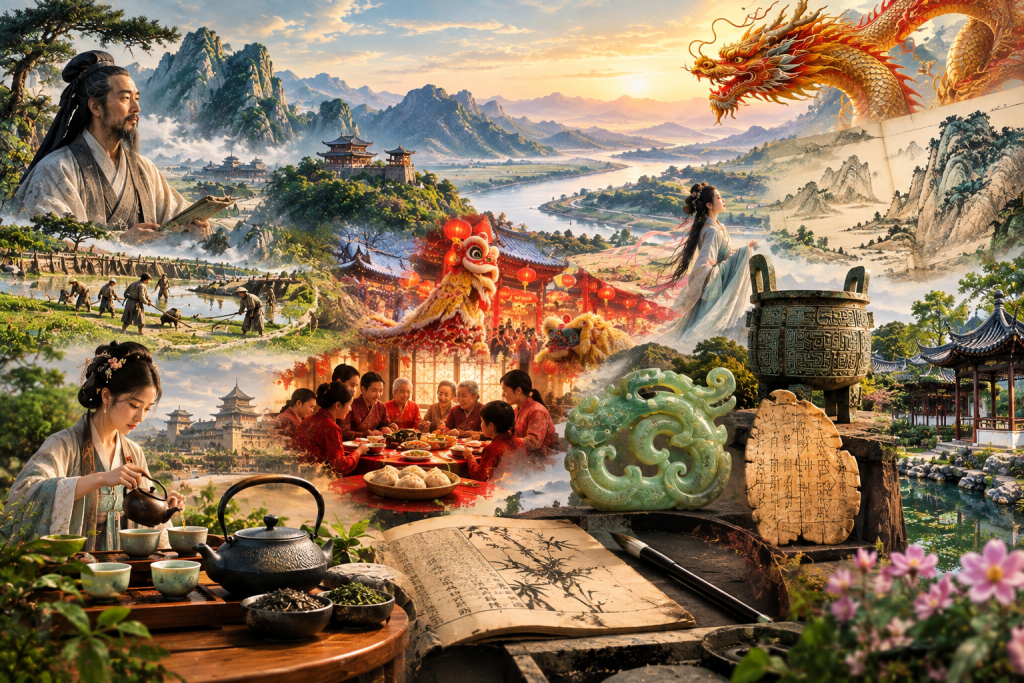
When people think about Chinese culture, they may think of the Chinese New Year, tea, calligraphy, Chinese food, kung fu, dragons, or the Great Wall.
These are all important parts of Chinese culture. But Chinese culture is much more than a collection of traditions, symbols, and customs.
It is a way of understanding the relationship between people, society, nature, time, and life.
For thousands of years, Chinese civilization developed across a vast and diverse land. Different regions, ethnic groups, dynasties, religions, philosophies, and social traditions all contributed to what we now call Chinese culture.
At the same time, one of the most remarkable features of Chinese culture is its continuity.
Dynasties changed. Political systems rose and fell. Cities moved, borders shifted, and new ideas entered China. Yet many cultural traditions continued to evolve rather than simply disappear.
To understand Chinese culture, therefore, is not simply to learn what Chinese people celebrate or eat.
It is to understand how generations of people in China have thought about the world and their place within it.
A Culture Shaped by Thousands of Years of History
Chinese culture cannot be separated from Chinese history.
The roots of Chinese civilization reach back thousands of years, long before the establishment of the first traditionally recognized dynasties. Early agricultural communities, ritual practices, social organization, writing, bronze technology, and political institutions gradually developed over long periods.
The Xia and Shang periods marked important stages in the development of early Chinese civilization, while the Zhou period introduced ideas that would profoundly influence Chinese political and cultural thought.
Later, during the Spring and Autumn and Warring States periods, China experienced an extraordinary period of intellectual development.
Thinkers such as Confucius, Laozi, Mozi, and Mencius, among many others, explored fundamental questions about society, morality, government, human nature, and the relationship between people and the natural world.
These ideas did not remain only philosophical theories.
Over centuries, they became deeply connected with education, family life, government, literature, art, and everyday behavior.
This is one reason Chinese culture is best understood as a living cultural tradition, rather than a collection of ancient relics.
The Idea of Continuity
One of the defining characteristics of Chinese culture is the importance placed on continuity.
Chinese history contains enormous political and social changes. Yet cultural traditions were often preserved, reinterpreted, and passed from one generation to another.
Writing played a particularly important role.
The Chinese writing system developed over a very long period, with early forms preserved in inscriptions such as oracle bone inscriptions from the Shang period. Over time, written Chinese became a major vehicle for recording history, philosophy, literature, government documents, poetry, and personal expression.
This created a strong relationship between writing, memory, and cultural identity.
The past was not simply something that had happened.
It was something that could continue to speak to the present.
This idea of cultural continuity can also be seen in family traditions, festivals, architecture, classical literature, rituals, and traditional arts.
A modern Chinese person may live in a rapidly changing city and use smartphones every day, yet still celebrate festivals, visit family during important occasions, drink tea, appreciate traditional architecture, or recognize cultural symbols that have existed for centuries.
Tradition and modern life are not necessarily opposites.
They often exist together.
Harmony as a Central Cultural Idea
One of the most important ideas for understanding Chinese culture is harmony.
The Chinese concept of harmony, often expressed through the word he (和), does not simply mean that everyone must agree.
It suggests balance, coexistence, and the ability of different elements to exist together.
This idea can be found in many areas of Chinese thought.
People are connected to families.
Families are connected to communities.
Communities are connected to society.
Human beings are also understood as part of a larger natural world.
Traditional Chinese thought often placed importance on finding an appropriate relationship between these different parts rather than viewing each one in complete isolation.
This does not mean that Chinese culture has always been peaceful or harmonious. Chinese history contains wars, political struggles, social conflicts, and profound disagreements.
Rather, harmony represents an important cultural ideal—something to be pursued even when reality is complicated.
This idea helps explain why concepts such as balance, moderation, relationships, and social responsibility appear repeatedly throughout Chinese philosophy and culture.
The Relationship Between People and Nature
Another important feature of Chinese culture is its long-standing interest in the relationship between human beings and nature.
Traditional Chinese philosophy and art often present humans not as completely separate from nature, but as part of a larger natural order.
This can be seen particularly clearly in Chinese landscape painting.
A human figure in a traditional landscape may appear very small compared with mountains, rivers, forests, and sky.
The purpose is not simply to show the size of the landscape.
It can also express an idea about the human position within the natural world.
Mountains and water became important cultural symbols in Chinese art and philosophy.
The Chinese term shan shui, literally meaning “mountain-water,” became associated with a major tradition of landscape painting.
Rather than attempting only to reproduce a particular physical location, artists often sought to express atmosphere, movement, balance, and the spirit of nature.
This relationship between people and nature can also be seen in traditional Chinese gardens, architecture, poetry, tea culture, and seasonal traditions.
Nature is not simply scenery.
It can become part of the way people understand life.
Family and Relationships
To understand traditional Chinese society, it is also important to understand the central role of family.
Family has historically been one of the most important social structures in Chinese life.
Respect for parents and elders, responsibility toward family members, and the importance of maintaining relationships have been strongly influenced by Confucian thought and broader social traditions.
The Chinese concept of filial piety, or xiao (孝), emphasizes respect and responsibility toward parents and elders.
But family relationships are only one part of a broader idea of social relationships.
Traditional Chinese thought often considers people not simply as independent individuals, but as people connected through relationships.
A person may simultaneously be a child, parent, sibling, friend, teacher, student, colleague, or member of a community.
Each relationship can involve different responsibilities.
This emphasis on relationships has had a lasting influence on Chinese family life, education, social behavior, and ideas about personal responsibility.
It is also one reason that concepts such as family reunion remain so powerful in Chinese festivals.
Confucianism, Taoism, and Other Traditions
Chinese culture was shaped by many intellectual and spiritual traditions.
Among the most influential are Confucianism and Taoism, while Buddhism also became deeply integrated into Chinese society after its introduction from South Asia.
Confucian thought placed strong emphasis on morality, education, relationships, responsibility, and social order.
Confucius did not simply provide a religious system. His teachings became part of a much broader intellectual tradition that influenced Chinese education, government, ethics, and family relationships.
Taoist traditions developed different approaches to questions of nature, life, change, and human existence.
Ideas associated with Dao (道), often translated as “the Way,” encouraged reflection on the natural order and the limits of human control.
Buddhism introduced new ideas about suffering, compassion, meditation, and liberation, which were gradually adapted to Chinese cultural contexts.
These traditions sometimes disagreed with one another.
Yet Chinese culture often allowed different traditions to coexist, interact, and influence each other.
This interaction became one of the defining characteristics of Chinese intellectual and spiritual life.
Yin and Yang: A Culture of Balance
Few Chinese cultural concepts are as widely recognized around the world as yin and yang.
The familiar symbol represents two complementary forces rather than a simple opposition between good and evil.
Yin and yang are traditionally understood as interconnected aspects of a changing whole.
Dark and light.
Quiet and active.
Soft and firm.
Winter and summer.
They are different, but they are also connected.
The important point is not that one side permanently defeats the other.
Instead, the relationship between them is dynamic.
This way of thinking about balance has influenced Chinese philosophy, traditional medicine, martial arts, art, architecture, and everyday cultural symbolism.
It also reflects a broader principle found throughout Chinese culture:
Life is constantly changing, and balance must be continually maintained.
Festivals: When Culture Becomes Everyday Life
Chinese festivals provide one of the clearest ways to see culture in everyday life.
The Chinese New Year, also known as the Spring Festival, brings together family reunion, food, traditional decorations, gift-giving, and wishes for good fortune.
The Mid-Autumn Festival is strongly associated with the moon, family reunion, and the idea of togetherness.
The Dragon Boat Festival is connected with traditional customs, seasonal practices, and the famous legend of Qu Yuan.
These festivals are not simply historical ceremonies.
They continue to evolve.
Modern Chinese families may celebrate them through a mixture of traditional customs and contemporary lifestyles.
This ability to adapt is another important feature of Chinese culture.
Tradition survives not necessarily because everything remains unchanged, but because traditions can acquire new meanings in new circumstances.
Tea, Food, and the Art of Everyday Life
Some of the most important aspects of Chinese culture are found in ordinary daily activities.
Tea is a good example.
China has one of the world’s oldest tea traditions. Tea can be connected with hospitality, conversation, contemplation, social relationships, and everyday relaxation.
Chinese food also carries cultural meanings far beyond nutrition.
Meals can represent family, celebration, hospitality, regional identity, and social connection.
The importance of shared meals is particularly significant.
Food brings people together around a table.
A meal can become a way of expressing friendship, respect, celebration, and belonging.
This is why understanding Chinese culture often means looking closely at seemingly ordinary activities.
A cup of tea.
A family meal.
A visit to an elder.
A festival gathering.
A walk through a traditional garden.
These everyday experiences can reveal cultural values more clearly than a museum display.
Art as a Way of Seeing the World
Chinese art is another important window into Chinese culture.
Calligraphy, painting, poetry, ceramics, architecture, gardens, silk, jade, and many other traditional arts developed distinctive aesthetic traditions.
Chinese calligraphy, for example, is not simply a method of writing characters.
The movement of the brush, the rhythm of the strokes, the balance of empty space, and the personality expressed through writing can all become part of the artwork.
Similarly, traditional Chinese painting often values suggestion rather than complete visual explanation.
An empty area of paper may represent sky, mist, water, or simply create space for the imagination.
This appreciation of space, simplicity, balance, and suggestion appears repeatedly in Chinese aesthetics.
It offers another way to understand the deeper relationship between Chinese culture and the idea of harmony.
Chinese Culture Is Not One Single Thing
It is important not to imagine Chinese culture as completely uniform.
China is a vast country with many regions, ethnic groups, languages, cuisines, landscapes, and local traditions.
The culture of northern China can differ significantly from that of southern China.
Coastal communities may have traditions very different from those of inland regions.
Tibetan, Mongolian, Uyghur, Dai, Miao, and many other ethnic cultures have their own histories and traditions while also contributing to the broader cultural landscape of China.
Chinese culture has also been influenced by interaction with neighboring civilizations and the wider world.
Therefore, “Chinese culture” should be understood as a large and evolving cultural ecosystem, not a single fixed set of rules.
Tradition and Modern China
Perhaps the most interesting question today is what happens when an ancient cultural tradition enters the modern world.
China is now one of the world’s most technologically advanced and rapidly changing societies.
People live in modern cities, work in global industries, travel internationally, and communicate through digital platforms.
Yet traditional culture continues to appear in new forms.
Ancient symbols appear in contemporary design.
Traditional festivals are celebrated through social media.
Classical poetry is introduced to younger generations through modern education and digital content.
Traditional crafts are being redesigned for contemporary consumers.
Tea culture is being reinterpreted through modern cafés and lifestyle brands.
This is not simply a revival of the past.
It is an ongoing process of reinterpretation.
Culture survives by changing.
Why Chinese Culture Still Matters
Chinese culture is important not only because it is old.
Its significance comes from the questions it has continued to explore:
How should people live together?
What responsibilities do we have toward our families?
How should human beings relate to nature?
What does a good society look like?
How should we respond to change?
What is the relationship between tradition and modern life?
These questions are not uniquely Chinese.
They are human questions.
What makes Chinese culture particularly interesting is the way generations of Chinese thinkers, artists, families, and communities have answered them through philosophy, literature, festivals, art, architecture, food, tea, and everyday life.
To explore Chinese culture is therefore not simply to look backward into history.
It is to understand a living tradition that continues to change.
Looking Deeper Into Chinese Culture
Chinese culture cannot be understood through a single symbol, festival, philosophy, or tradition.
It is the result of thousands of years of history, thought, interaction, adaptation, and everyday life.
From Confucian ideas about relationships and responsibility to Taoist reflections on nature and change; from the symbolism of dragons and jade to the quiet ritual of drinking tea; from classical gardens and ink paintings to modern cities and digital life—Chinese culture contains many layers.
The best way to understand it is to look beyond the surface.
Because behind every tradition is a story.
Behind every symbol is an idea.
And behind everyday life is a history that continues to shape the present.
Discover China. Look deeper.