
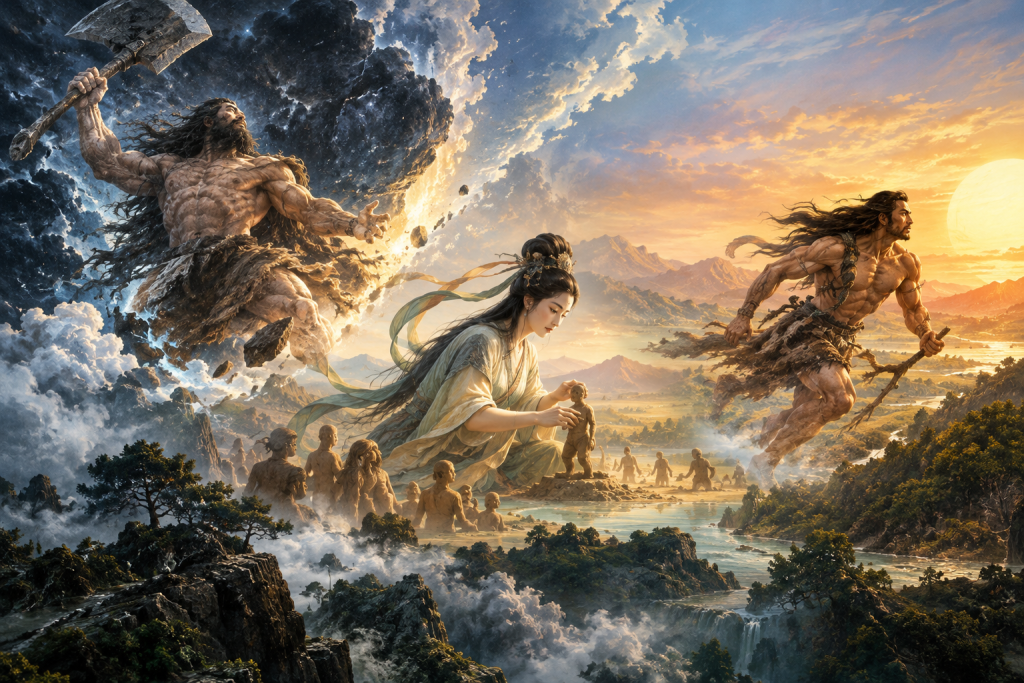
The Legendary Age of Chinese History: Pangu, Nuwa, and Kuafu
Long before written history began, people across ancient China told stories about gods, creation, nature, and the origins of humanity. These myths were passed down through generations and became an important part of Chinese mythology and cultural memory.
Among the best-known stories from this legendary age are the tales of Pangu, Nuwa, and Kuafu. Although these stories belong to mythology rather than documented history, they reveal how ancient Chinese people imagined the creation of the world, the origins of humanity, and the relationship between people and nature.
Pangu and the Creation of Heaven and Earth
According to an ancient Chinese creation myth, before humanity appeared, heaven and earth were not yet separated. Everything existed in a state of darkness and chaos, resembling a giant cosmic egg.
Inside this chaos lived Pangu, a powerful primordial being regarded in later Chinese tradition as the creator who separated heaven and earth.
After 18,000 years, Pangu suddenly awoke.
He could see nothing around him. Angry and confused, he seized a great axe and swung it with all his strength. With a tremendous crash, the giant cosmic egg split apart.
The light, pure, and clear elements rose upward and gradually became the sky. The heavier and murkier elements sank downward and formed the earth.
Pangu feared that heaven and earth might come together again, so he stood between them, pushing the sky upward with his head while keeping his feet firmly on the earth.
According to the legend, the sky rose higher each day while the earth became thicker and more solid. Pangu’s body grew along with them, allowing him to continue holding heaven and earth apart.
Eventually, after the structure of the universe had become stable, Pangu collapsed and died.
But his death did not mark the end of his role in creation. Instead, his body became part of the natural world.
His breath became the wind and clouds. His voice became thunder, while his left eye became the sun and his right eye became the moon. His hair and beard transformed into the stars in the night sky.
His limbs and body became the four directions of the earth and its great mountains. His blood flowed into rivers, his muscles became fertile fields, and even the hairs on his body transformed into grasses and trees.
Through this transformation, the world itself was formed from Pangu’s body.
The story of Pangu reflects an ancient imagination of how the universe came into being. More than a simple creation story, it expresses the idea that humanity and nature are deeply connected to the larger order of the cosmos.
Nuwa and the Creation of Humanity
In another famous Chinese creation myth, after Pangu had separated heaven and earth, the world remained empty and lifeless.
Nuwa, a powerful goddess in ancient Chinese mythology, looked across the vast and quiet landscape and felt that something was missing.
One day, she came to a clear pool of water and sat beside it. Looking at her own reflection, she took some yellow clay from the ground and shaped it into a small human figure resembling herself.
When she placed the clay figure on the ground, something extraordinary happened: it came alive and began to move.
Nuwa was delighted.
She continued shaping figures from yellow earth, creating many men and women. According to the legend, these newly created humans gathered around Nuwa, celebrating and expressing their gratitude before spreading across the land.
But Nuwa soon realized that individual humans would eventually die. If they could not reproduce, humanity would eventually disappear.
To ensure the continuation of the human race, Nuwa established the institution of marriage and instructed men and women to form partnerships, have children, and continue the human family from generation to generation.
The story of Nuwa creating humanity is one of the most important creation myths in Chinese mythology. It presents Nuwa not only as a creator but also as a protective mother figure responsible for the continuation of human life.
Unlike the story of Pangu, which focuses on the formation of the universe, the story of Nuwa centers on the origins and survival of humanity.
Together, the two myths form an important part of China’s ancient mythological tradition: Pangu explains the separation of heaven and earth, while Nuwa explains the creation and continuation of human beings.
Kuafu and the Sun
Another famous legend from this early mythological world is the story of Kuafu Chasing the Sun.
According to the legend, Kuafu was a descendant of Yandi, one of the legendary ancestors associated with the early Chinese tradition. He was described as a giant-like figure with great strength. Two yellow snakes hung from his ears, while he carried two more snakes in his hands.
Kuafu had an ambitious goal: he wanted to catch the setting sun and prevent it from disappearing beyond the horizon.
He chased the sun westward across the land. After reaching a place known as Yugu, he became extremely thirsty after his long journey.
He drank from a great river, but even its water could not satisfy his thirst. He then traveled north toward a vast body of water known as the Great Marsh in search of more water.
Before he could reach it, however, Kuafu died from thirst.
According to the legend, the walking stick he threw down before his death transformed into a vast forest known as Denglin.
The story of Kuafu is often interpreted as a myth about determination, courage, and the human desire to challenge the forces of nature. His pursuit of the sun was ultimately unsuccessful, but his final transformation into a forest gave the story another meaning: even in failure, life could continue in another form.
Myths at the Beginning of Chinese Civilization
The stories of Pangu, Nuwa, and Kuafu belong to the legendary world of ancient Chinese mythology rather than documented historical records.
Yet myths are an important part of understanding how early societies imagined the world around them.
Pangu represents the separation of heaven and earth. Nuwa represents the creation and continuation of humanity. Kuafu represents humanity’s struggle against the overwhelming forces of nature.
Together, these stories form part of a rich tradition of Chinese creation myths and legends that existed long before the development of written historical records.
They do not tell us exactly how the universe or humanity came into existence. Instead, they tell us something equally valuable: how ancient people imagined their place in the world.
And in this sense, the legendary age is an important starting point for exploring the long cultural and historical journey of China.