Introduction to Ancient China

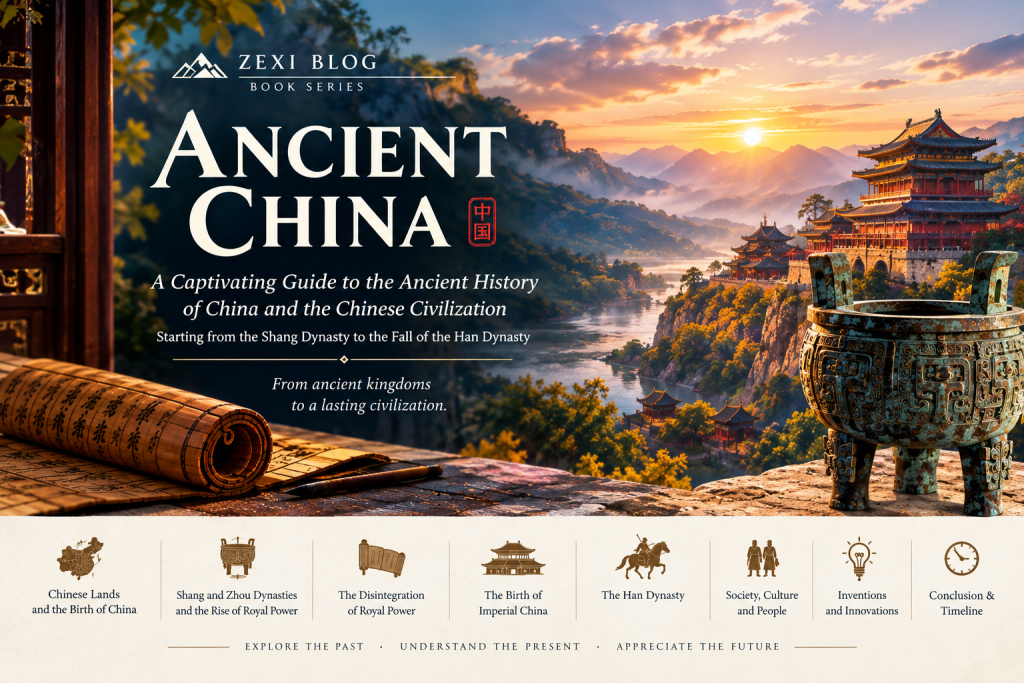
Ancient China book series featuring traditional Chinese palaces, bronze vessels, ancient scrolls, and a misty mountain landscape at sunset.
This entry is part 2 of 5 in the series Ancient China

Ancient China

Ancient China book series featuring traditional Chinese palaces, bronze vessels, ancient scrolls, and a misty mountain landscape at sunset.

Ancient China

Ancient China book series featuring traditional Chinese palaces, bronze vessels, ancient scrolls, and a misty mountain landscape at sunset.

Introduction to Ancient China

Ancient China book series featuring traditional Chinese palaces, bronze vessels, ancient scrolls, and a misty mountain landscape at sunset.

Chapter 1 – Chinese Lands and the Birth of China

Ancient China book series featuring traditional Chinese palaces, bronze vessels, ancient scrolls, and a misty mountain landscape at sunset.

Chapter 2 – The Shang and Zhou Dynasties and the Rise of Royal Power

Ancient China book series featuring traditional Chinese palaces, bronze vessels, ancient scrolls, and a misty mountain landscape at sunset.

Chapter 3 – The Disintegration of Royal Power

Introduction

Ancient China was the birthplace of one of the world’s great civilizations. Over thousands of years, its people built states, developed writing, created influential philosophies, and made discoveries that shaped their society and left a lasting mark on human history.
The history of ancient China is a story of change and continuity. Kingdoms rose and fell, rulers fought for power, and new systems of government emerged. Yet many ideas and traditions continued to influence later generations, even as Chinese society changed.
To understand this remarkable civilization, we must look beyond emperors and battles. We must also explore the lives of farmers, merchants, artisans, scholars, and ordinary families who helped build and sustain their communities.

From Early Kingdoms to Empire

The Shang dynasty provides some of the earliest substantial written and archaeological evidence of Chinese civilization. Shang rulers governed through military power and ritual authority, while skilled bronze workers produced objects of extraordinary complexity. Oracle-bone inscriptions offer valuable evidence of their beliefs, political concerns, and early writing.
The Zhou dynasty followed the Shang and introduced the influential idea known as the Mandate of Heaven, which connected a ruler’s authority with the responsibility to govern well. Over time, Zhou royal power weakened, and rival states competed for control. This age of conflict also encouraged new ideas about government, morality, and the proper organization of society.
In 221 BCE, the state of Qin unified much of the region and established China’s first imperial dynasty. Although the Qin Empire was short-lived, its centralizing reforms helped shape the imperial system inherited by the Han dynasty.
Under the Han, imperial institutions expanded and cultural, intellectual, and commercial life flourished. Connections with distant regions grew, while scholars and officials helped develop traditions that would influence Chinese history for centuries.

Ideas, Society, and Achievements

Ancient China was more than a succession of dynasties. It was also a place where people debated how to live and govern. Confucius emphasized ethical conduct, education, and social responsibility. Daoist traditions explored the Dao and humanity’s relationship with nature, while other thinkers focused on law, order, and the practical exercise of political power.
These ideas developed in particular historical settings and were interpreted differently over time. Together, they formed an important part of the intellectual heritage of Chinese civilization.
Everyday life was equally important. Most people depended on agriculture, while craftspeople, merchants, officials, and soldiers contributed to the wider economy and state. Family relationships, ritual practices, and local customs shaped communities, though experiences varied across regions and social positions.
Ancient Chinese achievements also included advances in bronze casting, ironworking, engineering, writing, and other fields of knowledge. These developments were the result of accumulated skill and experience, passed between generations and adapted to changing needs.

Why Ancient China Matters

Studying ancient China helps us understand how a civilization can change while preserving elements of its past. Political institutions, philosophical traditions, cultural practices, and historical memories were repeatedly reshaped, yet they remained important sources of identity and influence.
The ancient world should not be treated as a simple explanation of modern China. The societies of the past were different from those of today, and their history deserves to be understood in its own context. By examining evidence carefully, we can appreciate both the achievements of ancient Chinese people and the complexity of the world they inhabited.

A Journey Through Ancient Chinese History

This series will take readers through the major stages of ancient Chinese history, beginning with the lands and early states where Chinese civilization developed. We will explore the Shang and Zhou dynasties, the decline of royal power, the rise of imperial China, and the achievements and challenges of the Han dynasty.
We will also look at society, culture, philosophy, and innovation—not only the lives of rulers, but also the experiences and contributions of the people who shaped their world.
Ancient China is a story of ambition and uncertainty, conflict and creativity, tradition and transformation. By exploring its history, we can gain a deeper understanding of the foundations of Chinese civilization and the many ways its past continues to invite curiosity.
The journey begins with the land itself and the birth of China.

Ancient China

Ancient China Chapter 1 – Chinese Lands and the Birth of China

Leave a Comment

Your email address will not be published. Required fields are marked *

Scroll to Top