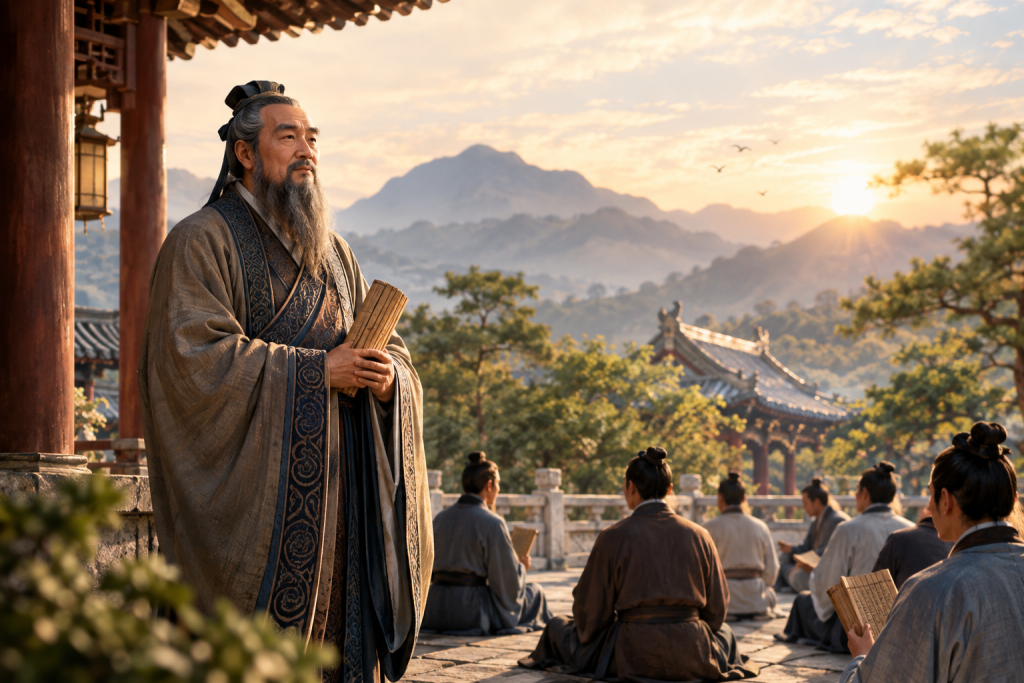
Confucius and Chinese Thought: The Ideas That Shaped Chinese Culture
When people first encounter Chinese culture, they often notice its festivals, food, family traditions, calligraphy, tea, or ancient architecture. But beneath many of these visible traditions lies a deeper question:
How should people live with one another?
For more than two thousand years, the ideas associated with Confucius have been an important part of the answer.
Confucius did not create every idea later associated with Confucianism, and Chinese culture has never been shaped by a single philosophy. Daoism, Buddhism, Legalism, local traditions, and many other influences have also played important roles.
Yet Confucius and the tradition that developed from his teachings had a remarkable influence on education, family relationships, morality, social behavior, government, and ideas about personal character.
To understand Confucius and Chinese thought, it is therefore useful to look beyond the historical figure himself and explore the ideas that became part of Chinese culture.
Who Was Confucius?
Confucius, known in Chinese as Kongzi or Kong Qiu, was born around 551 BCE in the state of Lu during the Eastern Zhou period. He lived during the Spring and Autumn period, an era of political competition and social change.
Confucius was deeply concerned with human life and society.
How should people behave?
How should parents and children treat one another?
What makes a good leader?
How can education improve a person?
What kind of person should we try to become?
These questions became central to Confucian thought.
Confucius was also a teacher. He placed great importance on learning, self-cultivation, and the possibility of becoming a better person through education and reflection.
His teachings were later preserved and developed by his followers and other thinkers. The Analects, a collection of sayings and conversations associated with Confucius, became one of the most important texts in the Confucian tradition.
Understanding Confucius therefore means understanding not only one ancient teacher, but also a much larger intellectual tradition that developed over many centuries.
Education as a Way to Improve Yourself
One of the most important ideas in Confucius philosophy is the value of education.
For Confucius, learning was not simply about collecting information. Education was closely connected with personal development.
Through learning, reflection, practice, and self-discipline, a person could develop better judgment and stronger moral character.
This made education a form of self-cultivation.
The idea had a profound influence on Chinese culture. In later periods, education became closely connected with social advancement and government service. The imperial examination system, which developed over many centuries and formally ended in 1905, gave education an especially important position in Chinese society.
The historical examination system was much more complex than Confucius’s original teachings. Nevertheless, the cultural connection between learning, personal improvement, and social responsibility became one of the enduring influences of Confucianism.
This is one reason Confucius on education remains an important subject when studying traditional Chinese thought.
Ren: The Importance of Humaneness
Among the central concepts associated with Confucius is ren (仁), often translated as “humaneness,” “benevolence,” or “human-heartedness.”
No single English word completely captures its meaning.
At its heart, ren concerns how people treat one another. It involves consideration for others, compassion, responsibility, and the development of good character.
Confucius repeatedly directed attention toward human relationships.
Instead of asking only what a person wants for themselves, Confucian thought asks people to consider how their actions affect others.
This makes ren an important part of traditional Chinese ethical thought.
A well-known principle associated with Confucius encourages people to consider others from their own perspective: do not impose upon others what you would not want for yourself.
The principle is simple, but its implications are broad.
It suggests that morality begins not only with abstract rules, but with everyday relationships.
This connection between personal behavior and social relationships is one of the most important themes in Confucius and Chinese thought.
Li: Ritual, Courtesy, and Social Relationships
Another important concept is li (礼).
The word is often translated as “ritual,” but its meaning is broader than religious ceremony.
Li can refer to manners, customs, etiquette, appropriate behavior, and the social practices that structure relationships.
For Confucius, good behavior was not simply about following rules mechanically.
Social customs could teach people how to respect one another and understand their responsibilities.
A greeting, a family ceremony, respect for elders, or appropriate behavior during an important occasion could all express something about the relationship between people.
This helps explain why traditional Chinese culture has often placed considerable importance on etiquette and appropriate social behavior.
Of course, Chinese customs have changed greatly across different periods and regions. Not every modern social practice can be directly traced to Confucius.
But the broader idea that relationships require care, respect, and responsibility has remained an important part of Confucian cultural influence.
Family and Filial Piety
Confucius and Chinese family values are closely connected because family relationships occupy an important place in Confucian thought.
One of the best-known concepts is xiao (孝), usually translated as filial piety.
Filial piety emphasizes respect and responsibility toward parents and elders.
However, it should not be understood simply as obedience.
Within the broader Confucian tradition, family relationships involve responsibilities in both directions. Parents have responsibilities toward children, while children have responsibilities toward parents.
The family therefore becomes one of the first places where people learn respect, responsibility, care, and social relationships.
This connects with a larger Confucian idea: personal character begins with everyday behavior.
How a person treats family members can reflect how that person behaves in wider society.
This does not mean that all Chinese families have always followed Confucian ideals. Nor does it mean that modern Chinese families share identical values.
Chinese family life has changed considerably through urbanization, education, economic development, migration, and changing ideas about individual choice.
Yet family-centered thinking remains an important part of the historical background needed to understand Chinese family values.
The Junzi: Becoming a Better Person
Confucius also developed an ideal known as the junzi (君子), often translated as “gentleman” or “exemplary person.”
The word originally had connections with social status. Confucian thought gave it a stronger moral dimension.
A junzi is not defined simply by wealth, power, or birth.
Instead, the ideal person develops character through learning, self-discipline, responsibility, and ethical behavior.
This is important because it shifts attention from social position to personal character.
A person becomes worthy not simply because of what they possess, but because of how they conduct themselves.
The idea of the junzi therefore reflects a central theme of Confucianism: people can cultivate themselves.
Becoming a better person is a lifelong process.
Good Government Begins With Good Character
Confucius also applied moral ideas to government.
He believed that rulers should lead through moral example rather than relying entirely on punishment.
A ruler who behaves responsibly can encourage people to behave responsibly as well.
This does not mean Confucian political thought rejected laws or government institutions. Rather, it placed considerable emphasis on the character and responsibilities of those who held authority.
This connection between personal morality and public leadership became especially important in later Chinese political thought.
Government officials were expected to possess education and moral cultivation as well as administrative ability.
Over time, this helped create a powerful cultural association between education, public responsibility, and government service.
Harmony Does Not Mean Everyone Must Agree
Another important aspect of Confucius and Chinese thought is the idea of harmony.
Harmony does not necessarily mean that everyone must think or behave in exactly the same way.
A well-known principle later expressed in the Analects is he er bu tong (和而不同), commonly translated as “harmony without uniformity.”
The idea suggests that people can maintain harmonious relationships without becoming identical.
This is an important distinction.
Harmony does not require the disappearance of difference. Instead, it can involve learning how to live with differences while maintaining mutual respect and social relationships.
This idea connects with a broader theme in Chinese culture: relationships matter, but relationships do not necessarily require everyone to think alike.
Harmony can involve balance, responsibility, and coexistence.
Confucius and the Meaning of Tradition
Confucius placed considerable value on learning from earlier traditions.
But tradition was not simply about repeating old customs.
It was also about understanding the meaning behind practices and using them to cultivate human character.
This helps explain the strong historical connection between education, history, family traditions, and cultural memory in Chinese society.
The past can become a source of guidance for the present.
At the same time, Chinese culture has never been completely static.
Confucian ideas were interpreted differently by different thinkers and historical periods. Later scholars developed new forms of Confucian thought, including Neo-Confucianism. Daoism, Buddhism, local traditions, and changing political and social conditions also influenced Chinese society.
For this reason, traditional Chinese thought should not be treated as one fixed system.
It is better understood as an evolving intellectual tradition.
Confucianism and Everyday Chinese Culture
The influence of Confucianism can sometimes be difficult to see because it is not always expressed through explicitly religious practices.
Its influence may instead appear in attitudes toward education, family responsibility, respect for elders, social relationships, learning, and personal conduct.
For example, the historical importance of education can be partly understood through the Confucian emphasis on learning and self-cultivation.
Family traditions can be viewed partly through the Confucian emphasis on relationships and responsibility.
Social etiquette can also be connected with the idea that appropriate behavior helps maintain respectful relationships.
But these aspects of Chinese life cannot be explained by Confucianism alone.
Chinese culture is much broader than any single philosophical tradition.
Daoism, Buddhism, local customs, regional traditions, economic change, modern education, and global culture have all influenced Chinese society.
Confucianism is therefore one important lens through which Chinese culture can be understood, rather than a complete explanation of it.
Confucius in Modern China
The place of Confucius has changed considerably throughout Chinese history.
There have been periods when Confucian ideas were strongly promoted and periods when they were heavily criticized.
In modern China, Confucius is often discussed as an important historical philosopher and cultural figure.
Contemporary Chinese society, however, is shaped by many forces beyond traditional philosophy, including modern education, technology, urbanization, globalization, individual choice, and changing social relationships.
This makes the study of Confucius particularly interesting today.
His teachings should not be treated as a complete description of how every Chinese person lives.
Instead, they provide part of the historical background for understanding ideas about learning, family, morality, relationships, and society that have influenced Chinese culture for centuries.
Why Is Confucius Important?
So, why is Confucius important?
The answer is not simply that he was an ancient Chinese philosopher.
His greater significance lies in the long intellectual tradition that developed around questions he considered fundamental.
How should we treat other people?
How should we educate ourselves?
What responsibilities do we have toward family and society?
What makes a good leader?
How can people live together with respect and harmony?
These questions remain relevant far beyond ancient China.
Understanding Confucius and Chinese thought therefore offers more than an introduction to one philosopher.
It provides a window into ideas that have shaped Chinese culture through education, family values, social relationships, morality, and the pursuit of personal character.
Perhaps this is the deeper reason to study Confucius.
Chinese culture is not only something we can see in temples, festivals, paintings, tea, architecture, or traditional customs.
It is also found in ideas about how people should live, learn, relate to one another, and become better versions of themselves.
To look deeper into China is to discover not only its history and traditions, but also the ideas that have quietly shaped its cultural life for generations.
Confucius and Chinese Thought: The Ideas That Shaped Chinese Culture