Chapter 3 – The Disintegration of Royal Power

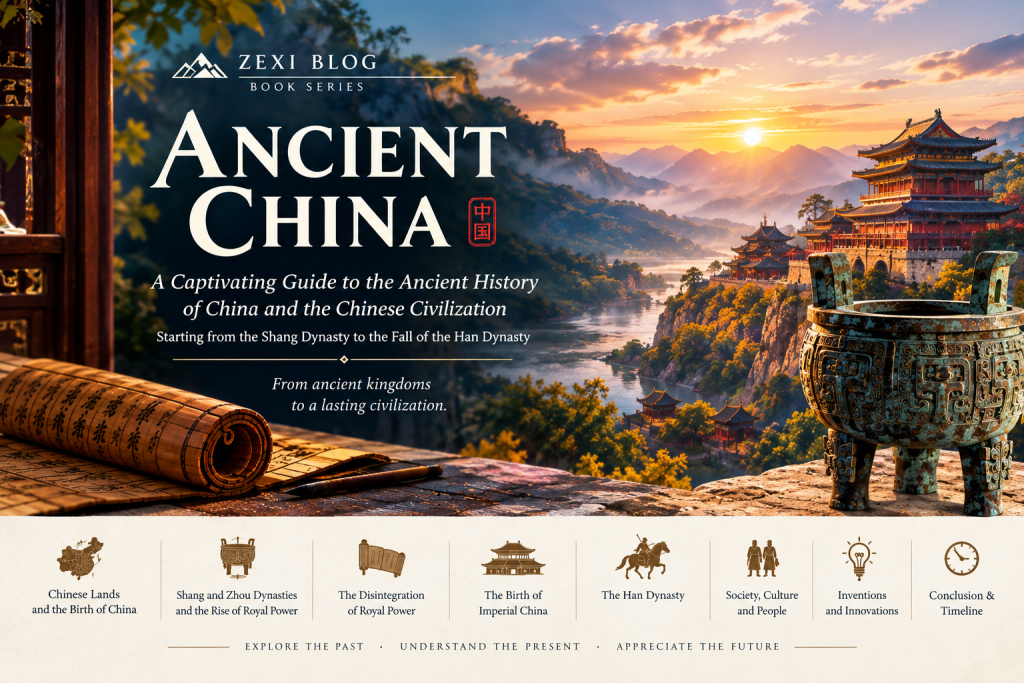
Ancient China book series featuring traditional Chinese palaces, bronze vessels, ancient scrolls, and a misty mountain landscape at sunset.
This entry is part 5 of 5 in the series Ancient China

Ancient China

Ancient China book series featuring traditional Chinese palaces, bronze vessels, ancient scrolls, and a misty mountain landscape at sunset.

Ancient China

Ancient China book series featuring traditional Chinese palaces, bronze vessels, ancient scrolls, and a misty mountain landscape at sunset.

Introduction to Ancient China

Ancient China book series featuring traditional Chinese palaces, bronze vessels, ancient scrolls, and a misty mountain landscape at sunset.

Chapter 1 – Chinese Lands and the Birth of China

Ancient China book series featuring traditional Chinese palaces, bronze vessels, ancient scrolls, and a misty mountain landscape at sunset.

Chapter 2 – The Shang and Zhou Dynasties and the Rise of Royal Power

Ancient China book series featuring traditional Chinese palaces, bronze vessels, ancient scrolls, and a misty mountain landscape at sunset.

Chapter 3 – The Disintegration of Royal Power

How the Zhou Kings Lost Control and the Chinese States Rose

The Zhou Dynasty did not disappear when the Western Zhou capital fell in 771 BCE.
The royal house survived.
But survival was no longer the same as power.
After the Zhou court moved east to Luoyang, the kings of Zhou continued to occupy the traditional position of the Son of Heaven. They still represented the ancient political order, performed important rituals, and remained symbols of legitimacy. Yet the military and economic power that had once supported Zhou rule increasingly passed into the hands of powerful regional states.
This transformation marked one of the most important turning points in ancient Chinese history.
The Eastern Zhou period, traditionally divided into the Spring and Autumn Period and the Warring States Period, saw the gradual breakdown of the old Zhou political order. Regional states became stronger, rulers built more sophisticated administrations, armies expanded, agriculture became more productive, and new ideas about government and society emerged.
The result was a China that was very different from the world created by the early Zhou kings.
The old order was disappearing.
A new one was taking shape.

From Western Zhou to Eastern Zhou

The beginning of the Eastern Zhou is generally associated with the movement of the Zhou capital eastward to Luoyang in 770 BCE, following the collapse of Western Zhou power. The Metropolitan Museum of Art dates the Western Zhou to approximately 1046–771 BCE and the Eastern Zhou to 770–256 BCE. The Eastern Zhou is conventionally divided into the Spring and Autumn Period, roughly 770–476 BCE, and the Warring States Period, 475–221 BCE.
This division can make history appear more orderly than it really was.
There was no single moment when Zhou authority suddenly vanished.
Instead, royal power weakened gradually.
During the early Zhou period, the king stood at the center of a political network of territories ruled by members of the royal family and other allied elites. The system depended on personal relationships, ritual obligations, military support, and inherited status.
As the Zhou court weakened, however, the regional states became increasingly independent.
Some controlled large territories.
Some possessed powerful armies.
Some developed wealthy agricultural economies.
And some were able to challenge the Zhou king himself.
The political center was slowly becoming the weakest major power in the system it had created.

The First Signs of a Broken Political Order

The relocation of the capital exposed the weakness of the Zhou court.
The eastern move was not simply an administrative decision. It reflected a fundamental change in the balance of power.
The Zhou king could no longer control the western heartland as effectively as before, while regional rulers increasingly depended on their own armies and resources.
The Zhou kings still possessed symbolic authority, but symbolism could not always enforce political obedience.
This distinction between legitimacy and actual power became one of the defining characteristics of the Eastern Zhou.
A ruler might acknowledge the Zhou king while simultaneously building his own army, expanding his territory, and interfering in the affairs of neighboring states.
The king remained the Son of Heaven.
But increasingly, other rulers decided what actually happened on the ground.
The Smithsonian’s National Museum of Asian Art similarly describes the Eastern Zhou as a period in which the individual states became increasingly independent, wealthy, and powerful while Zhou royal authority declined.

The Rise of the Regional States

The political landscape of Eastern Zhou China was not a unified country in the modern sense.
Instead, it consisted of many states of different sizes and levels of power.
Some were small territories centered around a city and its surrounding farmland. Others grew into large regional powers capable of mobilizing substantial armies and controlling extensive territories.
Among the most influential states during the Spring and Autumn Period were Qi, Jin, Chu, Qin, and several others.
Their rulers were not initially trying simply to destroy the Zhou system.
Many still operated within its traditional language of kingship, ritual, and legitimacy.
What changed was the meaning of power.
Instead of receiving authority primarily from their position within the Zhou royal hierarchy, rulers increasingly had to rely on their own resources.
Land.
Agriculture.
Taxation.
Administration.
Military organization.
These became the foundations of political strength.

The Age of the Hegemons

As Zhou authority declined, a new political institution emerged: the hegemon, or ba.
A hegemon was not formally the king of China.
Instead, the position represented the leadership of a powerful state over other states, often under the nominal authority of the Zhou king.
The system was an attempt to maintain a degree of order in a political world where the old royal structure was no longer strong enough to do so.
One of the earliest and most famous examples was Duke Huan of Qi.

Duke Huan of Qi

Duke Huan became ruler of Qi in the seventh century BCE.
Under his leadership, Qi strengthened its administration and expanded its ability to mobilize resources.
His chief minister, Guan Zhong, is traditionally associated with many of the reforms that made Qi more powerful and better organized.
The importance of Qi was not simply military.
The state demonstrated how administrative organization could turn agricultural resources and population into political and military power.
Duke Huan eventually emerged as one of the leading rulers of the age and was recognized as a hegemon.
His leadership was significant because it attempted to preserve the wider Zhou political order rather than immediately replace it.
The idea was, in part, to defend the Zhou king’s position while allowing the strongest regional ruler to coordinate the major states.
This was an unusual compromise.
The Zhou king remained the formal center of the political order.
The hegemon increasingly supplied the practical power needed to maintain it.

Protecting the Zhou Order

The hegemon system reveals something important about early Chinese political thought.
The regional rulers were not necessarily trying to establish an entirely new political system.
Many still claimed to defend traditional Zhou values.
They could intervene in conflicts, protect smaller states, oppose external threats, and enforce agreements between states while presenting themselves as supporters of the broader Zhou order.
This distinction between formal legitimacy and practical authority would remain important throughout Chinese history.
The ruler who possessed military power was not automatically considered the legitimate ruler of the entire civilization.
Political legitimacy still had to be explained.
And the Zhou concept of the Mandate of Heaven provided one of the most important frameworks for doing so.
The Mandate of Heaven held that legitimate rule depended on the moral quality of government rather than simply hereditary possession of power.
As Zhou power weakened, this idea became increasingly important because later rulers needed to explain why they deserved to rule.

From Qi to Jin and Chu

The position of hegemon did not remain permanently with one state.
After Duke Huan of Qi died in 643 BCE, internal struggles weakened Qi.
Other states then rose.
The state of Jin, located in northern China, became one of the major powers of the following generation. Duke Wen of Jin played an important role in strengthening the state and became recognized as another major hegemonic ruler.
At the same time, Chu expanded from the south.
Chu was different from many of the northern Zhou states.
It developed its own political traditions and expanded dramatically through the Yangtze region. Its rulers eventually adopted the title of king, asserting a level of independence that challenged the traditional Zhou political hierarchy.
The competition between northern states and Chu became one of the defining features of the Spring and Autumn Period.
Other states were drawn into alliances, conflicts, and diplomatic negotiations.
Political relationships constantly shifted.
An enemy in one decade could become an ally in another.
And peace was often temporary.

War Was Changing Ancient China

The wars of the Spring and Autumn Period were not simply a series of battles between aristocratic warriors.
They reflected a deeper transformation in the structure of the Chinese states.
As rulers gained greater control over territory and population, they could mobilize more resources.
Larger armies became possible.
Military organization became more sophisticated.
Weapons developed.
And warfare increasingly required administrators, engineers, farmers, craftsmen, and tax systems—not merely aristocratic warriors.
This meant that military power was becoming connected to the entire economic structure of a state.
A strong ruler needed a strong state behind him.
That was an important step toward the centralized states that would eventually emerge during the Warring States Period.

The Expansion of Chu, Wu, and Yue

The political transformation was not limited to northern China.
The southern and southeastern regions became increasingly important.
The state of Wu, in the lower Yangtze region, emerged as a major military power and challenged Chu.
Later, Yue became another important force.
The rivalry between Wu and Yue became one of the most famous struggles of the late Spring and Autumn Period.
The story of King Goujian of Yue became particularly influential in later Chinese historical tradition.
After suffering defeat, Goujian eventually rebuilt his power and defeated Wu.
By the early fifth century BCE, Yue had emerged as one of the leading powers.
But by this point, the traditional hegemon system was already losing much of its political meaning.
The Zhou king was no longer capable of acting as the effective center of the interstate system.
The states increasingly pursued their own interests.
The political world was moving toward something fundamentally different.

From Ritual Hierarchy to State Competition

The most important change of the Spring and Autumn Period was not simply that wars became more frequent.
It was that the old Zhou political structure stopped being sufficient.
Under the earlier system, political status was strongly connected to hereditary relationships and ritual hierarchy.
But the growing states needed something different.
They needed officials who could administer territory.
They needed tax systems.
They needed reliable agricultural production.
They needed larger armies.
They needed roads, irrigation systems, warehouses, workshops, and systems for managing populations.
As a result, political power gradually became less dependent on inherited aristocratic privilege and more dependent on administrative ability.
This was a profound transformation in ancient Chinese government.

The Rise of Merit and Administration

One of the important developments of this period was the increasing use of capable officials to manage state affairs.
The old hereditary aristocracy did not simply disappear.
But rulers increasingly needed talented advisers and administrators who could strengthen their states.
This helped create a new political elite.
Instead of being defined only by birth, political influence could increasingly be gained through knowledge, administrative skill, military ability, and service to a ruler.
This development would become even more important during the Warring States Period.
Eventually, rulers would build governments in which officials were appointed to administrative positions and were directly responsible to the central authority.
The foundations of this transformation can already be seen during the later Spring and Autumn Period.

Agriculture Became the Foundation of Power

Behind the political changes was a much more basic question:
How could a state feed and equip a larger population?
Agriculture was the answer.
As states expanded their control over land, they became increasingly interested in agricultural productivity.
More farmland meant more food.
More food supported larger populations.
Larger populations provided more labor and soldiers.
More agricultural production generated greater tax revenues.
And greater revenues allowed rulers to build stronger armies and administrations.
This created a powerful cycle:
land → agriculture → taxation → administration → military power
The state that could organize these resources most effectively gained an enormous advantage over its rivals.

Iron and the Transformation of Agriculture

The Eastern Zhou period also witnessed important developments in metallurgy.
Bronze remained highly important, especially for weapons, ritual objects, and elite display. But iron became increasingly significant, particularly for tools and agricultural equipment.
The transition was gradual rather than instantaneous.
China did not simply move from a Bronze Age to an Iron Age overnight.
Instead, bronze and iron existed alongside one another while new technologies gradually changed production and warfare.
Archaeological evidence from the Eastern Zhou demonstrates continuing sophistication in bronze production, while iron metallurgy became increasingly important during the later Zhou period. The Metropolitan Museum of Art notes major developments in Eastern Zhou metalworking, while the Smithsonian places the Eastern Zhou within a broader period of technological and artistic change.
For farmers, improved tools could make cultivation more efficient.
For rulers, greater agricultural productivity meant something even more important:
more resources could be extracted from the land.

Trade, Cities, and the Growth of the Economy

Agricultural production was only one part of the transformation.
As states became larger and more organized, trade also became increasingly important.
Cities developed into political, military, and commercial centers.
Craft production expanded.
Bronze casting, pottery, textiles, woodworking, and other forms of specialized production supported both ordinary life and elite consumption.
The development of roads and waterways also made it easier to move people, food, raw materials, and military supplies.
Economic exchange gradually became more sophisticated, and forms of coinage appeared in different regions of China.
These changes were not identical everywhere, nor did they happen simultaneously.
But together they reveal a broader transformation:
China was becoming an increasingly interconnected economic world even as it remained politically divided.

The Intellectual Transformation of the Spring and Autumn Period

Perhaps the most enduring consequence of this period was not military or economic.
It was intellectual.
The weakening of the old political order created difficult questions.
What makes a ruler legitimate?
How should a state be governed?
What is the proper relationship between ruler and subject?
How should people behave toward parents, neighbors, officials, and society?
Can political order be restored?
What makes a good society?
These questions became increasingly urgent as the old system stopped providing simple answers.
And from this environment emerged some of the most influential thinkers in Chinese philosophy.

Confucius and the Search for Social Order

Among them was Confucius, who lived approximately 551–479 BCE.
Confucius was born in the state of Lu during the Spring and Autumn Period, a time of political instability. The Smithsonian describes his thought as emphasizing good government, social order, moral behavior, proper relationships, and ritual.
Confucius did not attempt to create a completely new civilization.
Instead, he looked toward the traditions of the past.
But his interpretation of those traditions provided a new intellectual framework for dealing with a changing society.
For Confucius, political order began with human behavior.
A ruler should govern through virtue.
Officials should take their responsibilities seriously.
Children should respect parents.
People should understand their roles within society.
Ritual should not simply be an empty ceremony; it should express proper conduct and social relationships.
In this sense, Confucian thought emerged from a world in which political order was breaking apart.
Its response was a search for moral order.

The Beginning of the Hundred Schools of Thought

Confucius was not alone.
The Spring and Autumn and Warring States periods became an extraordinary era of intellectual experimentation later associated with the Hundred Schools of Thought.
Confucianism was only one tradition among many.
Daoist thought explored the relationship between human beings, society, and the natural order.
Other thinkers examined questions of law, military strategy, political authority, language, ethics, and social organization.
The political fragmentation of ancient China therefore produced an unexpected consequence.
As the old Zhou order weakened, Chinese intellectual life became more diverse.
The Smithsonian identifies the Spring and Autumn Period as a major period of flourishing in Chinese philosophy, while the wider Eastern Zhou era produced many of the intellectual traditions that would shape later Chinese civilization.
The political crisis was becoming an intellectual revolution.

From Spring and Autumn to Warring States

By the end of the Spring and Autumn Period, the old Zhou political system had changed almost beyond recognition.
Many smaller states had disappeared through conquest, alliance, or absorption.
The larger states had become increasingly centralized.
Their rulers relied less on the old aristocratic hierarchy and more on administrators, taxation, agriculture, and military organization.
The Zhou king remained at Luoyang.
But he no longer possessed the political authority that the early Zhou kings had exercised.
The next stage would be even more dramatic.
The Warring States Period, conventionally dated from 475 to 221 BCE, saw several major states compete openly for supremacy. The Metropolitan Museum and Smithsonian both place the Warring States Period immediately after the Spring and Autumn Period and before Qin unification in 221 BCE.
The old question had been:
Who should serve the Zhou king?
The new question was becoming:
Which state would rule China?

The Road Toward Imperial China

The disintegration of Zhou royal power did not simply create chaos.
It also created the conditions for political innovation.
Regional rulers experimented with new administrative structures.
Governments became more centralized.
Tax systems became more systematic.
Agriculture became increasingly productive.
Military organization became more sophisticated.
Trade and cities expanded.
And philosophers developed new theories about government, morality, society, and human behavior.
In other words, the collapse of the old order also created the environment in which a new order could emerge.
By the time the Warring States Period began, the political world of ancient China was already moving toward centralized territorial states.
One of them would eventually become powerful enough to defeat all its major rivals.
That state was Qin.
In 221 BCE, Qin conquered the remaining rival states and established the first unified imperial government of China. The Qin ruler Ying Zheng adopted the title Qin Shi Huang, or First Emperor, and created a centralized administrative system that would influence later Chinese governments.
But before that transformation could happen, China had to pass through one of the most competitive periods in its history.
The age of the Zhou kings was coming to an end.
The age of the states had begun.

Why the Disintegration of Royal Power Matters

The story of the Eastern Zhou is not simply a story about the decline of a dynasty.
It is the story of how political power itself changed in ancient China.
The Zhou king gradually lost direct control.
Regional states became stronger.
The old hereditary political order weakened.
Administration became increasingly important.
Agriculture and taxation became foundations of state power.
Military competition accelerated technological and organizational change.
Trade and cities expanded.
And the political crisis stimulated some of the most influential philosophical traditions in Chinese history.
The Zhou Dynasty would survive until 256 BCE, but the political world created by the early Zhou kings had already been transformed centuries earlier.
The next stage would push that transformation even further.
The competing states would no longer merely seek influence over the Zhou king.
They would seek to replace the entire political order.
And from that struggle, imperial China would be born.
Continue to Chapter 4 – Birth of Imperial China

Ancient China

Chapter 2 – The Shang and Zhou Dynasties and the Rise of Royal Power

Leave a Comment

Your email address will not be published. Required fields are marked *

Scroll to Top