
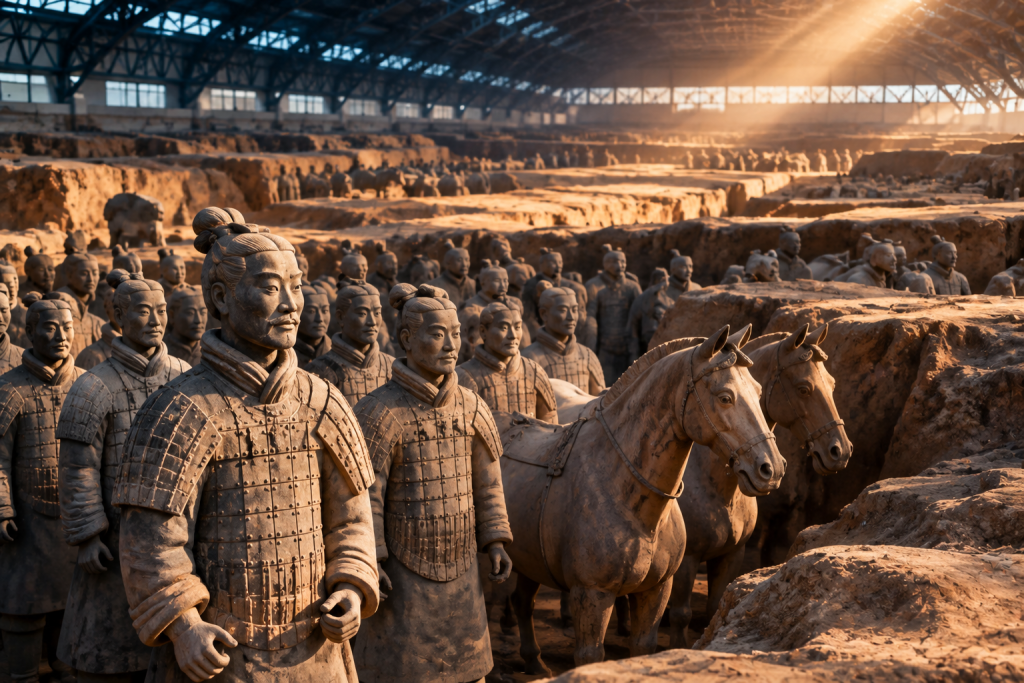
Beneath the earth outside Xi’an lies one of the most remarkable archaeological discoveries in the world: the Terracotta Army.
Thousands of life-size clay soldiers, horses, chariots, and other figures were created more than two thousand years ago to accompany Qin Shi Huang, the First Emperor of China, into the afterlife.
Discovered in 1974 by local farmers near Xi’an, the Terracotta Army quickly became one of the most important archaeological discoveries of the 20th century.
But these famous clay soldiers are only part of a much larger story.
The Terracotta Army belongs to the enormous mausoleum complex built for Qin Shi Huang, the ruler who unified China in 221 BCE and established the Qin Dynasty.
The site provides an extraordinary glimpse into the political power, military organization, craftsmanship, beliefs, and social structure of ancient China.
To understand the Terracotta Army is therefore to look beyond the individual statues and explore the world created by China’s first emperor.
What Is the Terracotta Army?
The Terracotta Army is a collection of thousands of life-size clay figures created to accompany Qin Shi Huang in his imperial tomb complex.
The figures include soldiers, cavalrymen, chariot warriors, horses, and other military-related figures.
They were buried in large underground pits located about 1.5 kilometers northeast of Qin Shi Huang’s main burial mound near present-day Xi’an in Shaanxi Province.
The figures were made from terracotta, a type of fired clay.
Many of the soldiers originally had brightly painted surfaces, although much of the original color disappeared after exposure to air and centuries underground.
The figures vary in hairstyle, clothing, facial features, posture, and military equipment, creating an impression of a large and organized army.
However, the Terracotta Army was not simply a collection of statues.
It was part of a much larger funerary complex designed to recreate aspects of the emperor’s world after death.
Who Built the Terracotta Army?
The Terracotta Army was created for Qin Shi Huang, whose original name was Ying Zheng.
He became king of Qin as a young ruler and gradually defeated the other major states during the Warring States period.
In 221 BCE, he completed the unification of the major rival kingdoms and declared himself the First Emperor of China.
His new empire introduced a highly centralized political system and standardized many aspects of administration, writing, currency, weights, and measures.
The emperor’s mausoleum reflected the enormous resources of this new imperial state.
According to historical records, construction of the mausoleum began soon after Ying Zheng became king of Qin and continued for many years.
Large numbers of workers and craftsmen were involved.
The scale of the project demonstrates the extraordinary organizational capacity of the early Chinese empire.
Why Was the Terracotta Army Built?
The main purpose of the Terracotta Army was connected with Qin Shi Huang’s beliefs about death and the afterlife.
Ancient Chinese societies often placed considerable importance on burial practices and the relationship between the living and the dead.
Important individuals could be buried with objects intended to serve them after death.
For an emperor, however, the requirements of the afterlife could be imagined on an enormous scale.
Rather than simply burying weapons or symbolic objects, the Qin imperial tomb complex included representations of people, animals, military units, buildings, and other elements associated with imperial life.
The Terracotta Army was therefore intended to serve as an imperial guard in the afterlife.
It reflects the idea that the emperor’s authority and needs could continue beyond death.
The Discovery in 1974
The modern story of the Terracotta Army began in March 1974.
Local farmers were digging a well near Xi’an when they encountered fragments of terracotta figures and other ancient remains.
Archaeologists were soon called to investigate.
Excavation revealed something far greater than anyone initially expected.
Large underground pits contained rows of terracotta soldiers arranged in military formations.
The discovery attracted international attention and transformed our understanding of the Qin Dynasty.
What had been hidden beneath farmland for more than two thousand years suddenly became one of the most important archaeological sites in China.
Today, the site is protected and presented as part of the Emperor Qinshihuang’s Mausoleum Site Museum.
The Three Main Terracotta Army Pits
Archaeologists have identified several pits associated with the Terracotta Army, with three major pits containing the most significant military formations.
Pit 1 is the largest and most famous.
It contains large numbers of infantry and other figures arranged in organized formations. The scale of the excavation gives visitors a powerful impression of an underground army.
Pit 2 contains a more diverse military arrangement, including archers, cavalry, chariots, and infantry.
Pit 3 is much smaller and is generally interpreted as having a command-related function.
There is also a fourth pit, which was found empty.
Together, these discoveries provide evidence of an organized military system rather than a random collection of sculptures.
The arrangement of the figures appears to reflect military formations known during the Qin period.
The Soldiers Were Not All the Same
One of the most fascinating features of the Terracotta Army is the apparent individuality of many figures.
Soldiers differ in hairstyle, clothing, facial features, age, and posture.
This has led to much discussion about how the figures were produced.
Rather than carving every statue completely from a single block of clay, craftsmen used molds and standardized components for some parts while also adding individual details by hand.
This combination of standardization and variation reflects the sophisticated production system behind the project.
The figures were also originally painted.
Bright pigments gave the soldiers more lifelike appearances, although exposure to oxygen after excavation caused much of the paint to fade or disappear rapidly.
Modern conservation techniques have helped researchers better understand the original appearance of the figures.
Horses, Chariots, and Weapons
The Terracotta Army was not made up only of infantry.
The pits also contain cavalrymen, horses, chariots, and different types of military figures.
Real bronze weapons have also been discovered, including swords, spears, arrowheads, and other equipment.
Some bronze weapons were remarkably well preserved.
Their presence provides valuable evidence about the military technology of the Qin period.
The Qin army was one of the most powerful military forces in ancient China, and its organization played a major role in the state’s success during the Warring States period.
The Terracotta Army preserves a visual representation of this military system.
The Mausoleum of Qin Shi Huang
The Terracotta Army is only one component of Qin Shi Huang’s enormous mausoleum complex.
The main burial mound is located nearby, although the central tomb chamber itself has not been fully excavated.
The entire complex was designed on an extraordinary scale.
Historical accounts describe an underground imperial world containing palaces, administrative spaces, treasures, and representations of the empire.
Some ancient descriptions are difficult to verify, and archaeologists continue to study the site carefully.
The decision not to fully excavate the central tomb also reflects the challenges of archaeological conservation.
The Terracotta Army therefore represents only a small part of a much larger archaeological landscape.
Qin Shi Huang and the Search for Immortality
The emperor’s tomb also reveals another important aspect of Qin Shi Huang’s life: his concern with death and immortality.
Historical records describe his interest in finding substances or methods that might extend his life.
His search for immortality existed alongside the enormous effort to prepare his tomb.
This contrast is striking.
The emperor who created a powerful centralized empire could control armies, build monumental projects, and reshape government, but he could not escape death.
The Terracotta Army can therefore be seen not only as a symbol of imperial power but also as evidence of the human desire to continue that power beyond life.
What Does the Terracotta Army Tell Us About Ancient China?
The archaeological importance of the Terracotta Army extends far beyond its visual appearance.
The figures provide information about Qin Dynasty military organization, clothing, weapons, transportation, craftsmanship, and social hierarchy.
The site also demonstrates how the early Chinese empire could mobilize enormous numbers of workers and resources for a single imperial project.
The figures reveal a society capable of coordinating specialized production on a remarkable scale.
At the same time, the mausoleum reflects ancient beliefs about death, authority, and the afterlife.
For historians and archaeologists, the site is therefore a valuable source of evidence about the political and cultural world of the Qin Dynasty.
From the Warring States to Imperial China
The Terracotta Army cannot be separated from the dramatic period that came before it.
During the Warring States period, several powerful states competed for territory and influence.
Qin eventually emerged as the strongest of these states.
Its military reforms, administrative system, economic resources, and centralized authority helped Qin defeat its rivals.
When Qin Shi Huang unified China in 221 BCE, he transformed a world of competing kingdoms into a centralized empire.
The Terracotta Army represents this transformation in physical form.
The thousands of soldiers standing in formation are a reminder of the military force behind Qin’s unification.
At the same time, the enormous mausoleum represents the emperor’s extraordinary concentration of political and economic power.
The Legacy of Qin Shi Huang
The Qin Dynasty itself was short-lived.
Qin Shi Huang died in 210 BCE, and the dynasty collapsed only a few years later.
Yet the political changes introduced during his reign had a lasting influence on Chinese history.
The Han Dynasty that followed retained and adapted many elements of the centralized imperial system.
The Terracotta Army therefore belongs to a short dynasty with a remarkably long historical legacy.
It also helps explain why Qin Shi Huang remains one of the most important and controversial figures in Chinese history.
His achievements in unification and standardization were enormous, but his government was also highly authoritarian and imposed heavy demands on the population.
The Terracotta Army reflects both sides of this legacy: extraordinary organization and craftsmanship on one hand, and the enormous human resources required by imperial power on the other.
The Terracotta Army Today
Today, the Terracotta Army is one of China’s most famous archaeological and cultural heritage sites.
Visitors can see large excavation halls where rows of soldiers stand in formation beneath enormous roofs.
The experience is striking because the figures were created to represent an army, yet they remained hidden underground for more than two thousand years.
Archaeologists continue to study the site, and conservation remains an important part of its preservation.
New discoveries and research can reveal additional information about the Qin Dynasty and the people who created the mausoleum.
The site also demonstrates why archaeology is so important.
Written historical records tell us one kind of story.
Objects buried beneath the earth can tell us another.
When these forms of evidence are studied together, our understanding of ancient China becomes much richer.
Why Is the Terracotta Army Important?
The Terracotta Army is important because it connects several major themes in Chinese history.
It represents the rise of the Qin Dynasty, the unification of China, the organization of the imperial military, the craftsmanship of ancient artisans, and traditional ideas about death and the afterlife.
It also gives us a physical connection to a ruler who lived more than two thousand years ago.
The soldiers are silent, but they reveal a great deal.
They show how an empire organized its army.
They reveal details of ancient clothing and weapons.
They demonstrate the scale of Qin craftsmanship.
And they remind us of the extraordinary power of the first emperor.
A Hidden Army Beneath the Earth
The Terracotta Army is often described simply as an army of clay soldiers.
But that description does not capture its full meaning.
Beneath the earth near Xi’an lies a remarkable record of the moment when competing kingdoms were transformed into a unified empire.
The figures were created to protect an emperor in the afterlife, but today they protect something else: our connection to one of the most transformative periods in Chinese history.
Like the Great Wall and the Forbidden City, the Terracotta Army is more than a famous Chinese landmark.
It is a place through which we can understand China.
The Great Wall reveals the story of frontiers and defense.
The Forbidden City reveals the political and cultural world of imperial rule.
The Terracotta Army reveals the military power, beliefs, craftsmanship, and ambition behind the birth of imperial China.
Together, these places show why the study of China’s landmarks is also a study of its civilization.
The Terracotta Army may have been created for an emperor who wanted to command an army forever.
More than two thousand years later, the soldiers remain standing—not as an army for the afterlife, but as one of the world’s most extraordinary windows into ancient China.