
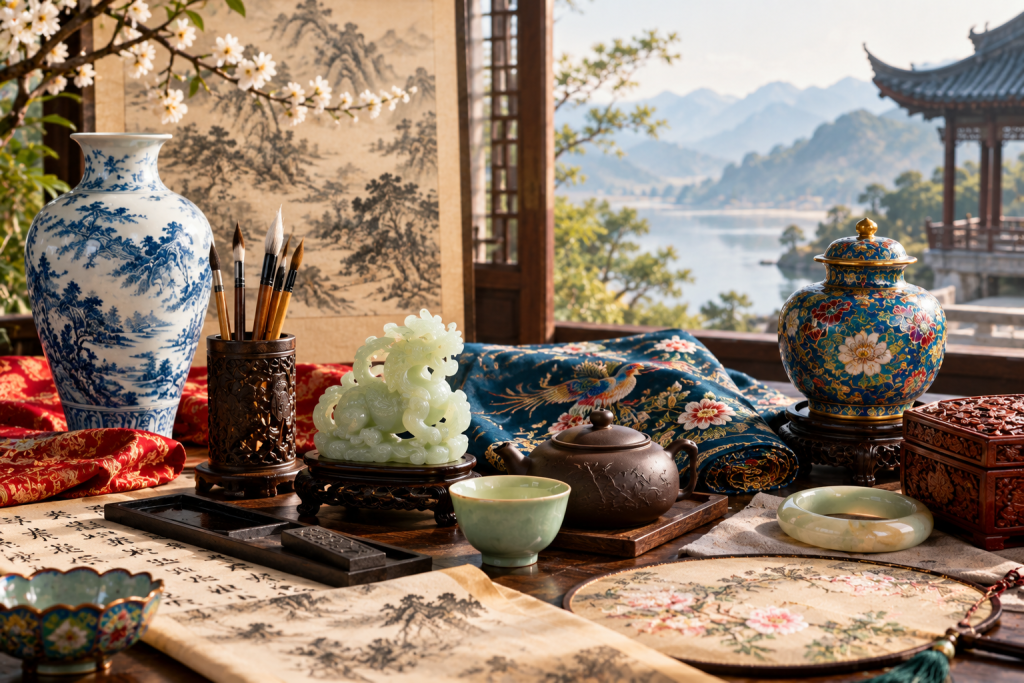
Chinese art and craft have developed over thousands of years, creating one of the world’s richest and most diverse artistic traditions.
From delicate porcelain and silk embroidery to Chinese painting, calligraphy, jade carving, lacquerware, and wood carving, traditional Chinese art and craft can be found in museums, temples, palaces, homes, and everyday life.
But Chinese art and craft are more than beautiful objects.
They reflect the ways Chinese people have understood nature, beauty, society, spirituality, and daily life. Behind a painting, a piece of porcelain, or a carved jade object are ideas about balance, harmony, craftsmanship, patience, and the relationship between people and the world around them.
To understand traditional Chinese art is therefore not simply to study techniques.
It is to look deeper into Chinese history and culture.
What Is Chinese Art and Craft?
Chinese art and craft include a wide range of visual arts, decorative arts, traditional techniques, and handmade objects developed throughout Chinese history.
Chinese art traditionally includes forms such as:
Chinese painting
Chinese calligraphy
sculpture
religious art
seal carving
decorative arts
Traditional Chinese crafts include:
Chinese porcelain
silk and embroidery
jade carving
lacquerware
wood carving
bamboo craft
cloisonné
paper cutting
traditional metalwork
The boundary between art and craft has not always been the same as it is in the modern Western art world.
In traditional China, an object could be beautiful, functional, symbolic, and technically sophisticated at the same time.
A teapot could be an everyday object and a work of art.
A piece of furniture could demonstrate both practical design and extraordinary craftsmanship.
A painted scroll could communicate landscapes, philosophy, poetry, and personal expression.
This connection between beauty and daily life is one of the important characteristics of traditional Chinese art and craft.
The Relationship Between Art and Nature
One of the most important themes in Chinese art is the relationship between humanity and nature.
This can be seen especially clearly in traditional Chinese landscape painting.
Chinese artists often painted mountains, rivers, forests, clouds, and distant landscapes not simply to reproduce what they saw.
Instead, landscapes could express a particular mood, state of mind, or understanding of the natural world.
Mountains could suggest strength and permanence.
Water could represent movement and change.
Empty space could create a sense of distance, atmosphere, and possibility.
This approach was influenced by long traditions of Chinese philosophy, including ideas associated with Confucianism, Taoism, and Buddhism.
Nature was not simply a background for human activity.
It was part of a larger world in which people lived.
This idea continues to influence Chinese painting and other forms of traditional Chinese art.
The Importance of Harmony and Balance
Harmony and balance are recurring ideas in Chinese aesthetics.
This does not necessarily mean perfect symmetry or complete uniformity.
Instead, traditional Chinese art often seeks relationships between different elements.
Light and dark.
Empty space and solid form.
Movement and stillness.
Mountains and water.
Human beings and nature.
These relationships can create a sense of visual and philosophical balance.
The idea of harmony is also closely connected with broader Chinese culture.
As we explored in our article Harmony in Chinese Culture, the concept of he (和) has traditionally been associated with balance, coexistence, and appropriate relationships.
Chinese art often expresses similar ideas visually.
A painting does not need to fill every part of the surface.
A ceramic object does not need excessive decoration.
A garden does not have to reveal everything at once.
Sometimes what is left empty is just as important as what is shown.
Chinese Calligraphy: When Writing Becomes Art
Among the most distinctive forms of traditional Chinese art is Chinese calligraphy.
Chinese characters are written using brushes, ink, paper, and inkstones, traditionally known together as the “Four Treasures of the Study.”
Calligraphy is not simply a method of writing.
The movement of the brush, the structure of the characters, the rhythm of the lines, and the relationship between empty and occupied space all contribute to the artistic result.
Different calligraphic styles developed throughout Chinese history, including seal script, clerical script, regular script, running script, and cursive script.
Calligraphy also became closely connected with education, literature, philosophy, and personal expression.
For educated Chinese scholars, the ability to write beautiful calligraphy was an important cultural accomplishment.
Even today, Chinese calligraphy remains an important part of Chinese culture and artistic life.
Chinese Painting and the Art of the Brush
Chinese painting has a long and sophisticated history.
Traditional Chinese ink painting often relies on a relatively small number of materials: brush, ink, paper, and sometimes silk.
Yet these simple materials allow artists to create extraordinary variations in line, texture, tone, and atmosphere.
Traditional Chinese painting includes many subjects, from landscapes and flowers to birds, animals, people, and historical scenes.
Landscape painting became particularly important in the development of Chinese artistic traditions.
Instead of trying to reproduce a landscape from a single fixed viewpoint, artists could combine different perspectives and visual experiences within one painting.
The result can feel less like a photograph and more like an experience of moving through a landscape.
This approach reflects the importance of contemplation and the relationship between human beings and nature.
Chinese Porcelain and the Art of Fire
If Chinese painting represents the art of the brush, Chinese porcelain represents the extraordinary possibilities of earth and fire.
Chinese ceramics developed over many centuries, eventually producing forms of porcelain that became highly valued both inside China and around the world.
Porcelain combined technical knowledge with artistic design.
Potters had to understand clay, minerals, glazing, temperature, kiln conditions, and firing techniques.
At the same time, craftsmen developed sophisticated decorative traditions.
One of the most famous examples is blue and white porcelain, which became especially influential during the Ming Dynasty.
Chinese porcelain was used in everyday life, religious contexts, imperial courts, and international trade.
Its history also demonstrates how Chinese craftsmanship became part of global cultural exchange.
Silk and Embroidery
Silk is another important part of China’s artistic and cultural heritage.
China has a very long history of silk production, and silk became one of the most important luxury materials associated with Chinese civilization.
Silk was used to make clothing, textiles, paintings, banners, and decorative objects.
Chinese embroidery developed into many regional traditions, each with distinctive techniques and visual characteristics.
Embroidery could depict flowers, birds, animals, landscapes, mythical creatures, and auspicious symbols.
The process required extraordinary patience and precision.
Thousands of individual stitches could gradually create complex images and patterns.
In this sense, Chinese embroidery demonstrates an important characteristic of traditional craft: beauty created through time.
Jade and the Meaning of Virtue
Jade has held a special place in Chinese culture for thousands of years.
Chinese jade objects include ornaments, ritual objects, decorative pieces, jewelry, and sculptures.
But jade was valued for more than its physical beauty.
Traditional Chinese thought associated jade with qualities such as purity, durability, integrity, and virtue.
Confucian traditions in particular developed rich symbolic associations between jade and moral character.
The hardness, smoothness, and subtle beauty of jade made it an ideal material for expressing ideas about both physical and moral perfection.
This is an important example of how Chinese craft can carry cultural meaning beyond its practical function.
A jade object is not simply something made from stone.
It can also represent values and beliefs.
Craftsmanship and Patience
Many traditional Chinese crafts require a remarkable amount of time and skill.
A ceramic vessel may pass through numerous stages before it reaches a finished form.
An embroidered textile can require countless hours of careful stitching.
A carved jade object may take considerable time because the material itself cannot simply be treated like ordinary wood or clay.
Traditional craftsmanship therefore places great value on patience, precision, repetition, and accumulated knowledge.
Skills were often passed from one generation to another.
A craftsman’s knowledge could include not only formal techniques but also practical experience developed through years of work.
This connection between craftsmanship and time remains one of the most meaningful aspects of traditional Chinese art and craft.
Art, Craft, and Everyday Life
One reason Chinese art and craft are so interesting is that they were not always separated from everyday life.
Beautiful objects could be used in homes, tea rooms, gardens, temples, study rooms, and ceremonies.
A scholar’s studio might contain calligraphy, paintings, porcelain, inkstones, carved objects, and carefully selected furniture.
Tea culture created another environment in which objects became part of an aesthetic experience.
Teapots, cups, trays, and other tea ware could be appreciated not only for their function but also for their material, shape, texture, and craftsmanship.
This connection between objects and daily rituals helps explain why Chinese art and craft remain relevant today.
Art does not always need to be placed behind glass.
Sometimes it is meant to be held, used, touched, and experienced.
Regional Diversity in Chinese Art and Craft
It is also important to remember that there is no single style that represents all of Chinese art.
China is geographically vast and culturally diverse.
Different regions developed their own materials, techniques, artistic traditions, and styles.
Jingdezhen became famous for porcelain.
Suzhou became closely associated with silk and embroidery.
Yixing became known for its distinctive purple clay teapots.
Other regions developed important traditions of wood carving, lacquerware, metalwork, paper cutting, and textile arts.
This regional diversity gives Chinese traditional art much of its richness.
It also reminds us that Chinese culture cannot be reduced to a small collection of familiar symbols.
Behind every craft is a particular environment, community, history, and tradition.
Tradition and Modern Chinese Art
Traditional Chinese art and craft have not disappeared in the modern world.
Some traditional techniques have adapted to contemporary design, architecture, fashion, interior decoration, and creative industries.
Artists and craftspeople continue to experiment with traditional materials and methods while responding to modern audiences.
At the same time, museums, cultural institutions, schools, workshops, and individual artisans play important roles in preserving traditional techniques.
This creates an interesting relationship between tradition and innovation.
Preserving a craft does not necessarily mean keeping it frozen in the past.
A living tradition can change while still maintaining its essential identity.
Why Chinese Art and Craft Matter
Chinese art and craft matter because they provide another way to understand Chinese civilization.
Historical records tell us about rulers, wars, governments, and major events.
Art and craft can tell us something different.
They show what people considered beautiful.
They reveal how materials were understood and used.
They preserve techniques developed over generations.
They reflect beliefs about nature, society, morality, spirituality, and daily life.
A piece of porcelain can tell us about technology and trade.
A landscape painting can reveal ideas about nature.
A piece of jade can express cultural values.
A tea vessel can connect craftsmanship with everyday life.
Together, these objects become a form of cultural memory.
Looking Deeper Into Chinese Art and Craft
Chinese art and craft are not simply collections of beautiful objects from the past.
They are expressions of a civilization that developed through thousands of years of history.
From the movement of a calligraphy brush to the careful shaping of porcelain, from the patient stitching of embroidery to the carving of jade, traditional craftsmanship often reflects the same ideas that appear throughout Chinese culture: harmony, balance, patience, respect for nature, and appreciation of time.
This is why Chinese Art and Craft deserves a place of its own on Zexi Blog.
In the articles that follow, we will look more closely at individual traditions and the stories behind them—from Chinese painting and calligraphy to porcelain, silk, jade, embroidery, lacquerware, and other traditional crafts.
Each object has its own history.
Each technique carries generations of knowledge.
And behind each work of art is a deeper story about how people in China have understood beauty, life, nature, and the world around them.
To look at Chinese art is to see China differently.
To understand its crafts is to understand the hands, ideas, patience, and traditions that helped shape its culture.