
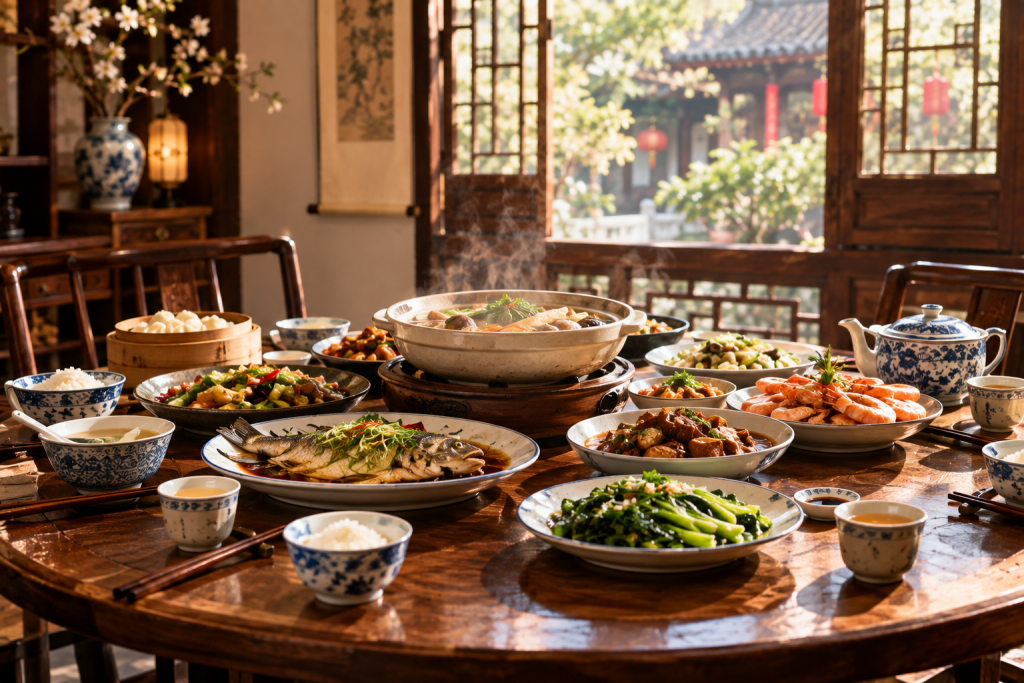
The Chinese Dining Table: More Than Just Food
To understand everyday life in China, sometimes you only need to look at the dining table.
Food is obviously important in every culture. But in China, a meal can be much more than something to eat. It can be a family gathering, a way to welcome guests, an expression of care, a moment of celebration, or simply a pause in the middle of a busy day.
This is one reason Chinese dining culture is so closely connected with family and social life.
A Chinese dining table may bring together grandparents, parents, children, friends, colleagues, or guests. The food placed on the table can reflect a region, a season, a family tradition, or a special occasion. The way dishes are shared can also reveal ideas about hospitality, relationships, and togetherness.
There is no single way to experience a Chinese meal. China is a vast country with enormous regional and cultural diversity. Yet across many different traditions, the dining table remains an important part of Chinese lifestyle and everyday life.
Why Is the Chinese Dining Table So Important?
Traditional Chinese meals are often associated with shared dishes rather than individual plates of a complete meal.
Several dishes may be placed in the center of the table, allowing everyone to take portions and enjoy different flavors together. Rice, noodles, vegetables, meat, seafood, soups, and other foods may appear depending on the region and occasion.
This shared style of eating naturally creates interaction.
People talk while eating. They offer food to one another. They ask whether someone has eaten enough. A host may recommend a particular dish or encourage a guest to try something special.
In this sense, the dining table becomes a social space.
The meal is not only about the food itself. It is also about the relationships between the people sitting around it.
Family Meals and Everyday Chinese Life
The family meal is one of the simplest ways to understand Chinese family culture.
For many families, eating together has traditionally been an important part of daily life. Breakfast, lunch, or dinner may provide an opportunity for family members to meet and talk, even when their schedules are busy.
The importance of family meals can become especially visible during festivals and major family occasions.
During Chinese New Year, for example, the reunion dinner is one of the most meaningful meals of the year. Family members may travel long distances to return home and share a meal together.
The food varies greatly by region and family. Dumplings are strongly associated with northern Chinese traditions, while fish, rice cakes, rice dishes, and many other foods have important regional and symbolic meanings.
The specific dishes may change, but the idea of gathering together remains central.
A meal can therefore become a way of expressing something that is difficult to put into words:
We are together.
Sharing Food Around the Table
One of the most recognizable features of Chinese dining culture is the practice of sharing food.
Instead of ordering one large dish for each person, a group may choose several dishes and place them in the middle of the table. Everyone can then try different foods.
This makes the meal more collective.
It also allows a meal to develop naturally. One person may suggest another dish. Someone may notice that a guest likes a particular food and offer more. Conversation continues while dishes are shared.
In a traditional family setting, this can be an ordinary part of everyday life rather than a formal custom.
The dining table becomes a place where food and relationships exist together.
Chinese Hospitality: Food as a Way of Welcoming People
Food is also closely connected with Chinese hospitality.
When guests visit a Chinese home, offering food or tea is often a natural way to make them feel welcome. A host may prepare fruit, snacks, tea, or a full meal depending on the occasion.
The message is often simple:
Please stay. Please eat. Make yourself comfortable.
This is why food can carry emotional meaning beyond taste.
Preparing a good meal for family members may be an expression of care. Cooking a favorite dish for a child who has returned home can communicate affection. Preparing a large meal for guests can express generosity and respect.
In this way, Chinese food culture is closely connected with relationships.
The meal becomes a language of hospitality.
Regional Diversity on the Chinese Dining Table
There is no single Chinese cuisine.
China’s geography, climate, history, and local traditions have produced extraordinary regional diversity.
Sichuan cuisine is famous for its bold flavors and use of chili and Sichuan pepper. Cantonese cuisine is known for its emphasis on fresh ingredients and a wide variety of cooking techniques. Jiangsu and Zhejiang cuisines often highlight delicate flavors and seasonal ingredients. Fujian cuisine has strong seafood traditions, while northern regions have long traditions centered around wheat-based foods such as noodles, buns, and dumplings.
Rice is especially important in many southern regions, while wheat-based foods have historically been more prominent across much of northern China.
Even within the same province, food traditions can vary from city to city and family to family.
This regional diversity is an essential part of Chinese food culture.
To talk about Chinese cuisine as if it were one fixed tradition would miss one of the most interesting aspects of Chinese everyday life: food changes with place.
Food, Season, and Everyday Life
Traditional Chinese food culture also has a strong relationship with seasons.
People in different regions have developed food traditions based on local climates, available ingredients, agricultural cycles, and seasonal customs.
Certain foods are particularly associated with festivals or important moments of the year.
For example, mooncakes are strongly associated with the Mid-Autumn Festival, while rice cakes, dumplings, tangyuan, and other foods have their own seasonal and regional associations.
But seasonal eating is not limited to festivals.
Fresh vegetables, fruits, seafood, grains, and other ingredients naturally change throughout the year. Traditional food knowledge often reflects an awareness of what is available and appropriate in a particular season.
This creates a close connection between food, agriculture, nature, and time.
The Dining Table and Chinese Family Values
Food can also reveal something about Chinese family values.
Parents and grandparents may show care by preparing food, reminding younger family members to eat properly, or remembering what someone likes and dislikes.
Children may learn family traditions through cooking and eating.
A recipe can travel from one generation to another without ever being written down. A grandmother’s dumplings, a father’s noodle recipe, or a family’s way of preparing a holiday dish can become part of a family’s cultural memory.
In this sense, the dining table can act as a bridge between generations.
Food preserves memories.
Meals as Social Life
The Chinese dining table is not limited to the home.
Restaurants, tea houses, neighborhood eateries, workplace canteens, street food stalls, and banquet halls all form part of everyday life in China.
Friends may meet for dinner after work. Colleagues may have a meal together. Business relationships may develop over shared food. Families may celebrate birthdays or other important events at restaurants.
A meal can therefore serve many purposes at once.
It can be practical, social, emotional, and celebratory.
This is especially important when understanding Chinese social life from outside the country. A dinner invitation may not simply mean “let’s have something to eat.”
It can mean:
Let’s spend some time together.
Chinese Dining Etiquette: Respect and Consideration
Chinese dining also has various traditions of etiquette, although practices differ according to region, generation, family, and situation.
Guests may traditionally be offered the best dishes. Younger people may show consideration toward older family members. Hosts may encourage guests to eat more.
At formal meals, seating arrangements can sometimes reflect relationships and social roles.
However, it is important not to treat every traditional rule as something followed by every Chinese person today.
Modern Chinese dining is diverse.
Young people may eat casually with friends, order food through mobile apps, enjoy international cuisines, or have meals alone because of work and personal schedules.
Traditional etiquette continues to influence many situations, but everyday life is constantly changing.
The Chinese Dining Table in Modern China
The modern Chinese dining table looks very different from the one experienced by previous generations.
Urbanization, smaller households, changing work patterns, technology, and new lifestyles have all influenced how people eat.
Food delivery has become part of urban life. Restaurants offer cuisines from around the world. Young people may enjoy coffee, fast food, Western desserts, Japanese cuisine, or other international foods alongside traditional Chinese dishes.
At the same time, traditional food remains deeply connected with family and cultural identity.
A young person may eat a quick lunch at work, order food online in the evening, and still return home during a festival to share a traditional family meal.
Modernity has not necessarily replaced tradition.
Often, the two simply exist together.
What the Chinese Dining Table Tells Us About China
The Chinese dining table offers a small but revealing window into Chinese life.
It shows how food connects with family, hospitality, friendship, regional identity, seasons, memory, and social relationships.
It also demonstrates something important about Chinese lifestyle: many traditions do not survive only in museums, ceremonies, or historical texts.
They survive through ordinary actions.
Someone prepares dinner.
A family sits down together.
A host pours tea for a guest.
A grandmother teaches a child how to make dumplings.
Friends order several dishes and share them around a table.
These moments may seem simple, but together they form part of the living culture of China.
Food Is Also a Way of Understanding People
When visitors encounter Chinese cuisine, it is easy to focus on the dishes themselves: dumplings, noodles, hot pot, roast duck, dim sum, tea, mooncakes, or countless regional specialties.
But food becomes much more interesting when we ask another question:
What happens around the food?
Who prepared it?
Who is sitting at the table?
Why are these dishes being served?
Is this an ordinary family dinner, a festival meal, a gathering of friends, or a meal for guests?
The answers reveal layers of Chinese culture that cannot be understood from a menu alone.
The dining table is therefore not simply a place where people eat.
It is a place where people meet, remember, celebrate, care for one another, and maintain connections between generations.
Looking Deeper Into Chinese Lifestyle
To understand China, we do not always need to begin with its most famous monuments or historical events.
Sometimes, everyday life tells us just as much.
A cup of tea, a shared meal, a family gathering, or a simple invitation to sit down and eat can reveal ideas about relationships, hospitality, time, and community.
That is what makes the Chinese dining table so interesting.
It is ordinary, yet meaningful.
It is traditional, yet constantly changing.
And above all, it reminds us that culture is not something that exists only in the past.
Culture lives in everyday life.