
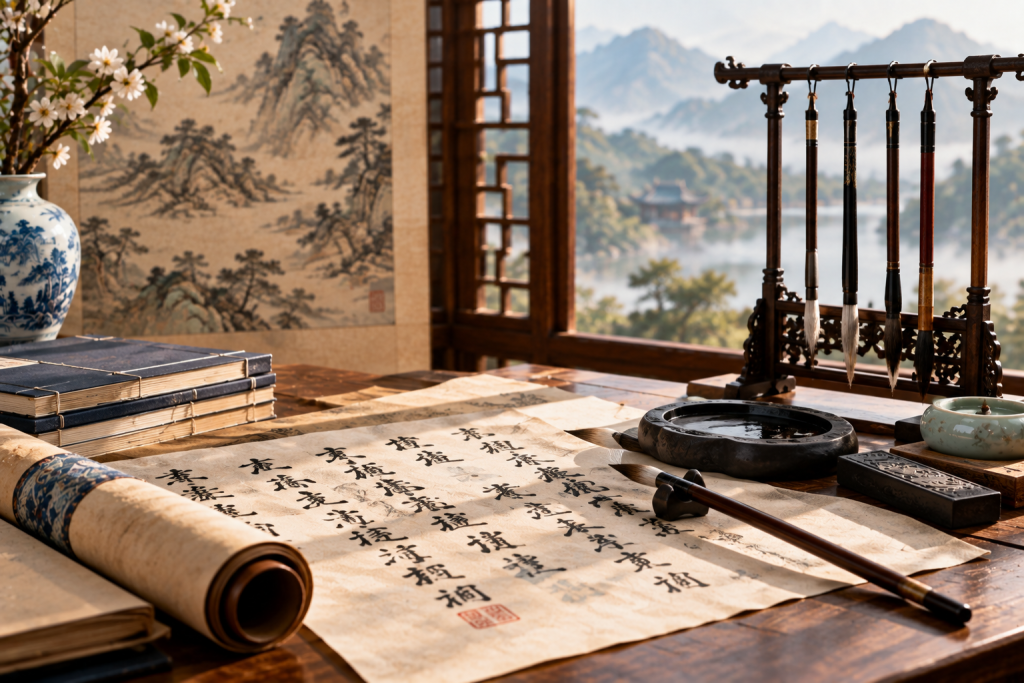
Chinese calligraphy is much more than beautiful handwriting. For thousands of years, writing in China has developed into a sophisticated art form in which lines, movement, rhythm, space, and emotion come together.
A Chinese character can carry meaning through its words, but the way it is written can also reveal something about the person holding the brush. The strength of a stroke, the balance of a character, the movement between lines, and even the empty space around the writing can become part of the artwork.
This is what makes Chinese calligraphy one of the most distinctive traditions in Chinese art.
To understand it, however, we need to look beyond the appearance of the characters. Chinese calligraphy connects language with visual art, education with personal cultivation, and technique with ideas about balance and harmony.
What Is Chinese Calligraphy?
Chinese calligraphy, known as shūfǎ (书法), literally means the “method” or “art of writing.”
It is the traditional artistic practice of writing Chinese characters with a brush and ink, although modern calligraphy can also use other tools and materials.
Unlike ordinary handwriting, traditional Chinese calligraphy places great importance on the quality and movement of every stroke.
The artist must consider:
the direction of each stroke
the pressure of the brush
the speed of movement
the thickness of the line
the relationship between characters
the balance of the entire composition
the empty space surrounding the writing
A calligrapher therefore does not simply write words.
The act of writing itself becomes an artistic performance.
The Chinese Brush: An Instrument of Expression
The traditional Chinese brush is central to the history of Chinese calligraphy and art.
A brush can create an extraordinary range of lines. A light touch may produce a thin and delicate mark, while stronger pressure can create a broader and darker stroke.
The movement can be quick or slow, controlled or expressive.
This makes the brush very different from a modern pen or printed typeface.
The final character records the movement of the hand.
In this sense, Chinese calligraphy preserves a moment in time. Once a brushstroke has been placed on paper, it cannot easily be erased or corrected.
The calligrapher must therefore combine concentration, control, rhythm, and confidence.
The Four Treasures of the Study
Traditional Chinese calligraphy is closely associated with the Four Treasures of the Study, known in Chinese as Wénfáng Sìbǎo (文房四宝).
They are:
brush
ink
paper
inkstone
These four objects became fundamental tools of scholars and artists.
The inkstone was used to prepare ink from an inkstick, usually by grinding the stick with water. The resulting ink could be adjusted in concentration to create different shades.
Paper provided the surface for writing, while the brush transformed ink into lines.
The Four Treasures were not merely practical tools. They also became objects of appreciation, craftsmanship, and collecting.
Beautiful brushes, inkstones, inksticks, and papers could reflect the owner’s taste and status.
The Evolution of Chinese Writing
The history of Chinese calligraphy is closely connected to the development of Chinese writing.
Early forms of Chinese writing can be seen in inscriptions on oracle bones from the late Shang period. Characters also appeared on bronze vessels and other materials during ancient China.
Over centuries, Chinese writing developed through several important script forms.
Among the best known are:
Seal Script (zhuànshū) — an ancient and highly stylized form of writing associated with early inscriptions and later artistic use.
Clerical Script (lìshū) — a major historical script that became prominent during the Qin and Han periods.
Regular Script (kǎishū) — a more standardized form that became an important model for formal writing.
Running Script (xíngshū) — a semi-cursive style that allows greater speed and fluidity.
Cursive Script (cǎoshū) — an extremely expressive style in which characters can become highly abbreviated and connected.
These styles demonstrate that Chinese calligraphy styles are not simply different fonts.
Each has its own structure, rhythm, history, and aesthetic character.
Five Major Styles of Chinese Calligraphy
The five major script traditions provide a useful introduction to traditional Chinese calligraphy.
Seal Script
Seal script has a distinctive ancient appearance, with carefully balanced forms and elegant lines.
It is strongly associated with early Chinese writing traditions and later remained important in seals and artistic calligraphy.
Clerical Script
Clerical script developed into a more standardized form during the Han period.
Its horizontal and sweeping strokes give it a recognizable visual character.
Regular Script
Regular script is perhaps the easiest style for beginners to recognize.
Characters are clearly structured, with individual strokes arranged according to established principles.
Many people learning how to write Chinese calligraphy begin with regular script because it provides a strong foundation for understanding character structure and brush control.
Running Script
Running script is more fluid.
Characters remain readable, but strokes may connect or flow into one another.
It occupies an interesting position between formal writing and expressive movement.
Cursive Script
Cursive script pushes movement and expression much further.
Characters may become highly abbreviated, and individual forms can be difficult for an inexperienced viewer to recognize.
For this reason, appreciating cursive calligraphy often requires familiarity with both Chinese characters and calligraphic conventions.
Why Chinese Calligraphy Is Considered an Art
One important question is: Why is writing considered art in China?
The answer lies partly in the special role of writing within Chinese civilization.
Chinese characters are not alphabetic letters. Each character generally carries meaning as a written unit, while its visual structure can also be appreciated independently.
This creates a natural connection between language and visual form.
Calligraphy also became closely associated with education and the scholar’s life.
Historically, educated Chinese elites were expected to read and write classical texts, and mastery of writing was an important part of scholarly culture.
As a result, Chinese calligraphy art became connected with learning, character, personal cultivation, and cultural identity.
Calligraphy and Chinese Philosophy
Chinese calligraphy is also closely connected to traditional Chinese ideas about balance and harmony.
A well-composed character must balance different elements.
One side cannot overpower the other. Strokes need enough space to breathe. The entire composition must maintain rhythm.
This does not mean that every calligraphic work is perfectly symmetrical.
In fact, expressive calligraphy often depends on controlled irregularity.
A slightly heavier stroke can be balanced by an open space. A fast movement can contrast with a slow one.
The result is a dynamic form of balance.
This relationship between movement and stability is one reason Chinese calligraphy and Chinese culture are so closely connected.
The Importance of Empty Space
Like traditional Chinese painting, calligraphy places great importance on empty space.
The white paper surrounding the characters is not simply unused background.
It helps determine the rhythm of the composition.
A character that is too crowded can feel heavy. Too much space can make the composition feel disconnected.
The relationship between black ink and white paper creates a visual rhythm.
This is similar to the principle of liúbái (留白), or “leaving blank space,” found throughout traditional Chinese aesthetics.
The same idea can be seen in Chinese landscape painting, gardens, architecture, and design.
What is not shown can be just as important as what is shown.
Famous Chinese Calligraphers
The history of Chinese calligraphy includes many influential artists.
Wang Xizhi of the Eastern Jin period is traditionally regarded as one of the greatest calligraphers in Chinese history. His work became an important model for later generations, and his Lantingji Xu is especially famous.
Yan Zhenqing of the Tang Dynasty developed a powerful and distinctive regular script style.
Liu Gongquan, also of the Tang period, was another highly influential calligrapher known for disciplined and elegant writing.
These artists were not simply producing attractive handwriting.
Their works helped establish standards of technique, composition, and artistic expression that influenced Chinese calligraphy for centuries.
Calligraphy, Poetry, and Painting
One of the most fascinating aspects of Chinese traditional art is the relationship between calligraphy, poetry, and painting.
A traditional Chinese painting may include a poem or inscription written by the artist.
The calligraphy becomes part of the visual composition.
The words may explain the painting, express the artist’s feelings, identify the subject, or simply create an additional artistic layer.
This is why Chinese painting and calligraphy are often discussed together.
Both depend on the brush.
Both use ink.
Both value rhythm and composition.
And both encourage the artist to express more than simple visual appearance.
Calligraphy as Personal Expression
Chinese calligraphy can also reveal something about the individual artist.
Two people can copy the same characters but produce very different results.
One may write with restrained precision.
Another may use powerful, energetic strokes.
A third may prefer delicate and elegant lines.
The differences can reflect training, personality, mood, artistic preference, and historical style.
This is one reason traditional Chinese scholars often treated calligraphy as more than technical skill.
It could become a form of personal cultivation.
The process required patience and concentration, while repeated practice gradually developed control and discipline.
Chinese Calligraphy in Everyday Life
Calligraphy has never existed only inside museums.
It has appeared on paintings, scrolls, seals, architectural decorations, religious objects, household items, and festive decorations.
During traditional festivals, especially Lunar New Year, people may display calligraphic couplets and auspicious phrases around their homes.
Calligraphy can also be found in temples, gardens, historic buildings, stone inscriptions, and public spaces.
Even today, Chinese calligraphy remains part of cultural education.
Children may learn basic brush writing, while adults practice calligraphy as a hobby, artistic discipline, or way to reconnect with traditional culture.
Chinese Calligraphy in the Modern World
Modern technology has fundamentally changed how people write.
Computers and smartphones have reduced the need for handwriting in everyday communication.
Yet this has not made Chinese calligraphy irrelevant.
Instead, calligraphy has increasingly become an important form of cultural and artistic practice.
Modern artists continue to explore traditional scripts while experimenting with contemporary materials, spaces, and visual concepts.
Calligraphy is also increasingly appreciated internationally as a distinctive form of Chinese art.
For people outside China, learning about calligraphy offers a valuable introduction to Chinese characters and the cultural world surrounding them.
Why Chinese Calligraphy Still Matters
Chinese calligraphy shows how something as ordinary as writing can become an art form.
It connects language with movement, discipline with creativity, and tradition with individual expression.
A brushstroke may last only a moment, but the techniques and ideas behind it have been transmitted across generations.
To look at a piece of traditional Chinese calligraphy is therefore to see more than characters written in ink.
You are seeing the history of a writing system, the discipline of the brush, the aesthetics of balance and empty space, and the cultural world of scholars, artists, and everyday people.
Chinese calligraphy reminds us that art does not always have to begin with an extraordinary subject.
Sometimes, it begins with something as simple as a single line.
And when that line is created with intention, rhythm, and skill, writing becomes art.