Chapter 2 – The Shang and Zhou Dynasties and the Rise of Royal Power

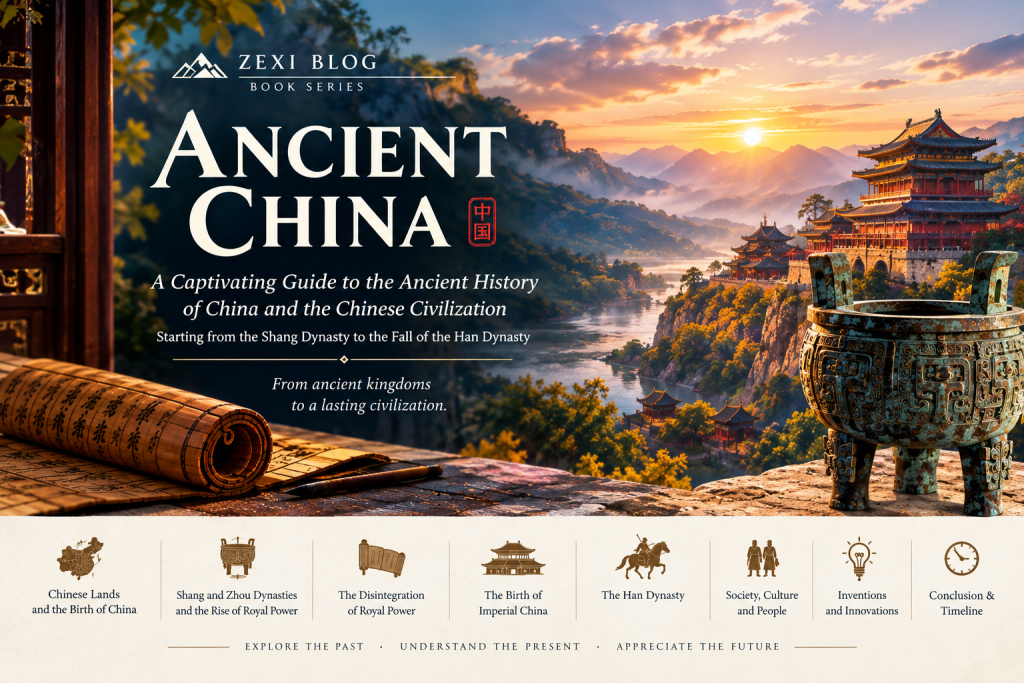
Ancient China book series featuring traditional Chinese palaces, bronze vessels, ancient scrolls, and a misty mountain landscape at sunset.
This entry is part 4 of 5 in the series Ancient China

Ancient China

Ancient China book series featuring traditional Chinese palaces, bronze vessels, ancient scrolls, and a misty mountain landscape at sunset.

Ancient China

Ancient China book series featuring traditional Chinese palaces, bronze vessels, ancient scrolls, and a misty mountain landscape at sunset.

Introduction to Ancient China

Ancient China book series featuring traditional Chinese palaces, bronze vessels, ancient scrolls, and a misty mountain landscape at sunset.

Chapter 1 – Chinese Lands and the Birth of China

Ancient China book series featuring traditional Chinese palaces, bronze vessels, ancient scrolls, and a misty mountain landscape at sunset.

Chapter 2 – The Shang and Zhou Dynasties and the Rise of Royal Power

Ancient China book series featuring traditional Chinese palaces, bronze vessels, ancient scrolls, and a misty mountain landscape at sunset.

Chapter 3 – The Disintegration of Royal Power

The story of early China changes dramatically with the rise of the Shang Dynasty.

In the previous chapter, we followed the long development of prehistoric communities, agriculture, regional cultures, and the emergence of early states. Much of that history remains visible mainly through archaeology.
With the Shang, however, the picture becomes clearer.
Bronze vessels, royal tombs, settlements, weapons, ritual objects, and most importantly, inscriptions on oracle bones provide direct evidence of a complex society ruled by kings. The Shang Dynasty, conventionally dated to about 1600–1046 BCE, is generally regarded as the earliest archaeologically recorded dynasty in Chinese history.
After the Shang came the Zhou.
The Zhou inherited much of the Shang political and ritual world, but they also introduced ideas that would have an extraordinary influence on Chinese history. Among them was the Mandate of Heaven, the principle that legitimate rule depended on the ruler’s ability to maintain order and serve the people.
Together, the Shang and Zhou transformed the foundations established during earlier periods into a more recognizable form of ancient Chinese civilization.

The Shang Dynasty and the Beginning of Recorded History

The Shang developed in the Yellow River region of northern China, where earlier Neolithic and Bronze Age cultures had already created sophisticated communities.
Unlike the legendary Xia Dynasty, whose historical identification remains debated, the Shang is supported by extensive archaeological evidence.
The remains of Shang settlements reveal large-scale construction, elite burials, bronze workshops, weapons, ritual vessels, and evidence of an organized political system.
The most important archaeological site is Anyang, in present-day Henan Province.
Anyang became the last major capital of the Shang and has provided some of the most important evidence for understanding early Chinese civilization. Excavations have uncovered royal tombs, bronze objects, and large quantities of inscribed bones and shells used for divination. These discoveries have also helped confirm many names and events preserved in later historical traditions.
This is one of the reasons the Shang period represents such an important transition.
For earlier periods, historians often have to move carefully between archaeology and later traditions.
For the late Shang, archaeology and written evidence begin to meet.

From Tang to the Shang Kingdom

Traditional Chinese histories describe Tang as the founder of the Shang Dynasty.
According to these accounts, Tang was originally a powerful leader under the Xia political order. He gradually expanded his influence and eventually challenged Jie, the last ruler of the Xia.
Later historical traditions portray Jie as a ruler who had lost the support of his people, while Tang is remembered as a more responsible and capable leader.
The story became an important model in later Chinese political thought:
A ruler who governs badly can lose political legitimacy, while a virtuous leader can replace him.
However, the exact historical details of Tang’s rise are difficult to reconstruct. The traditional accounts were written much later than the events they describe, and there is no contemporary Shang inscription providing a complete narrative of the transition from Xia to Shang.
What archaeology does show is that by the early second millennium BCE, powerful Bronze Age societies had developed in the Yellow River region.
The Shang emerged from this broader world and eventually became its dominant political power.

Bronze and the Power of the Shang Kings

Bronze was one of the defining technologies of Shang China.
The Shang used bronze for weapons, tools, chariot fittings, and—perhaps most importantly—ritual vessels.
Some of these vessels were enormous and highly elaborate.
Their production required much more than skilled craftsmanship. Mining and transporting raw materials, preparing molds, organizing workshops, training specialists, and distributing finished objects all required considerable resources.
This tells us something important about Shang political power.
A king who could command the production of large quantities of bronze was not simply a tribal chief.
He stood at the center of an increasingly complex political and economic system.
The Shang and Zhou periods are often described together as China’s Bronze Age because bronze played such an important role in technology, ritual, warfare, and elite culture. Chinese bronze casting also developed distinctive piece-mold techniques rather than simply copying the lost-wax traditions common in many other ancient Bronze Age cultures.
Bronze therefore became much more than a useful material.
It became a language of power.
A large ritual vessel could communicate the status of a family, commemorate ancestors, and demonstrate access to resources and skilled artisans.
The ability to produce such objects reinforced the authority of the ruling elite.

The Royal Capital at Anyang

The Shang did not always maintain their capital in one location.
Traditional histories record several changes of capital during the dynasty. Whatever the reasons behind these movements, the final major capital at Anyang became the best archaeological window into Shang civilization.
The remains found there reveal a highly organized society.
There were royal tombs, workshops, ceremonial areas, residential settlements, and evidence of military activity.
Among the most remarkable discoveries are the royal tombs containing bronze vessels, weapons, jade objects, ornaments, and other valuable materials.
These burials reveal a society with significant differences in wealth and status.
The tombs of rulers and elites contained objects that would have required enormous amounts of labor and resources, while ordinary people were buried in very different circumstances.
The archaeological record therefore provides evidence of a hierarchical society in which political authority, wealth, ritual status, and military power were closely connected.

Wu Ding and the Height of Shang Power

One of the best-known Shang rulers was King Wu Ding, whose reign is traditionally placed in the thirteenth century BCE.
Much of what we know about his reign comes from oracle-bone inscriptions.
These inscriptions record questions concerning warfare, harvests, weather, illness, sacrifices, royal activities, and other matters.
They provide an extraordinary glimpse into the concerns of the Shang royal court.
Wu Ding’s reign is also associated with military campaigns and the expansion or consolidation of Shang influence over neighboring groups.
One especially important figure from this period was Fu Hao, a royal consort who appears in inscriptions and whose tomb was discovered at Anyang.
Her burial contained a remarkable collection of bronze vessels, weapons, jade objects, and other treasures, providing evidence that elite women could hold significant positions within Shang society.
The Shang political system was therefore more complicated than a simple king-and-peasant hierarchy.
Royal relatives, military leaders, ritual specialists, aristocratic lineages, craftspeople, farmers, and captives all occupied different positions within the society.

The Shang Military

Warfare was an important part of Shang political life.
The kingdom competed with neighboring communities and conducted military campaigns to defend or expand its territory.
Shang armies included infantry equipped with weapons such as spears, axes, and bows. Chariots also became important among the elite and military leadership.
The introduction and development of horse-drawn chariots represented a major change in ancient Chinese warfare.
Chariots required horses, specialized equipment, skilled drivers, and trained warriors. Their presence therefore reflected both technological development and the growing resources of the ruling elite.
But Shang warfare was not simply about battles.
Military campaigns could bring prisoners, territory, labor, and prestige to the ruling class.
Warfare also strengthened the relationship between the king and aristocratic lineages that supplied soldiers and commanders.
The military was therefore closely connected to the political structure of the Shang state.

Ancestors, Divination, and Royal Power

Perhaps the most distinctive feature of Shang political culture was the close relationship between royal authority and religious practice.
Shang rulers were not simply political leaders.
They were also responsible for communicating with ancestors and supernatural powers.
Before making important decisions, the royal court could conduct divination.
Questions were carved onto animal bones or turtle shells. The objects were then heated, causing cracks to appear. The resulting patterns were interpreted as answers from the supernatural world.
These objects are known today as oracle bones.
The inscriptions found on them are among the earliest substantial examples of Chinese writing. They record questions concerning harvests, weather, illness, warfare, sacrifices, childbirth, royal journeys, and other concerns of the Shang court.
This is enormously important for the history of China.
Writing was not simply a way to record ordinary information.
It was deeply connected to ritual, political authority, and communication with ancestors.
The king stood at the center of this system.
By performing rituals and seeking supernatural guidance, the ruler reinforced his position as the intermediary between the royal family, the ancestors, and the wider community.

The Birth of Chinese Writing

The oracle bones also provide our earliest secure evidence for a mature Chinese writing system.
The characters found on Shang oracle bones are already sufficiently developed to demonstrate that writing had a history before the inscriptions were created.
We do not yet know exactly when Chinese writing first appeared.
Earlier forms may have existed on materials that have not survived, such as wood, bamboo, or other organic materials.
But the surviving Shang inscriptions demonstrate that by the late second millennium BCE, writing had already become an organized and sophisticated system.
This early script is one of the ancestors of later Chinese writing.
That makes the Shang period a turning point in the history of Chinese civilization.
For the first time, we can hear something directly from the ancient people themselves—not through stories written centuries later, but through inscriptions produced during their own period.

The Social Structure of Shang China

Shang society was highly hierarchical.
At the top stood the king and his royal family.
Below them were powerful aristocratic families and lineages connected to the royal house through kinship, political relationships, military service, and ritual obligations.
Specialists such as bronze workers, jade carvers, scribes, diviners, and other craftspeople occupied important positions.
Farmers formed the foundation of the agricultural economy.
There were also prisoners and enslaved people who could be used as laborers or sacrificed during certain rituals.
This hierarchy is visible in both written evidence and archaeology.
The scale of royal tombs and bronze production could not have been achieved without a large organized labor force.
At the same time, the distribution of valuable objects shows that access to wealth was highly unequal.
Shang civilization was therefore not simply a collection of agricultural communities.
It was an organized political society with specialized labor, social hierarchy, military institutions, ritual authority, and a powerful royal center.

The Fall of the Shang

No dynasty lasts forever.
By the eleventh century BCE, the Shang kingdom faced growing challenges.
Later Chinese histories describe the final Shang ruler, Di Xin, as cruel and irresponsible. Stories about his reign emphasize extravagance, violence, and the loss of political virtue.
Some of these accounts became increasingly dramatic as they were transmitted through later historical traditions.
Modern historians therefore need to distinguish between the archaeological evidence for the end of the Shang and the moral stories later generations told about its final king.
What we do know is that the Shang eventually lost its political dominance to the Zhou, a powerful group from the western part of the Shang world.
The decisive conflict is traditionally associated with the Battle of Muye, usually dated to around 1046 BCE.
The Zhou forces defeated the Shang, and the Shang political order collapsed.
The Zhou then established a new dynasty.
But the Zhou needed to answer an obvious question:
Why were they entitled to overthrow the Shang?
Their answer would become one of the most influential political ideas in Chinese history.

The Mandate of Heaven

The Zhou developed the concept known as the Mandate of Heaven, or Tianming.
According to this idea, political authority ultimately depended on Heaven.
A ruler did not possess an unlimited and permanent right to govern simply because he belonged to a royal family.
A legitimate ruler was expected to maintain order, govern responsibly, and protect the people.
If a ruler became corrupt or failed to fulfill these responsibilities, Heaven could withdraw its mandate.
The Zhou used this concept to explain why they had been justified in overthrowing the Shang.
The Shang had lost Heaven’s favor.
The Zhou had received it.
This was more than a religious explanation for a change of dynasty.
It created a flexible political theory that later Chinese dynasties could use to explain both their own legitimacy and the fall of their predecessors.
The idea became one of the most enduring concepts in ancient Chinese political thought.

The Zhou Dynasty and a New Political Order

The Zhou Dynasty ruled China for much longer than the Shang, traditionally dated from about 1046 to 256 BCE.
However, Zhou political power changed dramatically over time.
The early period is known as the Western Zhou, lasting approximately 1046–771 BCE. During this period, the Zhou royal house exercised significant authority over a large network of regional states.
The Zhou did not simply replace the Shang political system.
They inherited many elements of Shang culture, including bronze technology, ritual traditions, writing, and concepts of royal authority.
But they reorganized political relationships in a different way.
The Zhou rulers distributed territories to relatives, allies, and important supporters.
These regional rulers governed their own territories while recognizing the authority of the Zhou king.
This system is often called fengjian.
It is sometimes translated as a feudal system, but the comparison with medieval European feudalism can be misleading.
The Zhou system was deeply connected to kinship, ritual relationships, hereditary status, and political obligations within the Chinese context.
It created a network of states rather than a simple centralized bureaucracy.

The Zhou King and the Expanding Realm

The early Zhou rulers expanded their influence beyond the original Zhou heartland.
Some territories were placed under members of the royal family, while other areas were governed by allied elites.
This helped the Zhou establish political control over a much larger region.
The system worked particularly well when the Zhou king possessed sufficient military and political power.
The king stood at the top of the political hierarchy.
Regional rulers owed him recognition and obligations.
In return, they received territory, status, and legitimacy.
Ritual played an important role in maintaining these relationships.
Bronze inscriptions from the Zhou period also provide valuable evidence of political appointments, military campaigns, ceremonies, and relationships between rulers and their subjects. Zhou bronze inscriptions became longer and more detailed than many earlier Shang inscriptions, sometimes recording specific events and political achievements.
The written record was becoming increasingly important to government.

When Royal Power Began to Weaken

The Zhou system depended heavily on personal and family relationships.
But generations passed.
The close relationships that connected the earliest Zhou rulers to their regional lords gradually became more distant.
A king could no longer personally depend on every regional ruler as a brother, uncle, or close relative.
At the same time, regional states became stronger.
Their rulers developed their own armies, economies, territories, and political interests.
The balance between the Zhou king and the regional states therefore began to change.
The king remained symbolically important, but his direct political control weakened.
This process would eventually transform the Zhou political order.

From Western Zhou to Eastern Zhou

The turning point came in 771 BCE, when the Western Zhou capital was attacked and King You was killed.
The royal court moved eastward, and a new capital was established at Luoyang.
Historians generally divide Zhou history at this point into two major periods:
Western Zhou: c. 1046–771 BCE
Eastern Zhou: 770–256 BCE
The Eastern Zhou is further divided into the Spring and Autumn period and the Warring States period.
The Zhou Dynasty itself continued for centuries.
But the political reality had changed.
The Zhou king increasingly became a symbolic center rather than an all-powerful ruler.
Power moved toward the regional states.
This gradual decline would eventually produce one of the most politically dynamic periods in ancient China.

Why the Shang and Zhou Matter

The importance of the Shang and Zhou dynasties goes far beyond their dates on a historical timeline.
The Shang left behind some of the earliest substantial written evidence of Chinese civilization.
Their oracle bones preserve early Chinese writing.
Their bronze vessels demonstrate extraordinary technical and artistic achievement.
Their royal tombs reveal a highly stratified society.
Their rituals show how closely political authority and ancestral religion were connected.
The Zhou inherited this world but transformed its political meaning.
They developed the Mandate of Heaven, creating a powerful explanation for legitimate rule.
They organized a network of regional states through kinship and political relationships.
And over the centuries, Zhou thinkers and institutions helped establish concepts that would influence Chinese political philosophy long after the Zhou kings themselves had lost most of their power.
The Shang gave us some of the earliest direct evidence of China’s Bronze Age civilization.
The Zhou gave later generations a language for thinking about why rulers have the right to rule—and when that right can be lost.

From Royal Power to Political Competition

The story does not end with the decline of the Zhou king.
In fact, the weakening of royal authority opened the door to something new.
Regional states became increasingly independent.
Rulers competed for territory, resources, prestige, and political influence.
War became more organized.
Diplomacy became increasingly sophisticated.
New thinkers began asking how society should be governed and what makes a ruler legitimate.
From this environment emerged some of the most influential figures and ideas in Chinese history, including Confucius and other thinkers of the later Zhou world.
The political order established by the early Zhou was beginning to break apart.
And that disintegration would eventually reshape China.
Continue Reading → Chapter 3 – The Disintegration of Royal Power

Ancient China

Chapter 1 – Chinese Lands and the Birth of China Chapter 3 – The Disintegration of Royal Power

Leave a Comment

Your email address will not be published. Required fields are marked *

Scroll to Top