Chapter 1 – Chinese Lands and the Birth of China

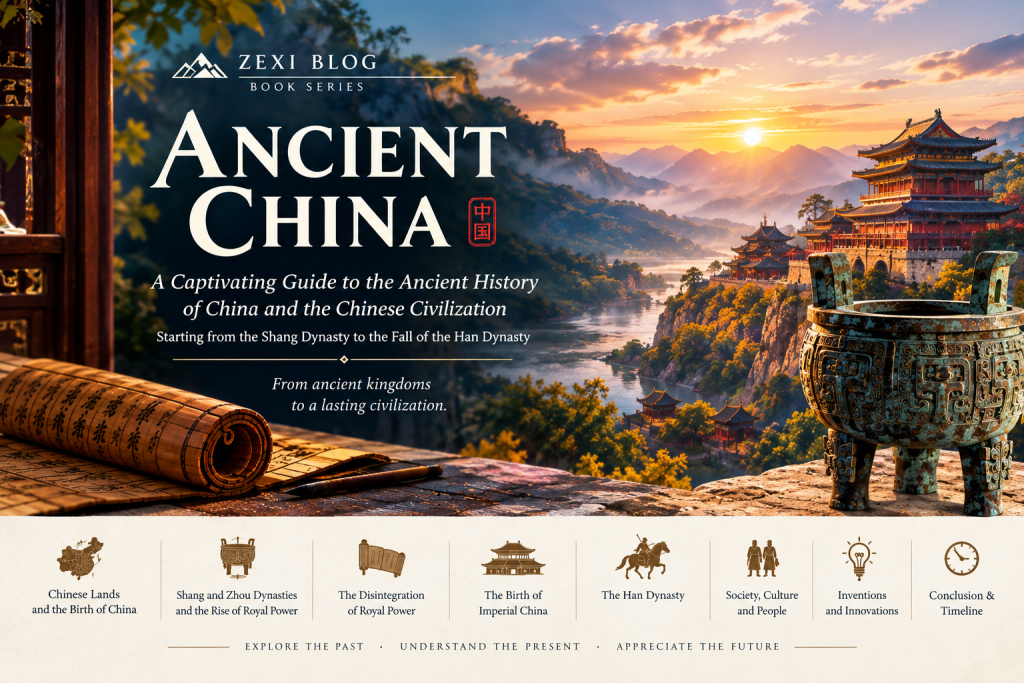
Ancient China book series featuring traditional Chinese palaces, bronze vessels, ancient scrolls, and a misty mountain landscape at sunset.
This entry is part 3 of 5 in the series Ancient China

Ancient China

Ancient China book series featuring traditional Chinese palaces, bronze vessels, ancient scrolls, and a misty mountain landscape at sunset.

Ancient China

Ancient China book series featuring traditional Chinese palaces, bronze vessels, ancient scrolls, and a misty mountain landscape at sunset.

Introduction to Ancient China

Ancient China book series featuring traditional Chinese palaces, bronze vessels, ancient scrolls, and a misty mountain landscape at sunset.

Chapter 1 – Chinese Lands and the Birth of China

Ancient China book series featuring traditional Chinese palaces, bronze vessels, ancient scrolls, and a misty mountain landscape at sunset.

Chapter 2 – The Shang and Zhou Dynasties and the Rise of Royal Power

Ancient China book series featuring traditional Chinese palaces, bronze vessels, ancient scrolls, and a misty mountain landscape at sunset.

Chapter 3 – The Disintegration of Royal Power

Chinese Lands and the Birth of China

The story of ancient China does not begin with an emperor sitting on a throne, a capital surrounded by walls, or even a dynasty with a written name.
It begins much earlier.
Long before the Xia, Shang, or Zhou dynasties, people were already living along the great rivers of East Asia, adapting to changing landscapes, cultivating crops, making pottery, burying their dead, creating tools, and developing communities that would eventually become part of one of the world’s oldest continuous civilizations.
So when we ask about the birth of China, there is no single date that provides the answer.
The origins of Chinese civilization were a long process.
They were shaped by geography, migration, agriculture, technology, ritual, warfare, trade, and the gradual emergence of more complex societies.
And alongside the archaeological evidence, ancient Chinese traditions preserved another version of this beginning—one populated by legendary figures such as Pangu, the Yellow Emperor, Yao, Shun, and Yu the Great.
To understand ancient China, we need to look at both.

From Creation Myths to Archaeological Evidence

According to one famous Chinese creation myth, the universe began in a state of chaos.
Pangu, a gigantic primordial figure, awakened within this chaos and separated heaven from earth. As the story developed through later traditions, his death transformed his body into elements of the natural world—mountains, rivers, forests, wind, and other features of the landscape.
Other traditions tell of divine figures creating humanity from clay.
These stories were not historical records in the modern sense. They belong to Chinese mythology and became part of a much larger tradition through which later generations imagined the origins of the universe, humanity, and their civilization.
The distinction matters.
The ancient Chinese did not leave us a single historical account describing exactly how civilization began. Much of the earliest traditional history was recorded many centuries after the periods it describes. Stories about legendary rulers therefore need to be read alongside archaeological evidence rather than treated as straightforward historical records.
Archaeology gives us a very different—and in many ways equally fascinating—story.
Human ancestors lived in what is now China hundreds of thousands of years ago, and evidence for much earlier hominin activity has also been discovered. Sites associated with early human evolution include important remains and stone-tool traditions from different parts of China.
Over immense spans of time, human populations adapted to China’s diverse environments, from river valleys and plains to forests, mountains, and northern grasslands.
The people living there were not yet “Chinese” in the later historical sense.
They belonged to prehistoric communities whose identities, languages, and cultures were very different from those of later dynastic China.
But these communities formed part of the long human history from which Chinese civilization eventually emerged.

The Rivers That Shaped Early China

Geography played a fundamental role in the origins of Chinese civilization.
Two river systems became especially important: the Yellow River in northern and central China and the Yangtze River farther south.
The Yellow River flows through a broad region of northern China, carrying large quantities of fine sediment. Its surrounding plains offered favorable conditions for agriculture and settlement, although the river could also be unpredictable and destructive.
Farther south, the Yangtze and its tributaries created another major center of early settlement.
The environments around these rivers were not identical, and neither were the cultures that developed there.
This is one of the most important things to understand about early Chinese history: ancient China did not begin as a single unified civilization.
Instead, many regional cultures developed across a huge geographical area.
The Neolithic period in China, beginning roughly 10,000 years ago, saw the growth of settled communities, agriculture, domesticated animals, pottery, tools, ritual practices, and increasingly complex forms of social organization. Archaeological evidence shows important cultures developing along both the Yellow River and Yangtze River systems.
This was the foundation on which later Chinese civilization was built.

Rice, Millet, and the Neolithic Revolution

One of the great turning points in the history of ancient China was the transition from mobile hunting and gathering toward settled agricultural life.
Agriculture did not appear everywhere in exactly the same way.
In northern China, millet became an important crop, while rice cultivation developed especially in the warmer and wetter regions associated with the Yangtze River.
The difference reflected China’s varied climate and geography.
Northern regions generally experienced colder winters and drier conditions, while southern areas offered warmer temperatures and greater rainfall. Different environments encouraged different agricultural traditions, and these traditions became associated with distinctive regional cultures.
Settled agriculture changed human life profoundly.
Once communities could produce and store food in larger quantities, populations could grow. Permanent settlements became possible. People could specialize in different activities rather than spending all their time obtaining food.
Potters could concentrate on ceramics.
Craftworkers could shape stone and jade.
Others could construct houses, prepare fields, care for animals, conduct rituals, or organize communal projects.
Archaeological discoveries from Neolithic China reveal surprisingly sophisticated societies. At Jiahu, for example, archaeologists found houses, pottery, stone and bone tools, burials, ornaments, and bone flutes, providing evidence of a complex community more than 7,000 years ago.
The Neolithic world was therefore much more than a collection of primitive villages.
It was the beginning of increasingly organized communities.

Many Cultures, Not One China

The phrase “ancient Chinese civilization” can sometimes create the impression that a unified Chinese culture already existed thousands of years ago.
The archaeological record tells a more complicated story.
Neolithic China contained many distinct cultural traditions.
Along the Yellow River, the Yangshao tradition became known for painted pottery and settled communities. Farther east and south, cultures such as Hemudu and Liangzhu developed their own traditions. Other cultures flourished across what are now Shandong, Gansu, Sichuan, and other regions.
The Metropolitan Museum of Art notes that these Neolithic cultures developed distinctive architectural, artistic, and burial traditions while also maintaining forms of communication and cultural exchange. Jade working became particularly important in several regions.
This diversity is essential to understanding the origins of Chinese civilization.
China was not created when one group suddenly conquered all the others.
Instead, regional communities interacted for centuries through migration, exchange, competition, warfare, marriage, ritual connections, and the movement of technologies and ideas.
Over time, some regions became more politically and economically powerful than others.
That gradual process eventually produced increasingly complex political societies.

The Rise of Social Hierarchy

The archaeological evidence also reveals another major transformation.
Early agricultural communities were not necessarily equal or simple, but over time differences in wealth, status, occupation, and political power became increasingly visible.
Some burials contain valuable objects such as jade ornaments or carefully crafted pottery, while others contain far fewer possessions.
Large settlements and public construction projects required organized labor.
Specialized craftsmanship became more important.
These developments suggest that some communities were becoming more socially stratified.
Jade is particularly revealing.
Long before the historical dynasties, jade objects were being produced and placed in burials. Cultures such as Liangzhu developed sophisticated jade traditions, while later societies continued to give jade an important ritual and symbolic role.
The emergence of specialists and elite objects tells us something important.
Ancient communities were no longer simply groups of farmers living together.
They were developing institutions, social ranks, ritual systems, and forms of authority.
The road toward the early state had begun.

The Legendary Three Sovereigns and Five Emperors

At this point, archaeology and traditional Chinese history begin to overlap in fascinating ways.
Ancient Chinese historical traditions describe a series of legendary rulers before the first dynasties.
Among the most famous are the Three Sovereigns and Five Emperors.
The Yellow Emperor, or Huangdi, became one of the most important figures in this tradition. Later accounts credited him with introducing or organizing many foundations of civilization, from agriculture and technology to government and ritual.
Other legendary rulers, including Yao and Shun, were remembered as wise and virtuous leaders.
Yu the Great became especially famous for controlling catastrophic floods and establishing political order.
These stories were recorded in historical traditions long after the supposed lifetimes of the legendary rulers. For that reason, modern historians do not generally treat the stories as straightforward biographies.
Yet dismissing them as simply “false” would also miss their importance.
They reveal how later Chinese societies understood their own past.
The legendary rulers represented an idealized progression:
from chaos to order,
from wandering communities to settled society,
from tribal leadership to political authority,
and eventually from virtuous rulers to hereditary kingship.
In this sense, the legends are valuable historical sources—not necessarily because they tell us exactly what happened, but because they tell us how later generations imagined the birth of Chinese civilization.

Yu the Great and the Story of the Flood

Among these legendary figures, Yu the Great occupies a special place.
Traditional accounts describe a time when devastating floods threatened communities along China’s great rivers.
Yu did not simply try to block the water. Instead, the stories say that he organized channels and drainage systems to guide the water away.
Whether every detail of these accounts is historical cannot be established.
But the underlying theme is significant.
Flood control would have been an enormous challenge for early agricultural communities living along major river systems. Organizing irrigation, drainage, agricultural production, and large labor forces could contribute directly to the development of political authority.
The story of Yu therefore reflects an important idea in early Chinese political thought:
a ruler demonstrated legitimacy by creating order and protecting society.
According to traditional chronology, Yu became the founder of the Xia Dynasty.
This is where the legendary past begins to approach the archaeological world.

The Xia Dynasty: History or Legend?

Traditional Chinese chronology places the Xia Dynasty at roughly 2070–1600 BCE.
For centuries, the Xia was treated as the first dynasty in the traditional sequence of Chinese history.
But there is a major problem.
No surviving contemporary inscription has been found that clearly identifies a Bronze Age political state as the Xia Dynasty.
This makes the Xia one of the most debated subjects in the study of early China history.
Archaeology has nevertheless revealed impressive societies in the Yellow River region dating to approximately this period.
The Erlitou culture, generally dated to the first half of the second millennium BCE, is particularly important. Archaeological discoveries include palatial structures, elite objects, bronze technology, jade, and evidence of increasingly complex political organization. The Metropolitan Museum of Art places Erlitou within the broader development of China’s early Bronze Age.
Some scholars have proposed that Erlitou represents the archaeological remains of the Xia Dynasty.
Others are more cautious.
The problem is identification.
The archaeological evidence demonstrates that a powerful and sophisticated society existed in the region. It does not, by itself, provide a definitive inscription saying:
“This is the Xia Dynasty.”
That distinction is crucial.
The question is therefore not whether complex civilization existed in China around this period—it clearly did.
The question is whether we can confidently connect a particular archaeological culture to the dynasty described in later historical texts.
For now, the connection remains debated.

Bronze Changes the Ancient Chinese World

The emergence of bronze technology marked another major stage in the development of early Chinese civilization.
By the early second millennium BCE, bronze casting had become an important part of elite culture.
Bronze could be used for weapons, tools, ritual vessels, and other objects associated with power.
The technology itself required knowledge, resources, skilled craftspeople, and organized production.
This was not simply a technological improvement.
It was also a social transformation.
The production of large bronze objects required access to raw materials, specialized labor, workshops, and systems capable of supporting craftspeople who did not spend all their time farming.
Bronze therefore tells us something about the development of political power.
By the time of the Shang Dynasty, bronze ritual vessels had become closely associated with authority, ancestral worship, and elite status. Archaeological evidence from the Shang period provides the earliest securely documented dynasty in Chinese history.
The transition from Neolithic cultures to Bronze Age states was therefore not a single event.
It was a long transformation involving technology, agriculture, warfare, ritual, craftsmanship, and political organization.

From Villages to Early States

By the second millennium BCE, some communities in ancient China had developed into large and complex political centers.
Settlements became larger.
Elite residences appeared.
Public works required organized labor.
Bronze workshops demonstrated specialized production.
Ritual systems connected political authority with ancestors and the supernatural world.
Warfare became increasingly important.
These developments created a society very different from the small farming villages of earlier millennia.
The Shang Dynasty, which followed the traditional Xia period, provides much clearer historical evidence.
The Shang left behind royal tombs, bronze vessels, cities, inscriptions, and other archaeological remains. Oracle-bone inscriptions from the late Shang period are particularly important because they provide direct written evidence of the political and religious world of early China. The Metropolitan Museum identifies the Shang as the earliest archaeologically recorded dynasty in Chinese history.
By this stage, the foundations of dynastic civilization were unmistakable.

How China Was Born

The birth of China was not a single moment.
It was a process lasting thousands of years.
It began with human communities adapting to the landscapes of East Asia.
It continued through the development of agriculture along the Yellow River, Yangtze River, and other river systems.
It expanded as villages became larger communities and regional cultures developed distinctive traditions.
It accelerated as agriculture supported population growth, specialized crafts, social hierarchy, ritual systems, warfare, and political authority.
And eventually, some of these societies became early states and dynasties.
The myths of Pangu, the Yellow Emperor, Yao, Shun, and Yu the Great preserve a traditional memory of this transformation. Archaeology provides another record through settlements, tools, pottery, jade, bronze, burials, and early cities.
Neither source should simply replace the other.
The legends show us how later generations understood the beginning of their civilization.
Archaeology shows us what material evidence can reveal about the people who actually lived in prehistoric and early historic China.
Together, they allow us to see the origins of Chinese civilization not as a single founding event, but as a long process of change.
The people who lived along China’s rivers thousands of years ago could not have known that their settlements, technologies, rituals, and traditions would eventually become part of one of the world’s great civilizations.
They were simply building communities, growing food, making tools, burying their dead, worshipping their ancestors, and adapting to the world around them.
But step by step, those communities created the foundations of ancient China.
And the story was only beginning.

What Came Next?

The emergence of early states and the development of bronze technology transformed the societies of ancient China.
The next chapter moves into the Shang and Zhou dynasties, where royal power, bronze ritual culture, warfare, ancestor worship, and new ideas about political legitimacy would reshape the ancient Chinese world.

Continue Reading → Chapter 2 – Shang and Zhou Dynasties and the Rise of Royal Power

Ancient China

Introduction to Ancient China Chapter 2 – The Shang and Zhou Dynasties and the Rise of Royal Power

Leave a Comment

Your email address will not be published. Required fields are marked *

Scroll to Top