
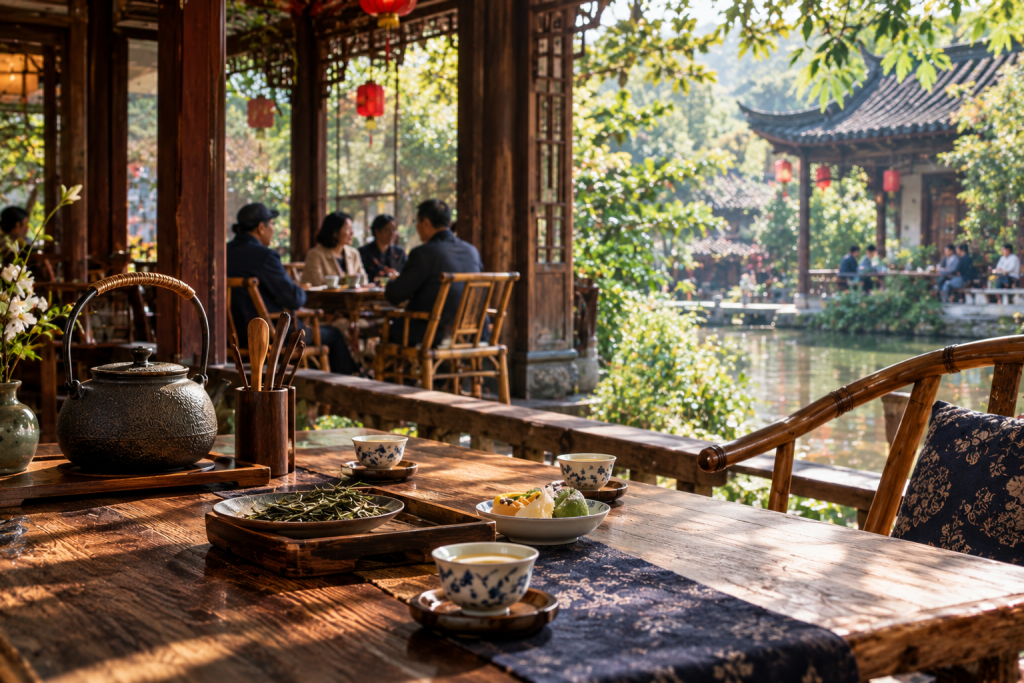
A Chinese tea house is more than a place to drink tea.
For centuries, tea houses have provided spaces where people could meet friends, welcome guests, conduct conversations, enjoy performances, rest after a long day, or simply sit quietly with a cup of tea.
The tea itself is important, but it is only part of the experience.
What makes a Chinese tea house interesting is everything that happens around the tea.
People talk.
They listen.
They watch.
They eat.
They meet old friends.
Sometimes, they do almost nothing at all.
In a rapidly changing China, modern tea houses can look very different from their historical counterparts. Some are traditional and quiet, while others are contemporary spaces designed around tea, food, design, and social experiences.
Yet the basic idea remains familiar:
A tea house creates a place where people can slow down and spend time together.
What Is a Chinese Tea House?
A Chinese tea house, or cháguǎn (茶馆), is traditionally a place where people gather to drink tea.
But describing it simply as a place that serves tea misses much of its cultural and social role.
Historically, tea houses could function as informal public spaces. Depending on the period and region, people might come to drink tea, meet acquaintances, exchange news, listen to storytelling, watch performances, play games, or conduct business.
Unlike a formal ceremony, visiting a tea house did not necessarily require special knowledge of tea.
You could simply sit down and enjoy a drink.
This everyday accessibility is an important part of Chinese tea house culture.
Tea did not always need to be complicated.
Sometimes it was simply part of ordinary life.
Tea Houses and Chinese Social Life
One of the most interesting things about traditional tea houses is their connection with Chinese social life.
A tea house can create a neutral space between home and work.
At home, people have family responsibilities. At work, they have professional roles. A tea house offers somewhere different—a place where friends, neighbors, colleagues, and acquaintances can meet more casually.
A conversation over tea can last for a few minutes or several hours.
There is no need to rush through the experience.
This makes tea houses especially interesting from the perspective of Chinese lifestyle.
They show that leisure does not always mean entertainment.
Sometimes leisure simply means having time to sit with other people.
A Place for Conversation
Tea houses have traditionally been associated with conversation.
Friends might discuss family matters, local events, business, sports, food, or everyday problems. Older generations might exchange stories and memories. Younger people might meet after work or school.
The subject of conversation is not necessarily important.
The act of spending time together is.
This is one reason tea houses can feel different from restaurants.
At a restaurant, food often structures the experience. People order, eat, and eventually leave.
At a tea house, the tea may encourage a slower rhythm.
A pot of tea can be refilled.
Another cup can be poured.
The conversation continues.
The table becomes a small social world.
Tea Houses and Hospitality
Tea has long been associated with Chinese hospitality, and tea houses extend this tradition into a public setting.
Offering tea to a guest is a simple gesture of welcome in many Chinese households. A tea house transforms that idea into a shared social experience.
The setting may be modest or luxurious.
A traditional tea house might have wooden furniture, Chinese calligraphy, porcelain cups, and quiet music. A modern tea space might combine traditional tea with contemporary architecture and minimalist design.
The visual style can change, but the underlying experience is similar:
Tea creates an invitation to stay.
This is one reason tea fits naturally into Chinese social culture.
Traditional Tea Houses and Entertainment
Historically, some tea houses offered much more than tea.
In different regions and periods, they could become places for entertainment and public culture. Storytelling, opera, music, puppetry, and other forms of performance could be connected with tea-house life.
This was particularly visible in places with strong tea-house traditions.
The tea house could therefore function as a small cultural center.
People did not necessarily visit because they wanted to study tea.
They visited because something was happening there.
Tea provided the foundation, while conversation and entertainment made the space socially alive.
Chengdu and the Culture of Relaxed Tea Drinking
One of the best-known examples of tea-house culture can be found in Chengdu, in Sichuan Province.
Traditional tea houses have long been part of the city’s social landscape. People may sit outdoors or under shaded spaces, drink tea, chat with friends, play mahjong, read, or simply relax.
The famous bamboo chairs often associated with Sichuan tea houses have become part of the visual image of this lifestyle.
But the important point is not the furniture.
It is the rhythm.
A person can sit down with a cup of tea and spend a considerable amount of time without needing to accomplish anything.
This offers an interesting perspective on everyday life in China.
In a society often described through rapid economic growth and busy urban life, there are also traditions that make space for doing less.
Tea Houses in Different Parts of China
Chinese tea house culture is not identical everywhere.
China’s regional diversity means that tea houses have developed different styles, customs, and atmospheres.
In Sichuan, tea houses have strong associations with relaxed social life.
In southern and southeastern regions, tea traditions can be closely connected with local tea production and regional drinking customs.
In cities such as Hangzhou, tea culture is naturally connected with the famous tea-growing landscape surrounding West Lake.
In other cities, modern tea houses may combine traditional tea with food, art, design, music, or contemporary lifestyle experiences.
There is therefore no single model of a Chinese tea house.
Some are deeply traditional.
Some are modern.
Some are designed for quiet personal time.
Others are lively social spaces.
Tea Houses and Leisure
Modern life often divides time into work and entertainment.
Tea houses suggest another possibility: simply spending time.
You do not necessarily need a major activity.
You can drink tea.
Look outside.
Talk to a friend.
Read a book.
Play a traditional game.
Watch people passing by.
Or sit quietly.
This is one reason tea houses fit naturally into the broader idea of Chinese leisure culture.
Leisure does not always have to be productive.
A quiet afternoon with tea can be valuable precisely because nothing important has to happen.
Tea, Food, and the Social Table
Tea houses also connect naturally with Chinese food culture.
Tea may be served with small snacks, pastries, fruit, noodles, dumplings, or regional specialties depending on the establishment.
This creates an experience somewhere between drinking and dining.
The relationship between tea and food also reflects the wider role of the table in Chinese life.
As discussed in our earlier article on The Chinese Dining Table, food often creates an opportunity for people to gather and communicate.
Tea works in a similar way.
The difference is that tea can extend the experience.
A meal may last an hour.
Tea can last an afternoon.
Tea Houses and Chinese Tea Culture
It is useful to distinguish Chinese tea culture from tea-house culture.
Chinese tea culture includes the history of tea, different tea varieties, preparation methods, tea ware, aesthetics, traditions, and cultural meanings.
A tea house is where some of these ideas become part of everyday life.
You might encounter green tea, oolong tea, black tea, white tea, yellow tea, or dark tea.
You might see porcelain cups, clay teapots, bamboo trays, or other traditional tea ware.
But you do not need to understand all of these things to enjoy the experience.
A tea house makes tea culture accessible through ordinary life.
Traditional and Modern Tea Houses
Today’s Chinese tea houses are changing along with Chinese cities.
Some contemporary tea spaces have minimalist interiors, carefully designed furniture, modern tea menus, specialty desserts, and sophisticated branding.
Others deliberately recreate traditional environments with wooden structures, calligraphy, gardens, porcelain, and classical music.
There are also tea spaces that combine tea with bookstores, art galleries, cultural events, or creative communities.
This evolution shows something important about tradition.
Tradition does not necessarily mean preserving everything exactly as it was.
It can also mean finding new ways for old practices to remain relevant.
The modern tea house is one example of how an ancient drink continues to find a place in contemporary Chinese life.
Tea Houses and the Pace of Life
Perhaps the most interesting thing about a tea house is its relationship with time.
Modern urban life is often organized around schedules.
Meetings begin at a certain time.
Messages require immediate replies.
Work moves quickly.
People travel from one place to another.
A tea house offers a different rhythm.
You sit down.
The tea arrives.
You pour a cup.
You drink.
You talk.
Then you pour another.
Nothing has to happen immediately.
This does not mean that Chinese people always live slowly. Modern China is energetic, urban, and fast-moving.
But alongside that speed exists a desire for moments of rest.
Tea houses provide one place where that desire can become part of everyday life.
Are Tea Houses Only for Traditional Culture?
No.
This is an important distinction.
A tea house should not be understood only as a museum of traditional Chinese culture.
For many people, it is simply a place to spend time.
Young people may visit contemporary tea spaces with friends. Older people may prefer familiar neighborhood tea houses. Tourists may visit traditional establishments to experience local culture.
Different people can use the same type of space for completely different reasons.
That flexibility is part of its strength.
The tea house survives because it can adapt.
What a Chinese Tea House Reveals About Chinese Lifestyle
Looking at a Chinese tea house from the outside, you might see tea, traditional furniture, porcelain cups, and perhaps a beautiful garden.
But looking more closely reveals something deeper.
You see people making time for relationships.
You see hospitality expressed through a simple drink.
You see friends meeting without needing a special occasion.
You see older traditions adapting to modern cities.
And you see the value of slowing down, even within a fast-changing society.
This is why the tea house belongs naturally in a discussion of Chinese lifestyle.
It is not simply about tea.
It is about how people use time.
A Place to Slow Down
Perhaps the simplest way to understand a Chinese tea house is this:
It is a place where tea gives people a reason to stay.
The tea may be excellent, but the experience is larger than the drink.
A conversation may begin with tea and move toward family, work, memories, food, travel, or simply everyday life.
A friendship may grow around a shared table.
A visitor may discover a local tradition.
Someone may spend an entire afternoon doing almost nothing.
And that is perfectly acceptable.
In the middle of modern life, a tea house creates a small space where people can pause.
Looking Deeper Into Chinese Lifestyle
The story of Chinese lifestyle is not only found in major festivals, famous landmarks, or ancient traditions.
It can also be found in ordinary places.
A dining table.
A neighborhood market.
A park in the morning.
A family kitchen.
And a tea house where people sit together for an afternoon.
These places reveal how culture becomes part of everyday life.
A cup of tea may seem simple.
But when it creates time for conversation, friendship, hospitality, and rest, it becomes something more.
It becomes part of the way people live.
Sometimes, understanding a culture begins with simply sitting down and sharing a cup of tea.