
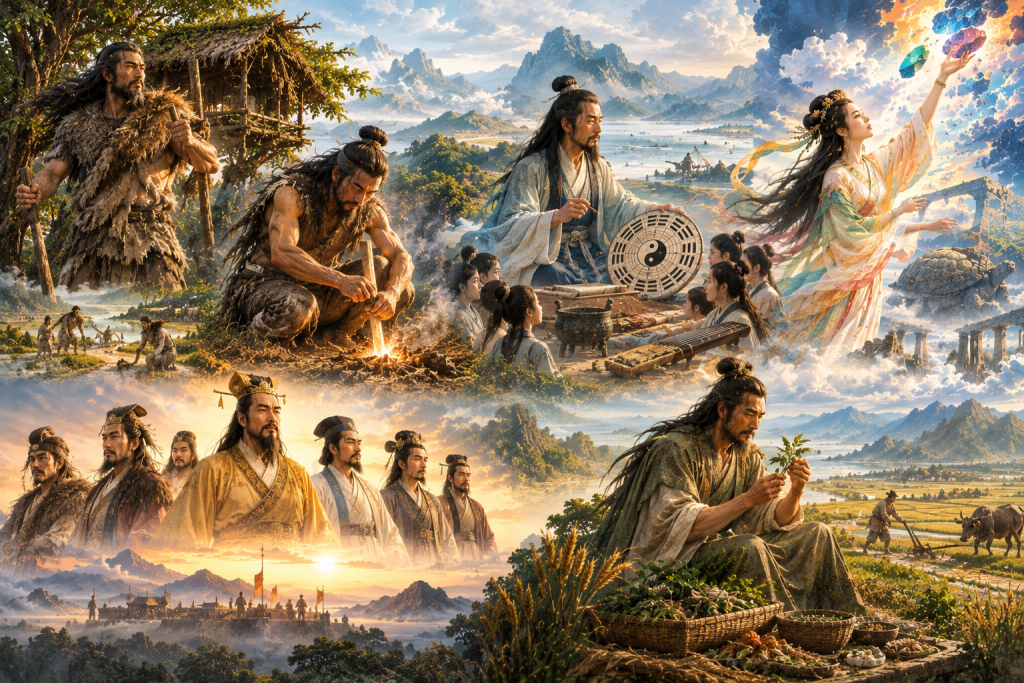
The Five Emperors of Ancient China: Huangdi, Zhuanxu, Emperor Ku, Yao, and Shun
Long before the rise of the Xia Dynasty, Chinese traditions preserved stories about a series of legendary rulers who were remembered as important ancestors and leaders of the early Chinese world.
Among them were Huangdi, the Yellow Emperor; Zhuanxu; Emperor Ku; Yao; and Shun. Together, these five figures became known in later historical tradition as the Five Emperors.
The Five Emperors belong to the legendary period of ancient Chinese history. Their stories were recorded and developed through generations of oral traditions and later written texts, especially works such as the Shiji (Records of the Grand Historian). Different ancient sources sometimes give different lists of the Five Emperors, but the tradition established by Sima Qian’s Shiji became particularly influential.
Rather than treating these stories as fully documented historical events, it is more useful to see them as part of China’s legendary history—stories through which later generations remembered the origins of political authority, tribal alliances, cultural practices, and civilization.
Huangdi: The Yellow Emperor
At the beginning of the traditional Five Emperors sequence stands Huangdi, commonly known in English as the Yellow Emperor.
According to ancient tradition, Huangdi belonged to a powerful tribal group that eventually became associated with the central regions of ancient China. His traditional surname was Ji, and he was also known by names such as Xuanyuan and Youxiong.
Many stories about Huangdi describe him as a culture hero as well as a legendary ruler. Later traditions credited him and his followers with a wide range of achievements, including the development of weapons, boats, carts, bows and arrows, clothing, and other technologies.
Other famous figures were also connected with his age. Leizu, traditionally described as Huangdi’s wife, was associated with the discovery and development of silk production. Cangjie was traditionally remembered as the creator or organizer of Chinese writing, while Danao was associated with the traditional heavenly stems and earthly branches used in Chinese calendrical systems.
These stories should be understood as later cultural traditions rather than evidence that one historical individual personally invented all of these technologies. For example, the legend of Cangjie creating Chinese characters is recorded in ancient literature, but scholars have not been able to establish him as the historical inventor of the Chinese writing system. Chinese writing developed over a long period of time.
Huangdi, Yandi, and Chiyou
One of the most famous parts of the Huangdi tradition concerns conflicts between different tribal groups.
According to traditional accounts, Huangdi, Yandi, and Chiyou were associated with powerful groups in the legendary landscape of ancient China.
The best-known story is the Battle of Zhuolu, in which Huangdi is said to have fought Chiyou. Chiyou is portrayed in later mythology as a powerful leader associated with the Jiuli.
Huangdi’s victory over Chiyou became one of the most important stories associated with the legendary formation of the Chinese world. Later traditions also describe conflicts between Huangdi and Yandi, particularly the Battle of Banquan.
These stories are not straightforward historical records. They have been interpreted by later historians and scholars as symbolic memories of conflict, migration, alliance, and integration among different prehistoric communities. The tradition of Huangdi as a common ancestor also became increasingly important in later Chinese history.
Zhuanxu: The Second of the Five Emperors
The second figure in the traditional sequence is Zhuanxu, also known as Gaoyang.
According to traditional genealogies, Zhuanxu was a descendant of Huangdi through Huangdi’s son Changyi. He was associated with Diqu, traditionally identified with an area around present-day Puyang in Henan.
Legends about Zhuanxu emphasize his role in establishing order and regulating religious and social practices.
One traditional story describes the earlier Jiuli communities as continuing practices associated with shamanism and the worship of multiple spirits. Zhuanxu was later said to have reorganized or restricted these practices and promoted a more unified religious order.
These accounts reflect how later writers understood the development of political and religious authority in early China. They should not be read as precise descriptions of a historical religious reform.
Zhuanxu was also placed at the center of several important ancestral genealogies. Later traditions connected various ancient peoples and ruling houses to his descendants, including the lineages of Shun and Yu the Great.
Emperor Ku: The High Ancestor
The third figure was Emperor Ku, also known as Gaoxin.
Traditional genealogy describes Emperor Ku as a descendant of Huangdi and associates him with the central plains of ancient China.
The stories surrounding Emperor Ku are particularly important because later traditions connected him with the ancestors of several major groups and dynasties.
According to traditional accounts, Emperor Ku had several wives, whose sons became important ancestral figures.
Jiang Yuan gave birth to Hou Ji, who later became associated with the origins of the Zhou people.
Jian Di gave birth to Xie, traditionally regarded as an ancestor of the Shang people.
Another wife, Qingdu, was said to have given birth to Yao, while Changyi was associated with another son, Zhi.
These genealogies are part of a much larger tradition that connected the legendary rulers of early China with the ancestors of later dynastic peoples. The Shiji and other historical traditions played an important role in organizing these genealogical relationships.
Yao: The Wise Ruler
The fourth of the Five Emperors was Yao, traditionally known as Tang Yao or Taotang.
According to traditional accounts, Yao was a son of Emperor Ku and ruled from Pingyang, traditionally associated with present-day Linfen in Shanxi.
Yao became one of the most admired rulers in Chinese tradition.
He was remembered not simply because he held power, but because he was said to place the interests of the people above his own comfort.
Later stories describe Yao as living a simple life rather than surrounding himself with luxury. His reputation became associated with humility, virtue, good government, and concern for ordinary people.
One of the most important stories about Yao concerns his decision about succession.
Yao’s son, Danzhu, was traditionally described as unfit to inherit the position of ruler. Rather than automatically passing power to his own son, Yao is said to have chosen Shun, a man regarded as virtuous and capable.
This story became one of the most famous examples of abdication in ancient Chinese tradition.
The idea that Yao selected Shun because of his ability and virtue became an important model of political legitimacy in later Chinese thought. Modern historians generally treat the story as part of the legendary tradition surrounding early political succession rather than as a fully documented historical event.
Shun: The Virtuous Successor
The fifth of the Five Emperors was Shun, traditionally known as Yu Shun or Yushun.
According to traditional accounts, Shun was descended from Zhuanxu and was associated with the Youyu clan.
Stories about Shun emphasize two qualities above all: filial devotion and moral character.
Traditional narratives describe Shun as a person who remained respectful toward his parents despite suffering difficult treatment from his family.
His reputation for patience, responsibility, and virtue eventually brought him to the attention of Yao.
Yao is said to have tested Shun’s character and abilities before selecting him as his successor. In traditional accounts, Yao even married his two daughters to Shun, partly as a way of observing his character and abilities.
Shun later became known for selecting capable people to help govern the realm.
Among them was Yu, who became famous for his efforts to control devastating floods.
According to tradition, Shun eventually passed his position to Yu rather than to his own son, Shangjun.
This created another famous example of the ideal of selecting a capable ruler rather than simply passing political power directly to one’s own descendants.
Yao, Shun, and Yu: The Tradition of Abdication
The stories of Yao, Shun, and Yu form one of the most important parts of China’s legendary history.
Yao was said to have selected Shun instead of his own son.
Shun was later said to have selected Yu instead of his own son.
This tradition is known as shanrang, or the ideal of political abdication and succession based on virtue and ability.
In these stories, political authority was not necessarily treated as a personal possession that had to remain within one family.
Instead, the ideal ruler was the person considered most capable of protecting the people and maintaining order.
This idea had a profound influence on later Chinese political philosophy.
At the same time, it is important to remember that the stories of Yao, Shun, and Yu were preserved in ancient texts written much later than the period they describe. Their exact historical details cannot be established with certainty.
What matters historically is not only whether every event happened exactly as described, but also how these stories shaped Chinese ideas about good government, moral leadership, political legitimacy, and the relationship between rulers and the people.
The Five Emperors and the Origins of Chinese Civilization
The stories of the Five Emperors stand at an important point between Chinese mythology and early historical tradition.
Huangdi represents the legendary origins of powerful tribal alliances and the cultural memory of a common ancestor.
Zhuanxu represents order, authority, and the organization of religious and social practices.
Emperor Ku connects different legendary lineages and later traditions concerning the ancestors of the Shang, Zhou, and other peoples.
Yao represents the ideal of a wise and virtuous ruler.
Shun represents moral character, filial devotion, merit, and the ideal of choosing a capable successor.
Together, these figures became part of a powerful narrative about how early Chinese society moved from legendary tribal communities toward increasingly organized political structures.
Traditional Chinese histories later placed the Five Emperors before the Xia Dynasty, creating a narrative sequence from the legendary age to the earliest dynastic period.
Modern archaeology cannot simply confirm all of these stories as literal historical events. However, archaeological discoveries from the late Neolithic period show that complex societies, regional centers, social hierarchies, ritual systems, and long-distance cultural interactions were already developing in China before the traditionally dated dynasties.
For this reason, the Five Emperors are best understood as figures at the intersection of myth, cultural memory, genealogy, and early historical tradition.
From Legendary Rulers to Dynastic China
The stories of the Five Emperors form the next step in the long journey through China’s past.
In the previous stories, ancient Chinese traditions imagined the origins of the world through Pangu, Nuwa, and Kuafu, and then described the origins of human skills and civilization through Youchao, Suiren, Fuxi, Nuwa, and Shennong.
With the Five Emperors, the stories begin to focus more strongly on leaders, tribal alliances, political authority, succession, and the organization of society.
The next stage of the traditional historical narrative leads toward Yu the Great and the Xia Dynasty, traditionally regarded as the beginning of China’s first dynasty.
Whether viewed as historical memory, mythology, or a combination of both, the stories of Huangdi, Zhuanxu, Emperor Ku, Yao, and Shun have played an enormous role in shaping how later generations imagined the origins of Chinese civilization.
They are not simply stories about five ancient rulers.
They are stories about where authority came from, what made a ruler worthy, how different communities became connected, and how the Chinese remembered the distant beginnings of their civilization.