
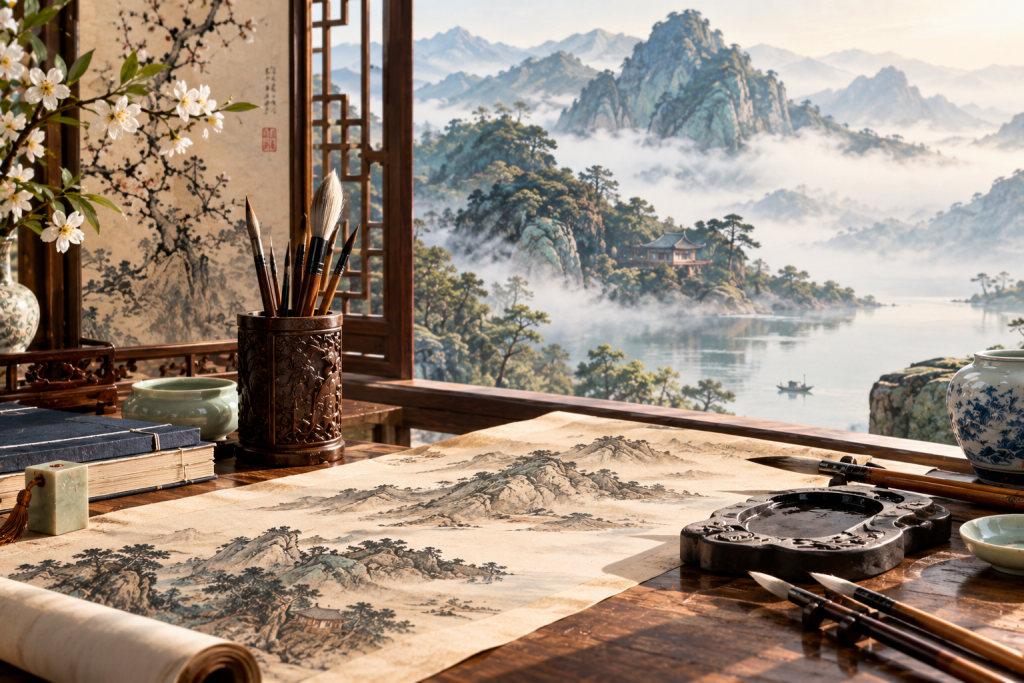
Chinese painting is one of the oldest continuous artistic traditions in the world. For centuries, Chinese artists have used ink, brush, color, silk, and paper to express landscapes, people, flowers, animals, and ideas about nature.
But traditional Chinese painting is more than a way of creating beautiful pictures. It is closely connected to Chinese philosophy, literature, calligraphy, and ideas about harmony and balance. A mountain may represent more than a mountain, while an empty area of paper may be just as important as the painted image itself.
To understand Chinese painting, it is therefore useful to look beyond technique. The real story lies in the way Chinese artists have viewed nature, time, space, and human life.
What Is Chinese Painting?
Chinese painting, traditionally known as guóhuà (国画), refers broadly to the traditional painting traditions that developed in China.
Unlike modern Western painting traditions, which often emphasize perspective, light, and realistic representation, traditional Chinese painting developed its own approaches to space, composition, brushwork, and expression.
Two major traditions are often discussed:
Gongbi painting, known for precise lines, detailed forms, and carefully applied colors.
Xieyi painting, often translated as “写意” or “painting the idea,” which emphasizes expressive brushwork and the spirit of the subject.
There is also shan shui, or Chinese landscape painting, which became one of the most important forms of traditional Chinese art.
These categories should not be treated as completely separate. Chinese artists have experimented with different combinations of ink, color, brushwork, and subject matter throughout history.
The Brush Is More Than a Painting Tool
One of the most important characteristics of traditional Chinese painting is the use of the brush.
Chinese painting shares a close relationship with Chinese calligraphy. Both rely on controlled brush movements, variations in pressure, rhythm, and the quality of the line.
A single brushstroke can be thick or thin, dark or light, wet or dry. The artist does not simply use the brush to fill an area with color. Instead, the movement of the brush becomes part of the artistic expression.
This is why traditional Chinese artists have often spent years practicing basic brush techniques.
The goal is not simply technical accuracy. A good brushstroke should have energy, rhythm, and character.
In this sense, Chinese calligraphy and painting developed together. The brush became both a writing instrument and an artistic instrument.
Ink and the Beauty of Simplicity
Ink is another defining element of traditional Chinese painting.
The famous Chinese ink painting tradition demonstrates how much an artist can express with relatively few colors. Different concentrations of ink can create deep black shadows, soft gray mountains, mist, water, clouds, and distant landscapes.
This approach is sometimes associated with shuǐmò huà (水墨画), or ink-and-wash painting.
Rather than covering every part of the surface, the artist may leave large areas untouched.
This creates one of the most distinctive features of traditional Chinese painting: the importance of empty space.
Empty space does not necessarily mean that nothing is there. It can suggest clouds, mist, water, distance, or simply allow the viewer’s imagination to complete the scene.
The result is often quiet rather than dramatic.
Chinese Landscape Painting and the World of Mountains and Water
Among the most recognizable forms of Chinese art is Chinese landscape painting, or shan shui (山水画).
The term literally means “mountain and water.” Mountains and rivers are not merely subjects to be copied from nature. They form a visual language through which artists explore the relationship between human beings and the natural world.
A traditional landscape may include towering mountains, flowing rivers, trees, waterfalls, clouds, small buildings, and tiny human figures.
The human presence is often deliberately small.
This creates a powerful visual relationship: nature appears vast, while human beings occupy only a small part of the world.
For this reason, Chinese landscape painting is closely connected with traditional Chinese ideas about nature and harmony.
The painting does not always attempt to reproduce one specific location exactly. Instead, the artist may combine observations, memory, imagination, and artistic composition to create an idealized landscape.
Why Mountains Matter in Chinese Painting
Mountains have an especially important place in Chinese culture.
They appear repeatedly in Chinese poetry, philosophy, religion, gardens, and painting. Mountains can represent permanence, strength, distance, spiritual retreat, and the grandeur of nature.
In shan shui painting, mountains may dominate the composition while rivers and valleys create movement through the scene.
A landscape can therefore become a meditation on life itself.
The viewer may imagine traveling through the mountains, following a river, entering a distant village, or stopping at a small pavilion.
This is one reason traditional Chinese landscape paintings can feel almost like journeys rather than static images.
The Influence of Chinese Philosophy
Chinese painting developed alongside major philosophical traditions, including Confucianism, Taoism, and Buddhism.
Taoist ideas have had a particularly strong influence on the way nature is represented.
Rather than seeing nature simply as something to control or conquer, traditional Chinese thought often emphasizes living in accordance with natural processes.
This idea can be seen in landscape painting.
Water flows around obstacles. Mountains remain still. Clouds move through valleys. Trees bend with the seasons.
The painting becomes a visual expression of relationships and balance.
This does not mean that every Chinese painting directly represents Taoist philosophy. Chinese art is far too diverse for such a simple explanation. However, the broader cultural appreciation of harmony between humans and nature is an important part of its history.
The Relationship Between Painting and Poetry
Traditional Chinese painting is also deeply connected to literature.
Many Chinese artists were scholars who practiced painting, calligraphy, poetry, and seal carving. These activities were not always viewed as completely separate disciplines.
A landscape painting might contain a poem written in calligraphy. A painting of flowers might be accompanied by a short inscription. The artist’s signature and seal could become part of the composition.
This combination of Chinese painting, calligraphy, and poetry created a distinctive form of cultural expression.
The image shows the visible world.
The poem adds thought and emotion.
The calligraphy adds movement and personality.
Together, they create something more than a painting.
Gongbi and Xieyi: Two Different Approaches
Two important approaches help explain the diversity of traditional Chinese painting.
Gongbi painting emphasizes precision and detail. Artists use fine brushwork to carefully describe clothing, architecture, flowers, birds, and other subjects. The technique requires patience and control, and colors can be layered carefully to create refined surfaces.
Xieyi, by contrast, emphasizes expressive brushwork and the spirit of the subject. The artist may use fewer strokes, allowing the viewer to understand the character of a flower, bird, or landscape through suggestion rather than detailed description.
Neither approach is simply “better” than the other.
They represent different ideas about how an artist can communicate.
One emphasizes refinement and detail. The other places greater importance on expression, movement, and suggestion.
Chinese Painting and the Idea of Empty Space
Perhaps one of the most interesting aspects of Chinese painting is its treatment of space.
In many traditional landscapes, large areas are intentionally left unpainted.
To a viewer unfamiliar with Chinese art, this may initially look incomplete.
But empty space can perform an important visual function.
It can represent mist, sky, water, distance, or an undefined space beyond the visible landscape. More importantly, it gives the composition room to breathe.
This principle is closely related to the broader Chinese aesthetic appreciation of balance.
What is shown and what is left unseen work together.
The same idea can be found in Chinese gardens, architecture, calligraphy, and traditional design.
Chinese Painting as a Way of Seeing
Traditional Chinese painting is not simply about reproducing what the eye sees.
The artist may observe a landscape from different viewpoints, remember it over time, and then reconstruct it on paper.
This creates a different relationship between painting and reality.
Instead of asking only, “What does this place look like?” the artist may also ask:
What does this place feel like?
That question helps explain why traditional Chinese landscape paintings can combine multiple perspectives or viewpoints.
The goal is not always photographic realism. It is often a deeper understanding of the subject.
From Ancient Masters to Modern Chinese Art
Chinese painting developed through many historical periods, including the Tang, Song, Yuan, Ming, and Qing dynasties.
Each period produced influential artists and different approaches to painting.
The Song Dynasty is especially important in the history of Chinese landscape painting, when monumental landscapes reached remarkable levels of sophistication.
Later artists increasingly explored personal expression, scholarly painting, brushwork, and individual styles.
In modern China, artists have continued to experiment with traditional ink painting while also engaging with Western painting, photography, contemporary art, and new forms of visual expression.
Chinese ink painting is therefore not simply a historical tradition preserved in museums. It continues to evolve.
Why Chinese Painting Still Matters
Chinese painting offers more than beautiful images of mountains, flowers, and ancient landscapes.
It provides a way to understand important ideas in Chinese culture: harmony, balance, nature, simplicity, patience, reflection, and the relationship between the individual and the larger world.
It also demonstrates how different forms of Chinese art can influence one another.
Painting connects with calligraphy.
Calligraphy connects with literature.
Literature connects with philosophy.
Philosophy influences the way artists understand nature.
And nature becomes one of the central subjects of Chinese visual culture.
This interconnectedness is one of the reasons traditional Chinese art remains so important today.
Looking Deeper Into Chinese Art and Craft
To understand Chinese painting is to understand more than a particular artistic technique.
It is to discover a different way of thinking about space, nature, movement, and human experience.
A mountain in a Chinese landscape may be a mountain, but it can also represent distance, permanence, solitude, or the relationship between humanity and nature.
A single brushstroke can suggest movement.
An empty area can suggest infinity.
A small figure can remind us of the vastness of the natural world.
This is the quiet power of Chinese painting.
It does not always tell the viewer exactly what to see. Instead, it creates a space in which the viewer can look, imagine, and reflect.
And perhaps that is one of the most enduring qualities of Chinese art and craft: the deeper we look, the more there is to discover.