
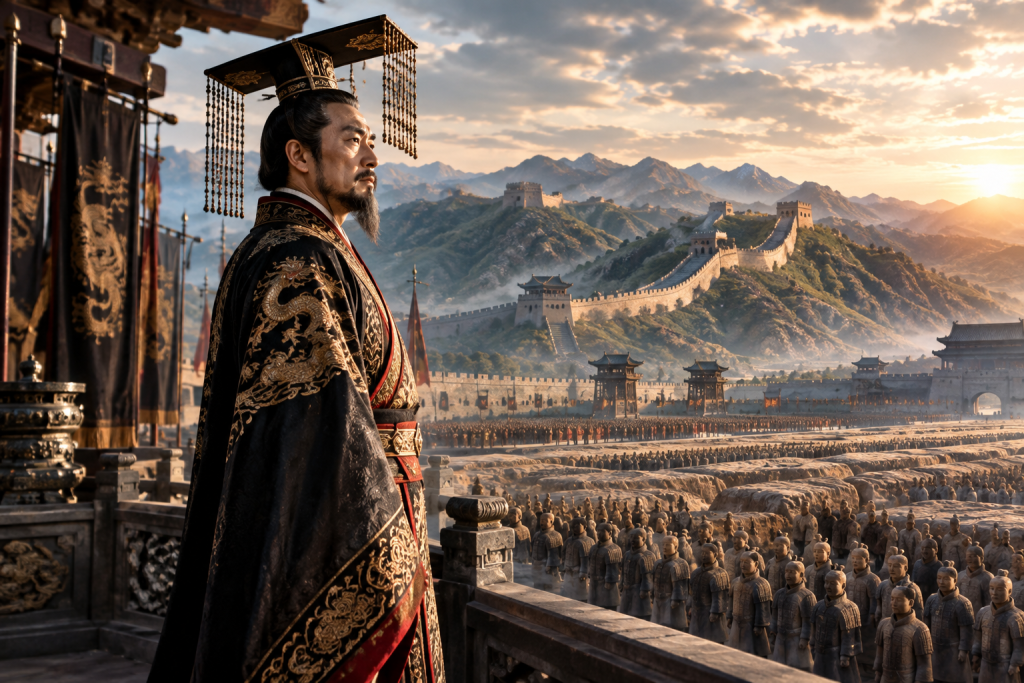
Qin Shi Huang: The First Emperor of China
Few figures in Chinese history transformed the country as dramatically as Qin Shi Huang.
Before his reign, ancient China was divided among competing states that fought for power for centuries. When Qin Shi Huang came to power, he eventually defeated his rivals and united the major states under a single imperial government.
In 221 BCE, he declared himself Qin Shi Huang, meaning the “First Emperor of Qin.” The title marked a new political era. Instead of ruling one kingdom among many, he presented himself as the first emperor of a unified empire.
His reign was short, but his influence lasted for centuries.
The institutions he created, the reforms he introduced, and even the enormous monuments associated with his name became part of China’s historical memory.
But who was Qin Shi Huang, and why does the First Emperor remain such a controversial and fascinating figure?
Who Was Qin Shi Huang?
Qin Shi Huang was born as Ying Zheng in 259 BCE, during the final centuries of the Eastern Zhou period.
At the time, China was in the middle of the Warring States period, when several powerful states competed for territory and political dominance.
Ying Zheng became king of Qin while still very young. Qin was one of the strongest states of the period, supported by military power and a highly organized political system.
Over the following years, Qin defeated its major rivals one after another.
By 221 BCE, the remaining independent states had fallen.
Ying Zheng had achieved something that earlier rulers had struggled to accomplish: political unification across much of the Chinese heartland.
He then adopted a new title—Qin Shi Huang, the First Emperor of Qin.
This moment traditionally marks the beginning of imperial China.
The Unification of China
The most important achievement associated with Qin Shi Huang was the unification of the major states.
Before Qin’s victory, different states had their own rulers, administrative systems, currencies, measurements, and writing conventions.
The Qin government attempted to replace this political fragmentation with a centralized imperial system.
The empire was divided into administrative units governed by officials appointed by the central government rather than hereditary local rulers.
This reduced the independence of regional aristocrats and strengthened imperial authority.
The Qin model became extremely influential.
Although the Qin Dynasty itself lasted only a short time, later dynasties adapted many of its administrative ideas.
In this sense, the importance of Qin Shi Huang was not simply that he conquered other states.
He helped establish a model of centralized imperial government that influenced Chinese history for more than two thousand years.
Standardizing the Empire
Unification required more than military conquest.
The Qin government introduced a series of standardizations intended to make the new empire easier to govern.
These included systems of:
weights and measures
currency
writing
laws
administrative practices
The standardization of writing was particularly important.
Different states had developed regional forms of written characters. The Qin administration promoted a standardized script for official use, helping communication across the newly unified territory.
The Qin also standardized measurements and promoted a common currency.
These reforms made economic activity and administration more consistent across the empire.
The process was not simply cultural uniformity in the modern sense. It was also a practical tool of government.
A centralized state needed systems that could function across a very large territory.
Qin Shi Huang and the Great Wall
One of the most famous structures associated with Qin Shi Huang is the Great Wall of China.
However, the common image of Qin Shi Huang ordering the construction of the entire Great Wall is misleading.
Walls and defensive fortifications had already been built by different states during the Warring States period.
After unification, the Qin government connected, repaired, and expanded sections of these earlier defenses, particularly along the northern frontier.
These projects helped protect the empire from northern groups and created a larger defensive network.
The Great Wall that visitors see today is largely the result of construction and rebuilding under much later dynasties, especially the Ming Dynasty.
Therefore, Qin Shi Huang should be understood as an important figure in the early history of the Great Wall, rather than its sole builder.
The Terracotta Army
Perhaps the most spectacular archaeological legacy of Qin Shi Huang is the Terracotta Army.
Thousands of life-sized clay figures were buried near the emperor’s mausoleum at present-day Xi’an.
The figures include soldiers, horses, chariots, and other military figures.
They were created as part of a vast funerary complex intended to accompany and protect the emperor in the afterlife.
The discovery of the Terracotta Army in 1974 revealed the extraordinary scale of Qin imperial power and craftsmanship.
The figures also provide valuable information about Qin military organization, weapons, clothing, and artistic production.
For modern visitors, the Terracotta Army has become one of the most recognizable symbols of Qin Shi Huang and ancient China.
Yet its original meaning was much deeper.
The enormous underground army reflects the emperor’s belief in the continuation of imperial power beyond death and the importance of preparing for the afterlife.
A Powerful but Harsh Government
The achievements of Qin Shi Huang came at a considerable human cost.
The Qin state relied heavily on laws, punishments, compulsory labor, taxation, and military service.
Large numbers of people were mobilized for construction projects, including roads, palaces, defensive works, and the emperor’s enormous mausoleum complex.
The political philosophy commonly associated with Qin government was Legalism, which emphasized strict laws, strong authority, and disciplined administration.
This approach helped Qin build a highly centralized state.
But it also created widespread resentment.
Later historical writers, especially those writing under the Han Dynasty, often portrayed Qin Shi Huang as a cruel and authoritarian ruler.
These accounts are important historical sources, but they were also written after the Qin Dynasty had fallen and were influenced by later political perspectives.
The historical Qin Shi Huang was therefore more complicated than either a purely heroic unifier or a simple tyrant.
Qin Shi Huang and Books
Qin Shi Huang is also associated with the famous story of burning books and burying scholars.
Traditional accounts describe policies against certain texts and intellectual traditions, particularly works considered politically or socially disruptive by the Qin government.
The traditional story has become one of the best-known examples of censorship in Chinese history.
However, modern historians have debated the scale, exact nature, and details of these events.
It is therefore better to avoid presenting every traditional account as an unquestioned historical fact.
What is much clearer is that the Qin state attempted to control intellectual and political life and strongly favored a centralized ideological and administrative order.
This remains an important part of the complicated legacy of the First Emperor of China.
The Emperor Who Sought Immortality
Despite his immense political power, Qin Shi Huang could not escape one of the oldest human concerns: death.
In his later years, he became increasingly interested in finding a way to extend his life.
He sent expeditions in search of legendary medicines or places associated with immortality.
These efforts were connected to religious and magical traditions of the period.
Ironically, the emperor who had conquered much of the known Chinese world could not conquer death.
Qin Shi Huang died in 210 BCE while traveling through the empire.
He was buried in the enormous mausoleum complex near modern Xi’an.
The central burial chamber itself has not been fully excavated, and ancient accounts describe an extraordinary underground complex.
The nearby Terracotta Army gives only a glimpse of the scale of the emperor’s preparations for the afterlife.
Why Did the Qin Dynasty Fall So Quickly?
The Qin Dynasty did not survive long after Qin Shi Huang’s death.
His successor faced political instability, rebellion, and growing resistance.
The harshness of Qin rule, heavy labor demands, taxation, and political conflict contributed to the collapse of the dynasty.
By 206 BCE, the Qin Dynasty had fallen.
At first glance, this may seem like a failure.
But the historical importance of Qin Shi Huang cannot be measured simply by the length of his dynasty.
The political system he established provided a powerful model for later rulers.
The Han Dynasty, which followed, rejected some of the harshest aspects of Qin rule but retained and developed many centralized administrative structures.
This created an important historical pattern:
The Qin unified the empire; the Han helped consolidate it.
Qin Shi Huang’s Lasting Legacy
The legacy of Qin Shi Huang is one of the most complex in Chinese history.
He unified territories that had previously been divided among competing states.
He established a centralized imperial government.
He promoted standardized writing, currency, weights, and measurements.
He expanded infrastructure and connected earlier defensive walls.
He created an imperial system that later dynasties would adapt and transform.
At the same time, his government was highly authoritarian, and many of his projects depended on enormous amounts of forced labor.
This dual legacy explains why Qin Shi Huang remains such a fascinating figure.
He can be remembered as a nation-builder, an authoritarian ruler, an ambitious emperor, or all three at once.
Qin Shi Huang and the Beginning of Imperial China
The story of Qin Shi Huang is ultimately larger than the story of one emperor.
His reign represented a major transformation in the history of China.
The centuries of political competition during the Warring States period gave way to a centralized imperial state.
The Qin Dynasty was short-lived, but the idea of a unified Chinese empire proved remarkably durable.
For more than two thousand years, successive dynasties would rule over territories that were repeatedly unified, divided, and reunified.
The institutions and political ideas developed during the Qin period became part of this longer history.
That is why Qin Shi Huang is important.
He did not create everything that followed, and the China of later dynasties was very different from the Qin Empire.
But his reign established a political framework that became one of the defining features of traditional Chinese history.
Looking Deeper Into Qin Shi Huang
Qin Shi Huang stands at a turning point between the world of the Warring States and the world of imperial China.
His story contains conquest and construction, political innovation and repression, ambition and fear of death.
He unified China, but his dynasty quickly collapsed.
He sought to create an empire that would last for generations, yet the system he built had to be reshaped by those who came after him.
That contradiction is part of what makes him so important.
To understand Qin Shi Huang is to understand not only one of the most powerful Chinese emperors, but also a crucial moment when a divided political landscape was transformed into an imperial state.
And the legacy of that transformation continues to shape how the history of China is understood today.