
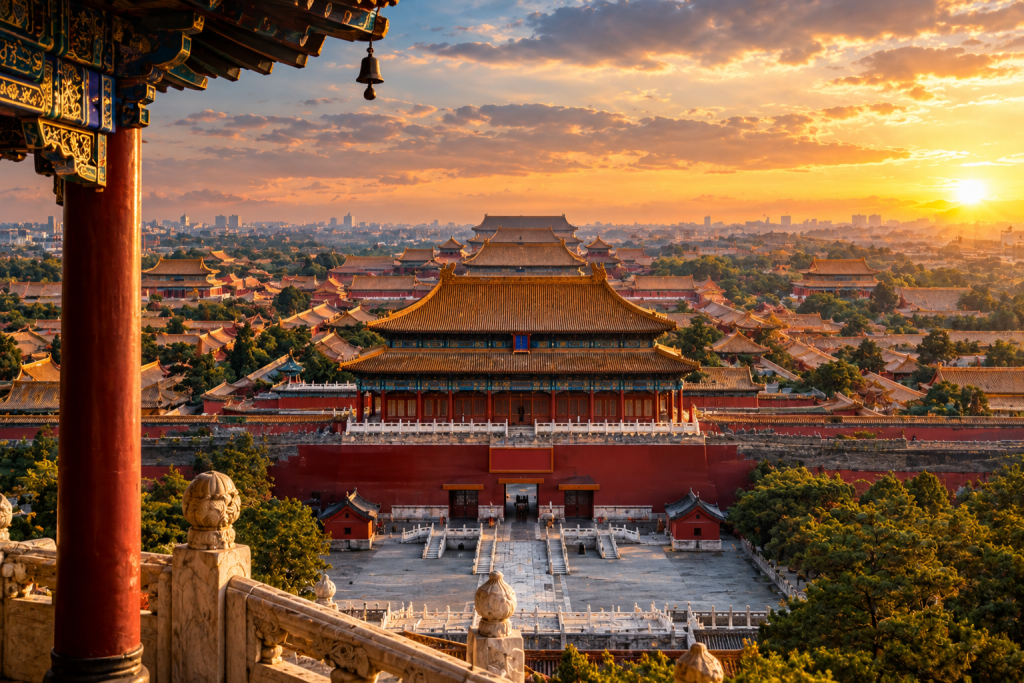
For nearly five centuries, the Forbidden City stood at the political and ceremonial center of imperial China.
Located in the heart of Beijing, this enormous palace complex was home to emperors, their families, court officials, and servants during the Ming and Qing dynasties. Behind its walls, decisions that shaped Chinese history were made, ceremonies were performed, and imperial life followed a highly organized system of rules and traditions.
Today, the Forbidden City is one of China’s most important historical landmarks and one of the best-preserved imperial palace complexes in the world.
But the Forbidden City is more than a collection of magnificent buildings.
Its architecture reveals how imperial China understood power, order, hierarchy, tradition, and the relationship between humanity and the cosmos.
To walk through the Forbidden City is therefore to enter a physical representation of the political and cultural world of ancient China.
What Is the Forbidden City?
The Forbidden City is a vast imperial palace complex in central Beijing. It was the principal imperial residence and ceremonial center of China from the early 15th century until the end of the Qing Dynasty in 1912.
Construction began in 1406, during the reign of the Yongle Emperor of the Ming Dynasty, and the main complex was largely completed around 1420.
For centuries, ordinary people were generally not allowed to enter the palace without official permission. This restricted access gave the complex its famous name: the Forbidden City.
The palace contains thousands of rooms and buildings arranged around courtyards, gates, halls, gardens, and ceremonial spaces.
Today, the site is officially known as the Palace Museum, and it houses an enormous collection of Chinese art and cultural treasures.
Why Was the Forbidden City Built?
The construction of the Forbidden City was closely connected with the Ming Dynasty’s decision to establish Beijing as the imperial capital.
After becoming emperor, the Yongle Emperor moved the political center of the Ming Empire from Nanjing to Beijing.
A new imperial palace was required to represent the authority of the emperor and provide a central location for government, ceremonies, and court life.
The location and design were carefully planned.
The palace was positioned along Beijing’s central north-south axis, an arrangement that later became one of the defining characteristics of the city’s historic landscape.
The enormous scale of the complex reflected the power and resources of the imperial state.
Its architecture was not designed simply for comfort. Every major element had political and symbolic meaning.
The Outer Court and Inner Court
One of the most important features of the Forbidden City is its division between the Outer Court and the Inner Court.
The Outer Court was primarily associated with official ceremonies and state affairs.
Its most famous buildings include the:
Hall of Supreme Harmony
Hall of Central Harmony
Hall of Preserving Harmony
The Hall of Supreme Harmony is the largest ceremonial hall in the Forbidden City. Major imperial ceremonies took place here, including important occasions associated with the emperor’s reign.
Behind the Outer Court was the Inner Court.
The Inner Court was more closely associated with the emperor’s residence and daily life, as well as the imperial family.
Its central buildings include the:
Palace of Heavenly Purity
Hall of Union
Palace of Earthly Tranquility
This distinction between public ceremony and private life reflects the highly structured organization of imperial society.
The Emperor at the Center
The Forbidden City was designed around the emperor.
In the political system of imperial China, the emperor occupied the highest position within the state hierarchy. His authority was connected not only with government but also with traditional ideas about the relationship between Heaven, Earth, and human society.
The architecture of the palace reinforced this central position.
The main halls are arranged along a central axis, with increasingly important buildings placed according to carefully established principles of hierarchy and symmetry.
The emperor was therefore not simply living inside a palace.
The palace itself expressed an idea of political order.
Visitors moving through its gates and courtyards encountered a carefully controlled sequence of spaces, from outer areas to increasingly restricted inner ones.
Architecture became a language of authority.
Chinese Architecture and the Meaning of Color
The visual appearance of the Forbidden City is one of its most recognizable features.
Golden glazed roof tiles dominate many of the major buildings. Red walls and wooden structures create a strong contrast, while white stone terraces and carved details add another layer of visual complexity.
These colors were not chosen randomly.
Yellow was strongly associated with imperial authority during the Ming and Qing periods, while red carried associations with auspiciousness and celebration in traditional Chinese culture.
The architecture also follows principles of symmetry and proportion.
Large courtyards create spacious ceremonial environments, while raised terraces and monumental stairways emphasize the importance of major buildings.
Decorative details can also reveal hierarchy.
The number and arrangement of certain roof ornaments, for example, could indicate the status of a building.
The result is an architectural system in which decoration, structure, color, and space work together.
The Central Axis of Beijing
The Forbidden City is part of a much larger urban design.
Its central north-south axis became an important organizing feature of historic Beijing. Major structures and ceremonial spaces were arranged in relation to this axis.
This arrangement reflected traditional Chinese ideas about order and hierarchy.
The emperor’s palace occupied the symbolic center of political life, while other institutions and urban spaces were positioned around it.
The relationship between the Forbidden City and Beijing therefore shows that Chinese architecture was not simply about individual buildings.
Cities themselves could be designed to express political ideas.
The Forbidden City remains one of the clearest examples of this relationship between architecture, urban planning, and imperial power.
The Forbidden City and Traditional Chinese Culture
The palace also reflects ideas that developed through centuries of Chinese history.
Confucian traditions placed considerable importance on hierarchy, responsibility, ritual, and social relationships. These ideas influenced the organization of imperial ceremonies and court life.
Traditional Chinese cosmology also shaped the symbolic language of the palace.
The number nine, for example, had special associations with imperial authority in traditional culture, and groups of nine appear in various architectural and decorative contexts.
The palace’s north-south orientation, symmetrical layout, ceremonial sequence, and relationship with the surrounding city all contributed to an environment designed to communicate order.
This does not mean that every feature of the Forbidden City can be reduced to a single philosophical idea.
Rather, the palace represents the interaction of architecture, political institutions, ritual traditions, cosmology, and artistic culture.
Life Inside the Forbidden City
Although the Forbidden City is often imagined as the private world of emperors, life inside the palace involved a large and highly organized community.
The emperor and members of the imperial family lived there alongside officials, servants, guards, craftsmen, and court personnel.
Daily life followed strict rules.
Ceremonies, audiences, meals, religious activities, appointments, and personal routines were all influenced by the requirements of court life.
For imperial family members, the palace could provide extraordinary luxury, but it could also be a highly controlled environment.
Personal freedom was limited by rank, custom, and political expectations.
The Forbidden City was therefore both a residence and an institution.
The Qing Dynasty and a Changing Empire
The Forbidden City continued to serve as the imperial center after the Qing Dynasty established rule over China in the 17th century.
The Qing rulers, who originated from Manchu society in northeastern Asia, adopted and modified many institutions of the previous Ming imperial system.
The palace continued to function as the center of political and ceremonial life.
During the Qing period, emperors such as Kangxi, Qianlong, and their successors used the Forbidden City as the heart of an empire that included a vast and culturally diverse territory.
The buildings therefore witnessed a long period of political change, cultural development, diplomacy, warfare, and court life.
The End of Imperial China
The Forbidden City’s role changed dramatically in the early 20th century.
The 1911 Revolution ended the Qing Dynasty and led to the establishment of the Republic of China.
Although the last emperor, Puyi, formally abdicated in 1912, he remained living within the palace for a period under special arrangements.
The centuries-long history of imperial rule had come to an end.
In 1925, the former imperial palace was opened as the Palace Museum, allowing the public to enter spaces that had once been restricted to the imperial court.
This transformation marked a new chapter in the history of the Forbidden City.
A place once designed to separate the emperor from ordinary society became a public institution dedicated to preserving and presenting China’s cultural heritage.
The Forbidden City as a Museum
Today, the Palace Museum contains an extraordinary collection of Chinese cultural treasures.
Its collections include paintings, calligraphy, ceramics, jade, furniture, textiles, clocks, religious objects, and objects associated with imperial court life.
These collections provide another way to understand Chinese history.
The buildings show how the imperial court organized space, while the objects reveal aspects of art, craftsmanship, technology, religion, daily life, and international exchange.
For this reason, the Forbidden City is both an architectural monument and a vast cultural archive.
Why Is the Forbidden City Important?
The importance of the Forbidden City goes far beyond its size and beauty.
It preserves an extraordinary physical record of imperial China.
Its buildings show how political power was expressed through architecture. Its collections preserve centuries of Chinese art and craftsmanship. Its layout reflects traditions of ceremony, hierarchy, and urban planning.
Most importantly, the palace provides a way to connect different parts of Chinese history.
The Ming Dynasty built it.
The Qing Dynasty continued to use it.
The final emperor lived there.
The end of imperial China transformed its role.
And today, millions of people visit it as a window into China’s past.
Visiting the Forbidden City Through History
For modern visitors, the most meaningful way to experience the Forbidden City is not simply to count its buildings or photograph its golden roofs.
Look at how the spaces change as you move through the complex.
Notice the enormous ceremonial courtyards of the Outer Court.
Then observe the more intimate spaces of the Inner Court.
Look at the relationship between the palace and Beijing’s central axis.
Pay attention to the roofs, colors, stone carvings, gates, courtyards, and decorative details.
Each element contributes to a larger story about how imperial China imagined authority and order.
The Forbidden City becomes much more interesting when viewed not simply as a tourist attraction, but as a historical document made of wood, stone, brick, color, and space.
A Palace That Tells the Story of China
The Forbidden City is one of the best places to begin understanding imperial China.
The Great Wall tells a story of frontiers, defense, geography, and interaction between different societies.
The Forbidden City tells another story: the story of the empire from its political center.
Here, architecture became a reflection of power.
Ceremony became part of government.
Art became part of court life.
And the organization of space expressed ideas about hierarchy, tradition, and order.
That is why the Forbidden City belongs at the heart of the Places in China section of Zexi Blog.
A place is never only a place.
When we look beyond its walls, the Forbidden City reveals centuries of Chinese history, culture, architecture, craftsmanship, and human experience.
And once you understand what happened inside the palace, you can begin to understand the larger world of imperial China beyond it.