
The Great Wall of China: History, Construction, and Cultural Legacy
The Great Wall of China is one of the most recognizable landmarks in the world. Stretching across mountains, valleys, deserts, and grasslands, it is often seen as a symbol of ancient China and one of the greatest architectural achievements in human history.
But the Great Wall is more than a single monument.
What we call the Great Wall of China today is the result of construction, expansion, rebuilding, and maintenance carried out by different states and dynasties over many centuries. Long before the famous brick walls of the Ming Dynasty appeared, ancient Chinese states were already building defensive walls to protect their territories.
The history of the Great Wall is therefore closely connected with the development of ancient Chinese civilization, warfare, political power, geography, and relations between agricultural and pastoral societies.
To understand the Great Wall is to look deeper into the history of China itself.
What Is the Great Wall of China?
The Great Wall of China refers to a vast system of defensive walls, fortifications, watchtowers, passes, and related structures built across northern China over different historical periods.
It is important to understand that the Great Wall was not built as one continuous wall at one time.
Different states constructed their own defensive walls during the Warring States period, particularly between the 5th and 3rd centuries BCE. These walls served local military and political purposes.
After the unification of China in 221 BCE, Qin Shi Huang, the First Emperor of China, ordered existing northern defensive walls to be connected, repaired, and extended in some areas. This helped create a larger defensive system along the northern frontier.
Later dynasties continued to build and rebuild sections of the wall. The Han Dynasty expanded defenses farther west, while later governments developed their own frontier fortifications.
The sections most familiar to modern visitors were mainly constructed or extensively rebuilt during the Ming Dynasty.
The Great Wall Before Qin Shi Huang
The history of the Great Wall began before the Qin Dynasty.
During the Warring States period, China was divided among competing states. States such as Qin, Zhao, and Yan built defensive walls along their borders and northern frontiers.
These early walls were constructed using locally available materials, including packed earth, stone, and other materials. Their purpose was not simply to defend against one particular enemy. They were part of a broader system of territorial defense.
The geography of northern China played an important role.
Mountains, deserts, grasslands, and river valleys created natural routes through which armies and travelers could move. Defensive walls and fortified passes could help control these strategic routes.
This early history shows why the Great Wall of China should be understood as a developing military system rather than a single architectural project.
Qin Shi Huang and the Early Great Wall
In 221 BCE, Qin Shi Huang unified the major rival states and established the Qin Dynasty, creating the first centralized imperial state in Chinese history.
After unification, northern defenses became an important concern. According to traditional historical accounts, Qin forces under the empire repaired, connected, and extended earlier walls in the north.
The purpose was partly to strengthen frontier defenses and protect agricultural regions from incursions by northern peoples, including the Xiongnu and other groups.
The Qin Great Wall was very different from the famous stone-and-brick structures that visitors see today.
Much of it was built using rammed earth and other locally available materials, particularly in regions where stone was scarce.
The construction required enormous amounts of labor and resources. It became one of the most powerful symbols of the centralized authority of the Qin Empire.
For more about the emperor behind this transformation, see our article on Qin Shi Huang: The First Emperor of China.
The Great Wall During the Han Dynasty
The development of the Great Wall continued during the Han Dynasty, which ruled China from 206 BCE to 220 CE.
The Han faced powerful political and military challenges along the northern frontier. At the same time, the empire expanded westward toward Central Asia.
As a result, Han defensive systems extended beyond the traditional northern frontier.
Walls, watchtowers, garrison settlements, and military roads helped protect important routes. Some defensive structures were built along areas associated with what later became the Silk Road.
This means the history of the Great Wall of China is also connected with trade and cultural exchange.
The wall was not simply a barrier separating China from the outside world. Frontier passes and military settlements also became places where soldiers, merchants, travelers, and different cultures interacted.
Why Was the Great Wall Built?
One of the most common questions about the Great Wall is why it was built.
The simplest answer is defense, but its functions were more complicated.
The Great Wall system could help governments:
defend important frontier regions
monitor movement across borders
control strategic mountain passes
provide early warning of approaching forces
protect agricultural settlements
support military communication
regulate trade and travel through controlled routes
Watchtowers were particularly important. Soldiers could observe surrounding landscapes and communicate warnings across long distances.
The wall therefore worked as part of a larger military network rather than functioning as an isolated structure.
Its effectiveness also depended on geography, troops, fortresses, supply systems, and the political strength of the dynasty maintaining it.
The Ming Great Wall
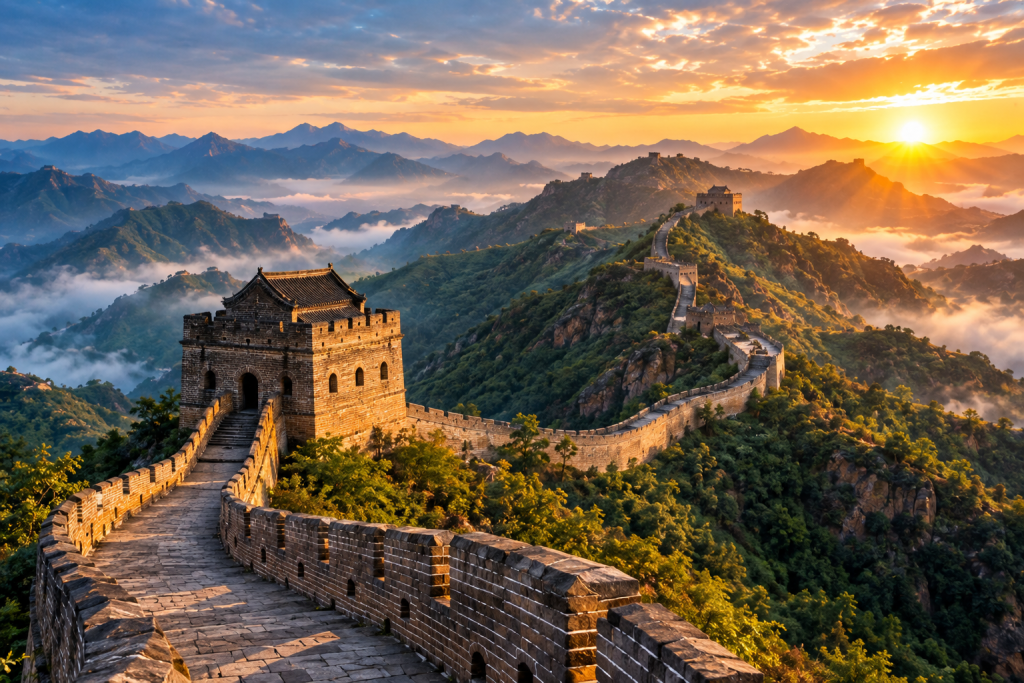
When people imagine the Great Wall of China, they usually picture the impressive stone and brick walls found near Beijing.
Most of these famous sections date from the Ming Dynasty, which ruled China from 1368 to 1644.
The Ming government invested heavily in frontier defenses, particularly after periods of conflict with Mongol forces.
Compared with many earlier walls, Ming fortifications were more substantial and sophisticated. Builders used bricks and stone extensively in important areas, while watchtowers and fortified passes became major components of the defensive system.
Some of the best-known sections include areas around Badaling, Mutianyu, Jinshanling, and Simatai.
These sections demonstrate the engineering and organizational abilities of the Ming state.
The walls follow mountain ridges whenever possible, using the natural landscape to strengthen their defensive position. From high points, soldiers could monitor large areas of surrounding terrain.
How Was the Great Wall Built?
The construction of the Great Wall varied greatly depending on the period and location.
In areas where stone was abundant, builders could use stone blocks. In other regions, they relied heavily on rammed earth.
The Ming builders often used bricks and stone, especially in strategically important sections.
The terrain itself was one of the greatest challenges.
Some sections cross steep mountains where the wall appears almost to climb vertically along the landscape. Others extend across dry northern plains and desert regions.
Building materials often had to be transported over difficult terrain. Workers included soldiers, laborers, craftsmen, and people mobilized by the state.
The construction of the wall therefore represented not only architectural skill but also the organizational power of ancient governments.
The Great Wall and the Landscape of China
One of the most remarkable aspects of the Great Wall is its relationship with the landscape.
Rather than ignoring geography, builders often incorporated it into the defensive system.
Mountain ridges provided natural barriers. Valleys created strategic passages. Rivers and deserts influenced the location of fortifications.
This relationship between architecture and nature is important when looking at traditional Chinese landscapes more broadly.
The Great Wall does not simply sit on top of the landscape. In many places, it seems to become part of the mountains themselves.
Today, photographs of the wall winding through misty mountains have become some of the most recognizable images of China.
The Cultural Meaning of the Great Wall
Over time, the Great Wall became much more than a military structure.
It became a powerful cultural symbol associated with China’s long history, endurance, engineering, and national memory.
For Chinese people, the wall has appeared in literature, poetry, painting, education, and popular culture.
It also became an important symbol through which China was presented to the wider world.
The Great Wall represents both the strength of imperial states and the enormous human effort required to build and maintain them.
At the same time, its history reminds us that ancient China was never completely isolated. Northern frontiers were zones of conflict, migration, trade, diplomacy, and cultural exchange.
The wall was therefore part of a much larger story about how different societies interacted across the landscapes of East Asia.
The Great Wall Today
Today, the Great Wall is one of China’s most important historical and cultural landmarks.
It attracts visitors from around the world, but tourism represents only one part of its modern significance.
The Great Wall has also become an important subject for historians, archaeologists, architects, and conservation specialists.
Many sections have suffered from natural erosion, weather, human activity, and the passage of time. Some sections are well preserved, while others survive only as ruins or traces in the landscape.
Protecting the Great Wall requires more than repairing visible walls. Researchers also study the surrounding environment, archaeological remains, watchtowers, passes, and historical records.
The goal is to preserve the Great Wall not simply as a tourist attraction, but as an important part of China’s historical heritage.
Is the Great Wall One of the Wonders of the World?
The Great Wall is often described as one of the greatest architectural achievements in human history.
It was also included in the list of New7Wonders of the World in a global campaign announced in 2007.
However, its importance does not depend on modern rankings.
Its real significance comes from the thousands of years of history represented by its different sections.
From the early defensive walls of the Warring States period to the fortifications of the Qin and Han empires and the impressive Ming structures seen today, the Great Wall reflects changing political systems, military strategies, technologies, and relationships between people and the landscape.
The Great Wall and the Story of China
The Great Wall of China is often introduced as a giant defensive wall built to keep invaders out.
That description is not wrong, but it is incomplete.
The Great Wall was created through centuries of construction and reconstruction. Different dynasties built different defensive systems for different political and military purposes.
It tells the story of imperial power, frontier life, warfare, engineering, geography, migration, trade, and cultural exchange.
Most importantly, it shows that Chinese history cannot be understood through monuments alone.
Behind the wall were soldiers, farmers, craftsmen, merchants, travelers, rulers, and communities whose lives were shaped by the frontier.
That is why the Great Wall is such an important place to begin exploring the Places in China section of Zexi Blog.
A place can tell us where something happened. But when we look deeper, it can also tell us why it happened, who shaped it, and what it means.
The Great Wall stands across the mountains of northern China as one of the clearest examples of this idea.
It is not simply a wall.
It is a landscape of history.