
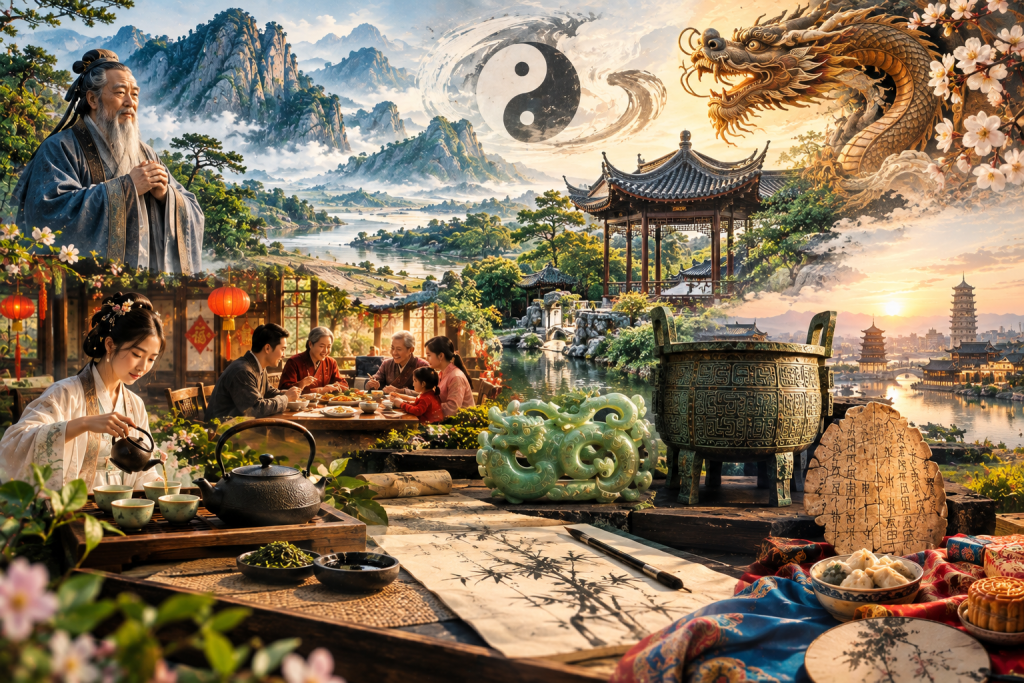
What Does Harmony Mean in Chinese Culture?
If you want to understand Chinese culture, there is one idea that appears again and again: harmony.
The Chinese character 和, pronounced hé, is commonly translated as “harmony,” but its meaning is broader than simply being peaceful or agreeing with everyone.
It can refer to balance, cooperation, coexistence, and the ability of different things to exist together without losing their own characteristics.
Harmony has played an important role in Chinese philosophy, social thought, literature, art, architecture, and everyday life.
It can be seen in the relationship between people and nature, between family members, between different parts of society, and even in the way traditional Chinese art creates balance between empty and filled space.
But harmony does not mean that everyone must think alike.
Instead, one of the deeper ideas behind 和 is that difference and balance can exist together.
To understand this idea is to gain an important key to understanding Chinese culture.
Harmony Does Not Mean Everyone Agrees
For people encountering Chinese culture for the first time, “harmony” can sometimes sound like a simple idea:
Everyone should agree with each other.
But this is not a complete understanding of hé.
Chinese philosophical traditions often recognized that the world contains differences and opposites.
People have different personalities.
Families have different roles.
Nature changes between seasons.
Society contains different occupations and responsibilities.
Even within an individual life, there are periods of activity and periods of rest.
Harmony does not necessarily eliminate these differences.
Instead, it seeks an appropriate relationship among them.
A useful way to think about it is not:
difference versus harmony
but:
difference within harmony.
This distinction is important.
A harmonious society is not necessarily one without disagreement. Rather, harmony can be understood as an ideal in which differences are managed through relationships, responsibility, balance, and mutual consideration.
The Ancient Roots of Harmony
The idea of harmony has deep roots in ancient Chinese thought.
Long before the modern concept of Chinese culture existed, early Chinese thinkers were already concerned with questions of order, balance, relationships, and the relationship between human beings and the natural world.
The character 和 appears in early Chinese texts, while related ideas developed through different philosophical traditions.
During the Zhou period and the centuries that followed, discussions of harmony became increasingly important in Chinese thought.
One famous expression from the Confucian tradition is:
和而不同
Often translated as:
“Harmony without uniformity.”
The idea suggests that people can maintain harmonious relationships without becoming identical.
This distinction between harmony and uniformity is especially useful when thinking about Chinese culture.
Harmony requires relationships.
Uniformity removes difference.
They are not the same thing.
Harmony and Confucian Thought
Confucianism provides one of the most important perspectives on harmony in Chinese culture.
Confucian thought places great importance on relationships.
A person is not understood only as an isolated individual, but also through relationships with parents, children, friends, teachers, neighbors, and society.
These relationships create responsibilities.
For example, children have responsibilities toward their parents, parents toward their children, friends toward one another, and rulers toward the people they govern.
Harmony therefore depends partly on people understanding their responsibilities within relationships.
This does not mean that Confucianism simply asks people to obey others.
It also places importance on moral behavior.
A relationship becomes stable when people act with appropriate conduct, respect, responsibility, and consideration.
In this sense, harmony is not simply an emotional state.
It is also a social and ethical ideal.
Harmony and the Family
The idea of harmony is particularly important in traditional Chinese family culture.
The family has historically been one of the fundamental social units in Chinese society.
Maintaining good relationships among family members was therefore not viewed simply as a private matter.
It was connected to wider social stability.
Respect for parents and elders, care for younger generations, and responsibility among relatives all contributed to an ideal of family harmony.
This helps explain why family reunion remains such an important theme in Chinese festivals.
During the Chinese New Year, for example, millions of people traditionally travel to reunite with their families.
The journey itself can be exhausting, but the reunion has a deeper cultural meaning.
Being together matters.
Sharing a meal matters.
Visiting parents and relatives matters.
These actions reinforce relationships that connect generations.
In this way, harmony is not an abstract philosophical idea.
It can be experienced around the family dinner table.
Harmony Between People and Nature
Another major dimension of Chinese culture and harmony is the relationship between human beings and nature.
Traditional Chinese thought often viewed humanity as part of a larger natural order rather than completely separate from it.
This idea appears particularly strongly in Chinese landscape painting and garden design.
A traditional Chinese landscape painting may place enormous mountains, rivers, clouds, and forests at the center of the composition, while human figures appear very small.
The message can be subtle.
Human beings are important, but they are not the entire world.
Nature has its own scale, rhythm, and power.
The human being exists within a larger environment.
This perspective can also be seen in traditional Chinese gardens.
Instead of simply creating a symmetrical geometric landscape, traditional gardens often combine rocks, water, plants, buildings, paths, windows, and changing views.
The goal is not necessarily to dominate nature.
It is to create a relationship with it.
The Chinese Idea of “Heaven, Earth, and Humanity”
Traditional Chinese thought often used the relationship among Heaven, Earth, and humanity to describe the larger order of existence.
The exact meanings of these concepts changed across different philosophical traditions and historical periods, but the broader idea is important.
Human life exists between the natural world above and the physical world below.
People depend on nature.
Society depends on people.
Human actions can also affect the environment and social order.
This encourages a way of thinking in which human life is connected to a larger system.
Instead of asking only:
“What do I want?”
traditional thought could also ask:
“What is my relationship with everything around me?”
This relational perspective is one of the most useful concepts for understanding traditional Chinese philosophy.
Harmony and Yin and Yang
The relationship between harmony and yin and yang is another important part of Chinese culture.
Yin and yang are often misunderstood in popular culture as simply “good and evil” or “positive and negative.”
That is not the traditional idea.
Yin and yang represent complementary aspects of a changing whole.
Light and darkness.
Activity and rest.
Warmth and cold.
Expansion and contraction.
Neither side exists completely independently of the other.
The famous symbol associated with yin and yang expresses this relationship visually: each side contains a small element of the other.
The deeper principle is one of dynamic balance.
Balance does not mean that everything remains exactly equal.
It means that relationships change over time.
Day becomes night.
Summer becomes autumn.
Activity is followed by rest.
Growth eventually gives way to decline and renewal.
From this perspective, harmony is not a frozen condition.
It is an ongoing process of adjustment.
Harmony and Chinese Medicine
The idea of balance also became important in traditional Chinese medical thought.
Traditional Chinese medicine developed its own theories concerning health, the body, and relationships between different processes.
Concepts such as yin and yang and the Five Phases became part of traditional medical frameworks.
Within these traditions, health was often discussed in terms of balance and relationships rather than focusing only on a single isolated part.
It is important, however, to distinguish traditional Chinese medical theory from modern biomedical science.
Traditional Chinese medicine is a historical medical tradition with its own concepts and practices. Its traditional theories should not automatically be treated as scientifically established explanations of human physiology.
Nevertheless, as a cultural subject, the traditional emphasis on balance provides another example of how deeply the idea of harmony has influenced Chinese thought.
Harmony in Chinese Art
Chinese art provides some of the most beautiful examples of harmony.
Consider traditional Chinese ink painting.
A painting may contain mountains, trees, water, buildings, and people, but large areas of the paper may remain empty.
To a viewer unfamiliar with Chinese painting, the empty space may seem unfinished.
But the empty space is often part of the composition.
It can represent mist, sky, water, distance, or simply provide room for imagination.
The relationship between what is painted and what is left unpainted creates balance.
This principle can also be seen in Chinese calligraphy.
The beauty of a written character is not only in the individual strokes.
It also depends on proportion, rhythm, movement, spacing, and the relationship between the character and the surrounding empty space.
In both painting and calligraphy, harmony comes from relationships between elements.
Harmony in Chinese Architecture and Gardens
Traditional Chinese architecture also demonstrates this principle.
Buildings are often designed in relation to courtyards, gardens, pathways, water, mountains, and surrounding structures.
The architecture does not always attempt to stand alone.
Instead, the experience develops through movement.
You may enter through a gate, pass through a courtyard, see a pavilion through a window, follow a path beside water, and suddenly discover a different view.
Traditional gardens use this sequence of spaces to create changing relationships between architecture and nature.
The famous idea of “borrowing scenery” (jie jing, 借景) describes the practice of incorporating distant landscapes or surrounding features into the visual experience of a garden.
A mountain beyond the garden wall can become part of the garden.
A reflection in water can become part of the composition.
The garden and its surroundings become connected.
This is harmony expressed through space.
Harmony in Chinese Tea Culture
Tea offers perhaps one of the simplest ways to experience harmony in everyday Chinese life.
A traditional tea setting can bring together:
water
tea leaves
teaware
temperature
time
space
people
The preparation of tea requires attention to relationships among these elements.
Too much heat can affect the tea.
Too little heat can change the result.
The amount of tea, the water, the brewing time, and the vessel all influence the final cup.
Tea culture therefore provides a practical metaphor for balance.
But tea is also social.
People sit together.
They talk.
They pause.
They share tea.
In a fast-moving modern world, this simple act can create a moment of attention and connection.
This is one reason tea remains such an important part of Chinese culture.
Harmony and the Chinese Dining Table
Chinese food culture provides another everyday expression of harmony.
Traditional Chinese meals are often shared rather than individually portioned.
Several dishes are placed in the center of the table, allowing people to eat together.
The meal becomes a social experience.
Different flavors appear at the same time:
sweet and savory,
light and rich,
hot and cold,
crisp and soft.
The variety itself creates a sense of balance.
More importantly, sharing food reinforces relationships.
A meal can express hospitality.
It can welcome a guest.
It can celebrate a wedding.
It can bring a family together.
It can mark a festival.
Food therefore becomes more than food.
It becomes part of the relationship between people.
Harmony Does Not Mean a Perfect Society
It is important not to romanticize the concept.
Chinese history was not a continuous story of harmony.
There were wars, political conflicts, rebellions, social inequalities, family disputes, and struggles for power throughout Chinese history.
The ideal of harmony existed precisely because conflict existed.
A cultural ideal should not be confused with a perfect historical reality.
When Chinese thinkers discussed harmony, they were often asking how people should live together rather than claiming that society already worked that way.
This distinction is important when studying any culture.
The values people admire are not necessarily identical to the way people always behave.
Understanding the ideal can nevertheless help us understand the culture.
Harmony Does Not Mean Losing Individuality
Another common misunderstanding is that a culture emphasizing harmony must reject individuality.
That is too simple.
The traditional idea of 和而不同—harmony without uniformity—offers a different perspective.
People can have different opinions.
Different regions can have different customs.
Different artistic styles can coexist.
Different philosophical traditions can influence the same culture.
China itself demonstrates this diversity.
There is no single Chinese cuisine, single regional tradition, or single way of living.
Sichuan cuisine is different from Cantonese cuisine.
Northern architecture differs from southern architecture.
Local festivals and customs vary across regions.
Harmony does not require everything to look the same.
It can mean finding ways for differences to coexist.
Harmony in Modern Chinese Life
The idea of harmony is not limited to ancient China.
It continues to appear in modern Chinese life, although its meaning can vary depending on context.
Modern Chinese cities combine traditional temples with skyscrapers.
Young people may drink coffee and bubble tea while also celebrating traditional festivals.
Modern design may incorporate ancient patterns.
Traditional crafts may be adapted for contemporary lifestyles.
Digital technology exists alongside centuries-old cultural practices.
This combination illustrates something important about Chinese culture:
continuity does not necessarily mean remaining unchanged.
A tradition can survive by adapting.
A cultural idea can acquire new meanings.
The relationship between tradition and modernity can itself become a form of cultural balance.
Why Harmony Matters When Understanding China
If you only look at individual Chinese traditions, some of them may seem unrelated.
Why is family reunion so important?
Why do Chinese gardens emphasize natural scenery?
Why does traditional painting leave empty space?
Why are tea and shared meals so closely connected with social relationships?
Why do yin and yang represent complementary opposites?
Why does Confucian thought place so much emphasis on relationships?
The idea of harmony provides one possible thread connecting many of these traditions.
It is not the only explanation for Chinese culture.
But it offers a useful lens.
It helps us see Chinese culture not as a collection of unrelated customs, but as a network of ideas about relationships, balance, coexistence, and change.
Harmony as a Way of Seeing
Perhaps the most useful way to understand harmony in Chinese culture is not as a rule, but as a way of seeing.
Instead of looking at one thing by itself, look at its relationship with everything around it.
A person within a family.
A family within a community.
A human being within nature.
A building within a landscape.
A brushstroke within a painting.
A cup of tea within a conversation.
A tradition within a changing society.
The meaning often comes from the relationship.
This is one of the reasons the concept of harmony remains so powerful in Chinese cultural thought.
It encourages us to look beyond individual elements and pay attention to the connections between them.
Looking Deeper Into Chinese Culture
Harmony is only one part of the vast world of Chinese culture.
But it provides an important starting point.
To understand Chinese culture is not simply to memorize festivals, symbols, foods, or historical facts.
It is to explore the ideas that connect them.
Harmony is one of those ideas.
It can be found in philosophy, family relationships, art, architecture, gardens, tea, food, and the relationship between people and nature.
And perhaps its most important lesson is simple:
Different things do not always need to become the same in order to exist together.
Sometimes, harmony comes from learning how differences can belong to a larger whole.
That idea has shaped Chinese culture for centuries—and it remains relevant in the modern world.