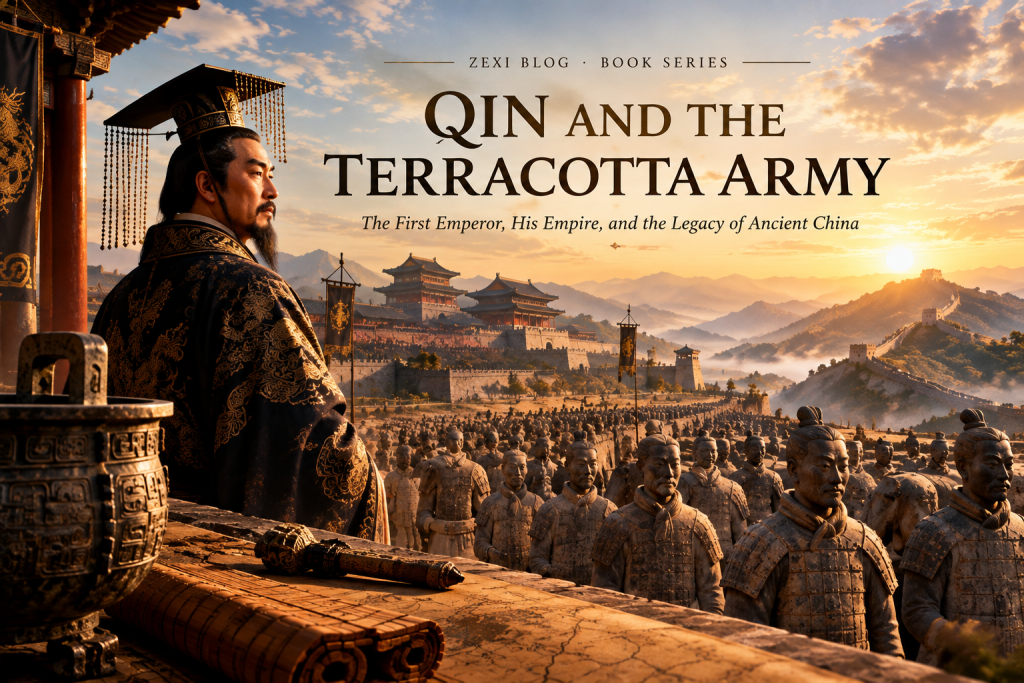
Ancient China During the Warring States Period
To understand the early life of Qin Shi Huang, we must first understand the world into which he was born.
By the third century BCE, the authority of the Zhou kings had declined significantly. Although the Zhou royal house retained its traditional prestige, real power had shifted toward regional states. These states maintained their own governments, armies, and political ambitions. Competition among them led to repeated wars, shifting alliances, and major changes in administration and military organization.
This era is known as the Warring States Period, conventionally dated from 475 to 221 BCE. The principal states included Qin, Chu, Zhao, Wei, Han, Yan, and Qi. Each sought to strengthen its position, but Qin gradually became one of the strongest contenders for dominance.
Qin occupied territory in the west, around the Wei River valley and areas of present-day Shaanxi. Its rulers had expanded their influence over generations, supported by agricultural development, military organization, and administrative reforms. The state’s location also offered opportunities to control important routes and expand into neighboring territories.
Qin was not yet an empire when Ying Zheng was born. It was a powerful kingdom competing against other states in a fragmented political landscape. Its eventual victory depended on more than one ruler’s ambition: it grew from developments that had taken place long before the future emperor reached adulthood.