Introduction to Qin and the Terracotta Army

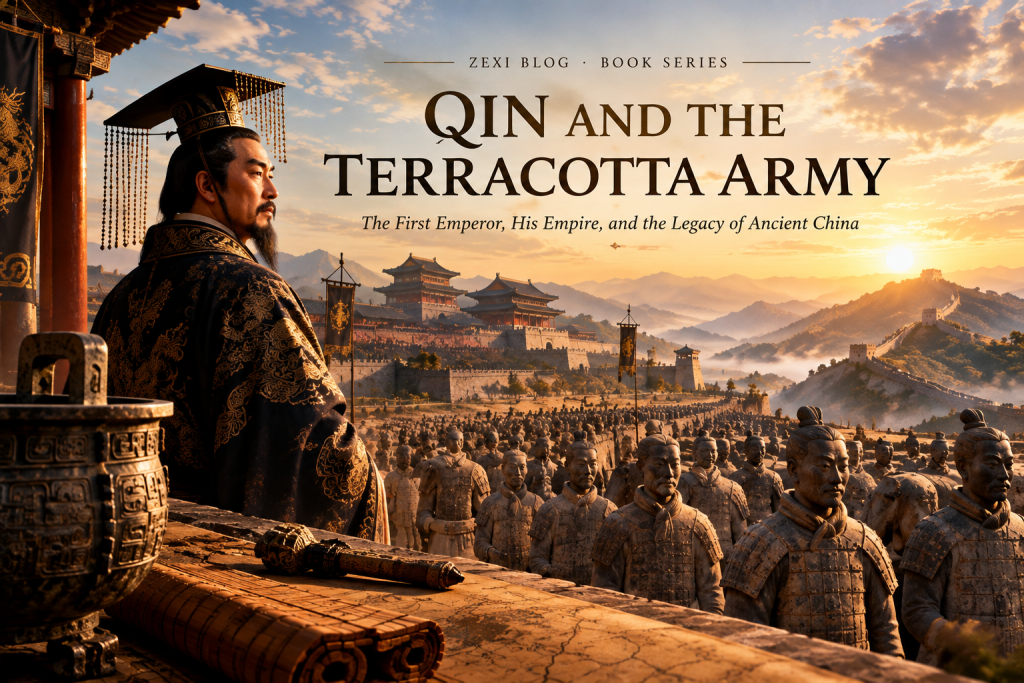
Qin Shi Huang overlooking the Terracotta Army, with ancient Chinese palace walls, a bronze ritual vessel, bamboo scrolls, and a golden sunset over misty mountains.
This entry is part 2 of 3 in the series Qin and the Terracotta Army

Qin and the Terracotta Army

Qin Shi Huang overlooking the Terracotta Army, with ancient Chinese palace walls, a bronze ritual vessel, bamboo scrolls, and a golden sunset over misty mountains.

Qin and the Terracotta Army

Qin Shi Huang overlooking the Terracotta Army, with ancient Chinese palace walls, a bronze ritual vessel, bamboo scrolls, and a golden sunset over misty mountains.

Introduction to Qin and the Terracotta Army

Qin Shi Huang overlooking the Terracotta Army, with ancient Chinese palace walls, a bronze ritual vessel, bamboo scrolls, and a golden sunset over misty mountains.

Chapter 1 – Qin Shi Huang’s Early Life and the Road to Power

The Terracotta Army is one of the most extraordinary archaeological discoveries in the world. Buried for more than two thousand years near Xi’an in present-day Shaanxi Province, China, thousands of life-sized clay warriors stand in formations that reveal the military power, craftsmanship, and ambitions of the Qin Empire. Their discovery opened an extraordinary window into the world of Qin Shi Huang, the First Emperor of China, and the civilization he sought to build.
But the Terracotta Army is only one part of a much larger story. Behind these silent warriors lies the rise of a powerful kingdom, the unification of ancient China, the creation of a centralized empire, and the enormous mausoleum complex built for its first emperor.
In this series, Qin and the Terracotta Army, we will explore the emperor, the empire, the people who lived under Qin rule, and the archaeological discoveries that continue to shape our understanding of ancient Chinese history.

Who Was Qin Shi Huang?

Qin Shi Huang (259–210 BCE) was the ruler who unified the competing states of ancient China and established the Qin Dynasty in 221 BCE. Before his rise, the region was divided among rival kingdoms whose leaders fought for territory, resources, and political supremacy during the Warring States Period.
Born Ying Zheng, he became king of Qin in 246 BCE. Over the following decades, Qin expanded its power through military campaigns, political reforms, and an increasingly effective system of administration. In 221 BCE, after defeating the remaining rival states, Ying Zheng declared himself Huangdi, a title commonly translated as “emperor.”
This achievement transformed the political landscape of ancient China. Rather than ruling one kingdom among many, Qin Shi Huang claimed authority over a unified empire. His government introduced standardized systems of administration and promoted common standards for important measures, including weights, measures, and writing. Roads and other infrastructure helped connect territories that had previously belonged to separate states.
Yet the Qin Empire was also marked by strict laws, demanding labor obligations, and heavy burdens on its population. The dynasty collapsed only a few years after the emperor’s death in 210 BCE. Its reign was brief, but its political and administrative legacy profoundly influenced later Chinese dynasties.
Understanding this contrast between unification and hardship is essential to understanding both Qin Shi Huang and the Terracotta Army.

What Is the Terracotta Army?

The Terracotta Army is a collection of life-sized clay figures created as part of the burial complex associated with Qin Shi Huang. The figures include soldiers, officers, chariots, and horses arranged in military formations.
Unlike small figurines made simply as burial objects, these warriors were produced on a remarkable scale. Their faces, hairstyles, armor, and poses display considerable variation, although scholars continue to investigate how much of this variation represents individual portraiture, workshop practices, or standardized production methods.
The figures were made to accompany the emperor in death, reflecting ancient beliefs about the afterlife and the desire to preserve power beyond the grave. Their military arrangement suggests that the underground army was intended to serve a protective or symbolic role within the larger funerary complex. The precise beliefs behind every feature of the tomb, however, cannot be reconstructed with certainty.
The Terracotta Army also offers valuable evidence about the Qin military. Armor, weapons, ranks, and formations help researchers investigate how the empire organized its forces. Together with historical texts and other archaeological discoveries, the figures provide a more detailed picture of the military system that helped Qin conquer its rivals.

The Mausoleum of Qin Shi Huang

The Terracotta Army belongs to a vast funerary landscape near modern Xi’an. The emperor’s mausoleum was not simply a burial chamber surrounded by soldiers. It formed part of an extensive complex containing burial pits, architectural remains, associated tombs, and other features that archaeologists continue to study.
According to traditional historical accounts, work on the mausoleum began when Ying Zheng became king of Qin in 246 BCE and continued during his rise to imperial power. The project required the coordination of enormous numbers of workers, craftsmen, and officials. Its scale reflects the resources that the Qin state could command, as well as the emperor’s determination to construct a fitting monument for himself.
The central burial chamber has not been fully excavated. Ancient written accounts describe extraordinary features within the tomb, including a representation of the empire and rivers of flowing mercury. These descriptions remain important historical evidence, but they should not automatically be treated as confirmed archaeological facts.
The distinction between historical records, later traditions, and scientific evidence is particularly important when exploring Qin Shi Huang’s mausoleum. Some of its secrets remain unresolved, making it one of the most intriguing archaeological sites in China.

How Was the Terracotta Army Discovered?

In 1974, local farmers digging a well near Xi’an uncovered fragments of terracotta figures. Their discovery led archaeologists to investigate the area, revealing pits containing thousands of clay warriors and horses.
The find attracted international attention because of the scale and preservation of the figures. Subsequent archaeological work identified several major pits associated with the Terracotta Army, each providing evidence about its layout and composition. Researchers have also studied weapons, manufacturing techniques, pigments, and the organization of the workshops that produced the figures.
Excavation and conservation are continuing efforts. The discovery of the army did not immediately answer every question about the emperor’s burial complex. Instead, it opened a long-term research project involving archaeology, history, materials science, and heritage preservation.
Today, the site forms part of the Mausoleum of the First Qin Emperor, a UNESCO World Heritage property. It is both a major archaeological resource and an important cultural heritage site.

What This Series Will Explore

The Terracotta Army cannot be fully understood without examining the history that produced it. This series therefore moves beyond the clay warriors to explore the political, military, social, and cultural world of the Qin Empire.
We will begin with Qin Shi Huang’s early life and rise to power, examining the kingdom of Qin and the circumstances that brought Ying Zheng to the throne. We will then consider the assassination attempts associated with the emperor, the challenges of imperial rule, and the events surrounding his death and the rapid collapse of the Qin Dynasty.
Next, we will turn to the mausoleum itself. We will explore its underground palace and burial pits, examine the arrangement of the Terracotta Army, and investigate what the figures reveal about Qin soldiers, military organization, weapons, and battlefield technology.
The series will also examine how the warriors were made, who may have contributed to their construction, and how a project of such extraordinary scale could be organized. Other articles will consider Qin Shi Huang’s association with the Great Wall, his search for immortality, and the archaeological work that has transformed the site into one of the world’s most important historical landmarks.
Throughout the series, we will distinguish established evidence from historical interpretation and legend. Where archaeological discoveries remain incomplete or scholarly interpretations differ, those uncertainties are part of the story.

Why the Terracotta Army Matters

The Terracotta Army is more than an impressive collection of ancient sculptures. It connects several dimensions of Chinese history: the unification of competing states, the organization of a powerful military, the development of imperial government, the achievements of ancient craftsmen, and the beliefs surrounding death and the afterlife.
The figures also remind us that monumental achievements depend on the labor of many people. Behind the emperor’s ambition stood soldiers, artisans, laborers, administrators, and countless others whose individual stories are only partially preserved in the historical record.
Their work has survived even though the dynasty that commissioned it lasted only a short time. The Qin Empire fell in 206 BCE, but the idea of a unified imperial state endured through later dynasties, each adapting and reshaping the institutions inherited from its predecessors.
By studying the Terracotta Army alongside the history of Qin Shi Huang, we can better understand how a brief and turbulent dynasty left such a lasting mark on Chinese civilization.

Begin the Journey into Qin and the Terracotta Army

The silent warriors buried near Xi’an invite us to look deeper. Who was the emperor they were created to accompany? How did the Qin state become powerful enough to unite China? What can the soldiers reveal about warfare, craftsmanship, and daily life more than two thousand years ago? And how much remains hidden beneath the earth surrounding the emperor’s tomb?
These questions guide our journey through the Qin Empire and its most remarkable archaeological legacy.
The Terracotta Army preserves only part of the story. To understand the world that created it, we must explore the emperor, the people, the institutions, and the ambitions behind it.
This is where our journey into Qin and the Terracotta Army begins.
Discover China. Look deeper.

Qin and the Terracotta Army

Qin and the Terracotta Army Chapter 1 – Qin Shi Huang’s Early Life and the Road to Power

Leave a Comment

Your email address will not be published. Required fields are marked *

Scroll to Top