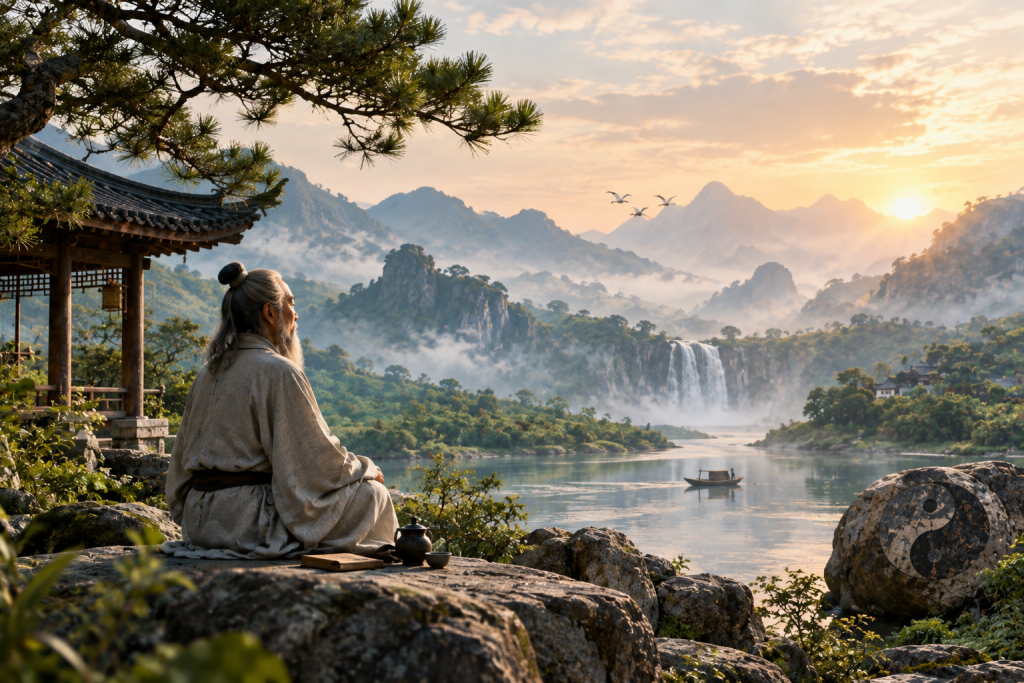
Taoism and the Chinese Way of Living: Nature, Balance, and Simplicity
When exploring Chinese culture, it is easy to notice traditions that emphasize family, social relationships, education, and responsibility. But there is another important side of traditional Chinese thought: the idea of living in harmony with nature, accepting change, and avoiding unnecessary struggle.
This way of thinking is closely associated with Taoism, also known as Daoism.
Taoism is one of the major traditions in Chinese philosophy and has influenced Chinese ideas about nature, health, art, literature, religion, and everyday life for more than two thousand years.
To understand Taoism and the Chinese way of living, however, it is important to look beyond simple definitions. Taoism is not simply a philosophy of “doing nothing” or escaping from society. It offers a different way of thinking about how human beings relate to nature, change, desire, and life itself.
What Is Taoism?
Taoism developed in ancient China and is traditionally associated with thinkers such as Laozi and Zhuangzi.
The word “Dao” (道) is usually translated as “the Way.” But the Dao is not simply a road or a set of instructions. It can refer to the natural way things unfold and the underlying order or process of the world.
The Tao Te Ching, traditionally associated with Laozi, is one of the foundational texts of Taoist thought. The Zhuangzi, associated with the philosopher Zhuangzi, is another important work.
Over time, Taoism developed into both a philosophical tradition and a religious tradition. These dimensions overlap but should not be treated as exactly the same thing.
For Taoism in Chinese culture, one of its most enduring contributions is a distinctive way of thinking about the relationship between human beings and nature.
Living With Nature
One of the central ideas in Taoist philosophy is that human beings are part of nature rather than completely separate from it.
Instead of trying to control every aspect of life, Taoist thought often encourages people to observe natural processes and understand their rhythms.
A river does not need to fight the landscape to move forward. A tree grows according to its nature. The seasons change without being forced.
These images help express an important Taoist idea: life has its own patterns, and wisdom can involve recognizing those patterns rather than constantly resisting them.
This perspective has influenced traditional Chinese landscape painting, poetry, gardens, architecture, and other forms of Chinese art.
Mountains and water, for example, are not merely beautiful scenery. They can also represent a larger relationship between humanity and the natural world.
Wu Wei: Acting Without Forcing
One of the most famous Taoist concepts is wu wei (无为).
It is often translated as “non-action,” but this translation can be misleading.
Wu wei does not necessarily mean doing nothing. It is closer to acting without unnecessary force or resistance.
Imagine someone trying to move a heavy object. Pushing harder is not always the best solution. Sometimes the better approach is to understand the object’s position, find the right direction, and use the least effort necessary.
In this sense, wu wei suggests a form of intelligent action.
It encourages people to recognize circumstances, avoid unnecessary struggle, and respond to situations with flexibility.
This idea has become one of the most recognizable examples of Laozi philosophy, although its meaning is much deeper than the popular phrase “go with the flow.”
Simplicity and Less Desire
Another important theme in Taoism is simplicity.
Taoist thinkers often questioned excessive desire, unnecessary competition, and the endless pursuit of status or possessions.
This does not mean that Taoism requires people to reject everything material.
Instead, it asks a deeper question:
How much do we really need to live well?
In a society where people constantly pursue more, the Taoist preference for simplicity can offer a different perspective.
A quiet morning, a walk through nature, a cup of tea, or time spent without constant distraction can become meaningful experiences.
This aspect of Taoist thought connects naturally with some elements of Chinese lifestyle and culture, where appreciation of quiet spaces, gardens, tea, poetry, and nature has long been important.
Yin and Yang and the Idea of Balance
Taoism is often discussed together with yin and yang, represented by the familiar black-and-white symbol.
Yin and yang describe complementary forces rather than two completely separate opposites.
Day and night, activity and rest, light and darkness, softness and strength can be understood as different but interconnected aspects of experience.
The important idea is not that one side should permanently defeat the other.
Instead, change and balance are part of life.
Although yin-yang thinking has a broader history within Chinese thought and should not be treated as belonging exclusively to Taoism, it fits naturally with the Taoist appreciation of balance, transformation, and interconnectedness.
This way of thinking has influenced Chinese philosophy, medicine, art, martial arts, and traditional ideas about living in harmony.
Taoism and Chinese Art
The influence of Taoism can be seen especially clearly in Chinese art.
Traditional Chinese landscape painting often gives mountains, rivers, clouds, and empty space an important role.
Human figures may appear very small compared with the surrounding landscape.
The composition can suggest that humanity is part of a much larger natural world.
Chinese gardens can express a similar idea. Rather than completely controlling nature, traditional gardens often create carefully designed spaces that appear natural, with rocks, water, plants, pathways, pavilions, and borrowed views working together.
This relationship between design and nature reflects a broader Chinese appreciation for balance and harmony.
Taoism in Everyday Life
It would be too simple to say that every aspect of traditional Chinese life comes directly from Taoism.
Chinese culture has been shaped by many traditions, including Confucianism, Buddhism, folk beliefs, regional customs, and historical changes.
Yet Taoism and Chinese culture have influenced how people have imagined nature, simplicity, balance, health, leisure, and the relationship between human beings and the world around them.
Its influence can be found in poetry, painting, gardens, tea culture, martial arts, traditional medicine, literature, and ideas about living a less hurried life.
For modern people, some of these ideas can feel surprisingly familiar.
In a world filled with schedules, notifications, competition, and constant activity, the Taoist appreciation of simplicity and natural rhythm offers another way of looking at time.
Taoism and the Chinese Way of Living
The deeper value of Taoism may not be found in a single rule.
It lies in a different attitude toward life.
Instead of always asking how to control the world, Taoist thought encourages people to observe it.
Instead of always seeking more, it asks whether less might sometimes be enough.
Instead of treating change as something to defeat, it suggests learning how to move with change.
And instead of seeing nature as something completely separate from humanity, it presents human life as part of a larger natural world.
This is why Taoism and the Chinese way of living remain an important subject when exploring Chinese culture.
Chinese culture is not built around one philosophy. But Taoism provides one of its most distinctive perspectives: a reminder that life can sometimes be understood not by pushing harder, but by paying closer attention.
To look deeper into China is therefore not only to discover ancient philosophies.
It is also to discover different ways of thinking about time, nature, balance, simplicity, and the art of living.
Taoism and the Chinese Way of Living: Nature, Balance, and Simplicity