
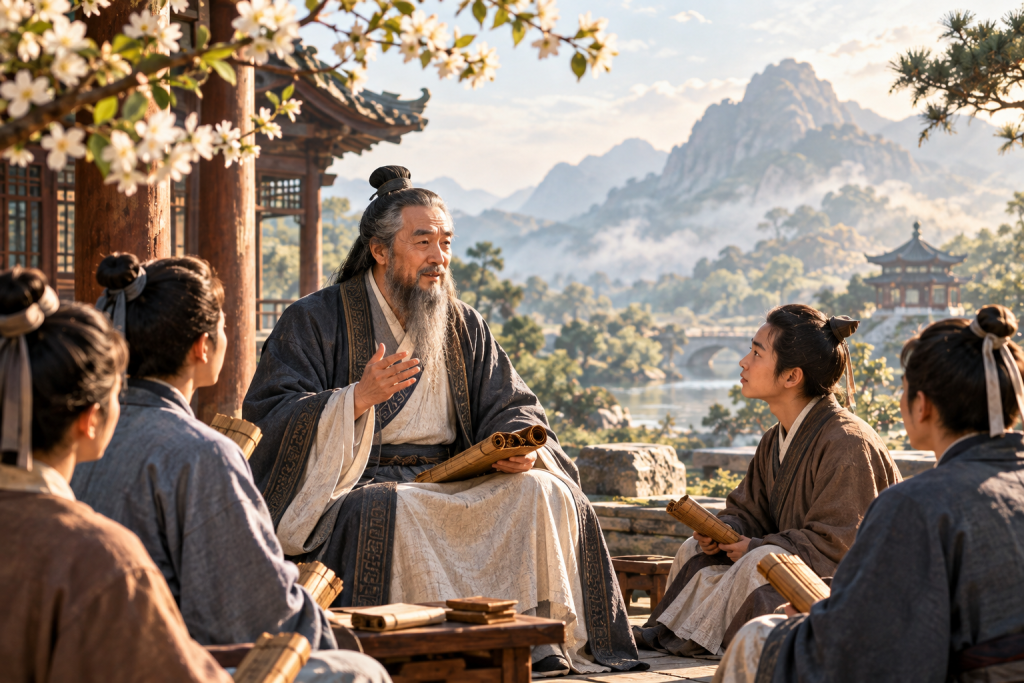
Confucius: The Man Who Shaped Chinese Thought and Culture
When people think about Chinese culture, they often encounter ideas about family, education, respect for elders, social responsibility, and harmony. Many of these ideas have deep historical roots, and one of the most influential figures behind them is Confucius.
Born more than 2,500 years ago, Confucius became one of the most important philosophers in Chinese history. His teachings influenced education, family relationships, government, ethics, and social life across generations.
But Confucius was not simply a philosopher who wrote a system of abstract ideas. He was also a teacher who believed that people could improve themselves through learning, reflection, discipline, and relationships with others.
So, who was Confucius, and why does he still matter today?
Who Was Confucius?
Confucius was born around 551 BCE in the state of Lu, in what is now Shandong Province in eastern China. His Chinese name was Kong Qiu, and he is traditionally known as Kongzi, meaning “Master Kong.”
He lived during the later part of the Eastern Zhou period, a time when political divisions and conflicts were common. Different states competed for power, while traditional social and political institutions were changing.
Confucius believed that society could become more stable if people cultivated themselves and fulfilled their responsibilities toward others.
He worked in several official positions during his life, but teaching became one of his most important activities. He traveled with students and discussed history, morality, government, education, and human relationships.
His teachings were later preserved and compiled by his followers, most famously in the Analects of Confucius, a collection of sayings and conversations associated with him.
Confucius did not describe himself as creating an entirely new philosophy. Instead, he looked to the traditions of the past and tried to understand how they could help people live better lives.
Confucius and the Importance of Education
One of the most important aspects of Confucius philosophy was education.
Confucius believed that education should not be limited to a small hereditary elite. A person could develop moral character through learning and effort.
This was an important idea in the history of Chinese education.
For Confucius, learning was not simply about memorizing information. Knowledge had to influence a person’s character and behavior.
A truly educated person should become more thoughtful, disciplined, responsible, and capable of treating others properly.
This connection between education and personal development became a lasting feature of Chinese thought.
Centuries later, education became deeply connected with government service through systems of classical learning and civil examinations. Although these institutions developed long after Confucius himself, they drew heavily on Confucian texts and traditions.
Ren: The Idea of Humaneness
At the heart of many Confucius teachings is the concept of Ren (仁), often translated as “humaneness,” “benevolence,” or “human-heartedness.”
Ren is difficult to translate with a single English word because it describes a broad ideal of how people should treat one another.
For Confucius, being a good person was not simply about following rules. It involved developing empathy, consideration, and a sense of responsibility toward others.
This idea can be seen in one of the most famous principles associated with Confucian thought: treating others in ways that one would wish to be treated oneself.
Ren therefore begins with personal character but extends outward into family, community, and society.
This is one reason why Confucius and Chinese culture are so closely connected. His philosophy did not separate personal morality from everyday relationships.
Li: Ritual, Courtesy, and Social Order
Another important concept in Confucian thought is Li (礼).
Li is often translated as “ritual,” but its meaning is broader than religious ceremony. It can refer to proper conduct, manners, social customs, ceremonies, and respect for established relationships.
Confucius believed that social harmony required people to understand how their actions affected others.
A respectful greeting, proper behavior toward parents, appropriate conduct between leaders and followers, and observance of important ceremonies could all contribute to social order.
Li was therefore not simply about formal rules.
It was about learning how to behave appropriately within different relationships and situations.
Together, Ren and Li illustrate an important feature of Confucius philosophy: good society begins with good character, but character must be expressed through behavior.
Confucius and Family Values
To understand Confucius and Chinese society, it is essential to understand the importance of family.
Confucius regarded family relationships as an important foundation of moral development. Children should respect their parents, parents should care for their children, and different generations should recognize their responsibilities toward one another.
This tradition became closely associated with filial piety, or xiao (孝).
Filial piety is often translated as respect and devotion toward one’s parents and elders. However, it should not be reduced to simple obedience.
In the broader Confucian tradition, family relationships involve mutual responsibilities and moral conduct.
The family was seen as one of the first places where people learned respect, responsibility, self-discipline, and care for others.
This helps explain why family values in Chinese culture have remained such an important subject.
Ideas associated with Confucianism influenced not only family life but also education, social relationships, and expectations of personal responsibility.
Confucius and the Idea of the Junzi
Confucius also described an ideal type of person known as the Junzi (君子).
The word originally had connections with social status, but in Confucian thought it increasingly came to represent a person of moral character.
The Junzi does not become admirable simply because of wealth, power, or birth.
Instead, such a person continually works on himself.
A Junzi should be:
thoughtful
responsible
respectful
willing to learn
capable of self-reflection
concerned with the well-being of others
This idea is important because it shifts attention from social position to personal character.
A person’s worth depends not only on what he possesses, but also on how he behaves and how he treats other people.
Confucius and Good Government
Confucius also had strong ideas about government.
He believed that rulers should lead through moral example rather than relying only on punishment and force.
A government could create laws and punishments, but lasting social order required people to develop a sense of responsibility and morality.
In this sense, the character of a ruler mattered greatly.
A leader who behaved with integrity could influence society through example, while a ruler who acted selfishly could weaken trust and social order.
These ideas later became extremely influential in Chinese political thought.
For many centuries, Confucian learning became an important part of the education of officials and the intellectual foundation of imperial government.
Confucius and the Meaning of Harmony
Confucius did not teach that everyone should think exactly the same way.
Instead, his ideas emphasized appropriate relationships, mutual respect, and moral responsibility.
This connects closely with the broader Chinese cultural idea of harmony.
Harmony does not necessarily mean the absence of disagreement. It can mean finding a way for different people and interests to exist within a stable relationship.
This idea would become an important theme in later Chinese philosophy and culture.
For Zexi Blog, this connection is especially important because understanding Confucius provides a deeper way to understand why concepts such as family, education, responsibility, and harmony appear so often in discussions of Chinese culture.
Why Is Confucius Important Today?
The influence of Confucius continued long after his death.
His teachings became the foundation of what is now called Confucianism, a tradition that developed through the work of later thinkers and scholars. Confucian ideas influenced China for more than two thousand years and also spread to other parts of East Asia, including Korea, Japan, and Vietnam.
At the same time, Confucius should not be treated as the sole creator of everything associated with traditional Chinese culture.
Chinese culture developed through many historical periods, philosophies, religions, communities, and regional traditions.
Confucianism was one major influence among several, alongside traditions such as Daoism and Buddhism.
Nevertheless, Confucius remains essential for understanding many aspects of Chinese intellectual and social history.
His questions are still surprisingly familiar:
How should we treat our parents?
What makes a good person?
What is the purpose of education?
How should a leader behave?
How can society become more harmonious?
These questions are not limited to ancient China.
Confucius and Modern Chinese Culture
Modern China is very different from the world in which Confucius lived.
Family structures have changed. Education has changed. Technology, cities, careers, and individual choices have transformed everyday life.
Yet some ideas associated with Confucian tradition continue to appear in discussions of family, education, respect for elders, personal responsibility, and social relationships.
Their meaning has also changed over time.
Modern Chinese people do not all interpret Confucian ideas in the same way, and traditional values sometimes exist in tension with modern ideas about independence and individual choice.
This tension is part of the continuing story of Chinese culture.
Tradition does not simply remain unchanged. It is constantly interpreted by new generations.
Looking Deeper Into Confucius
Confucius is important not because every idea attributed to him can be applied directly to modern life, but because his teachings became part of one of the world’s most influential intellectual traditions.
To understand why Confucius is important, it helps to look beyond individual sayings and see the larger picture.
He connected education with self-improvement, family with moral development, personal character with social responsibility, and leadership with ethical example.
These connections helped shape Chinese thought for centuries.
And that is why studying Confucius is not simply studying one ancient Chinese philosopher.
It is a way to begin understanding the deeper ideas behind Chinese culture, Chinese family values, education, social relationships, and traditional Chinese society.
More than two thousand years later, the questions he asked about how people should live with one another are still worth asking.