
Why Is Family So Important in Chinese Culture?
To understand Chinese culture, one of the best places to begin is the family.
Family has played an important role in Chinese society for thousands of years. It has influenced ideas about responsibility, respect, education, relationships, traditions, and the meaning of home.
For many people around the world, family is important. But in traditional Chinese culture, family has often been understood as more than a private relationship between parents and children.
It is also a place where people learn how to relate to others, how to take responsibility, and how to connect one generation with another.
This is why ideas such as filial piety, respect for elders, family reunion, and education have remained important parts of Chinese culture.
At the same time, Chinese families are changing with modern life.
To understand Chinese family culture, therefore, we need to look at both its traditions and its evolution.
The Family as a Foundation of Chinese Society
Traditional Chinese society placed strong importance on relationships.
A person was not understood only as an individual, but also through relationships with parents, children, siblings, relatives, teachers, friends, and the wider community.
The family was the first place where these relationships were experienced.
Children learned how to respect parents and elders. Parents were responsible for raising and educating their children. Older generations passed knowledge and traditions to younger ones.
These relationships were closely connected with the broader idea that a stable society begins with responsible relationships between people.
This idea became particularly influential through Confucianism.
Confucius and Family Values
Confucius placed great importance on relationships, responsibility, education, and moral behavior.
In Confucian thought, the family was an important place for developing personal character.
How a person treated parents, children, siblings, and other family members was part of learning how to behave in society.
This helped establish a cultural tradition in which personal behavior was often considered in relation to others.
The goal was not simply individual success.
It was also to become a responsible member of a family and society.
This way of thinking has had a lasting influence on Chinese culture, even though modern Chinese society is very different from the world in which Confucius lived.
Filial Piety: Respect for Parents and Elders
One of the best-known concepts in Chinese family culture is filial piety, or xiao (孝).
Filial piety traditionally refers to respect, care, and responsibility toward parents and elders.
Historically, it could include caring for aging parents, maintaining family relationships, honoring ancestors, and behaving in ways that brought respect to the family.
However, filial piety does not have exactly the same meaning for every Chinese person today.
For some, it may mean visiting parents regularly.
For others, it may mean helping with living expenses, caring for elderly parents, or simply spending time together.
The traditional concept has therefore adapted to modern circumstances.
Its central idea remains relatively simple:
Family members have responsibilities toward one another.
Respect Between Generations
Respect for older generations has traditionally been an important part of Chinese family culture.
Age can represent experience, knowledge, and a connection to previous generations.
This can be seen in everyday family life, from the way younger people greet older relatives to the importance placed on including elders in family gatherings.
Grandparents can also play an important role in passing traditions to younger generations.
A recipe, a family story, a festival custom, or a traditional skill may be learned informally through everyday family life.
In this way, culture does not always need to be taught in a classroom.
Sometimes it is simply passed down through living together.
Family and Education
Education has long held a special place in Chinese culture.
Confucian traditions emphasized learning and self-cultivation, while China’s historical civil service examination system made education an important path to government service and social advancement.
Although the imperial examination system ended in 1905, the cultural importance of education continued.
Today, many Chinese parents continue to place great importance on their children’s education.
Education can represent more than academic achievement.
It may be connected with future opportunities, personal development, family hopes, and social mobility.
At the same time, modern Chinese families increasingly discuss the pressure that can come with intense educational competition.
The importance of education remains, but the way families understand success is changing.
Family Reunion and Chinese Festivals
Few traditions show the importance of family more clearly than Chinese festivals.
The Spring Festival, commonly known as Chinese New Year, is especially associated with family reunion.
Millions of people traditionally travel to their hometowns during the holiday to spend time with parents, grandparents, and relatives.
For many families, the most meaningful part of the celebration is simply being together.
The Mid-Autumn Festival also has a strong connection with family reunion.
The full moon traditionally symbolizes completeness and togetherness, making the festival an important occasion for families to gather and share food.
These traditions show that festivals in Chinese culture are not only about ceremonies.
They are also about relationships.
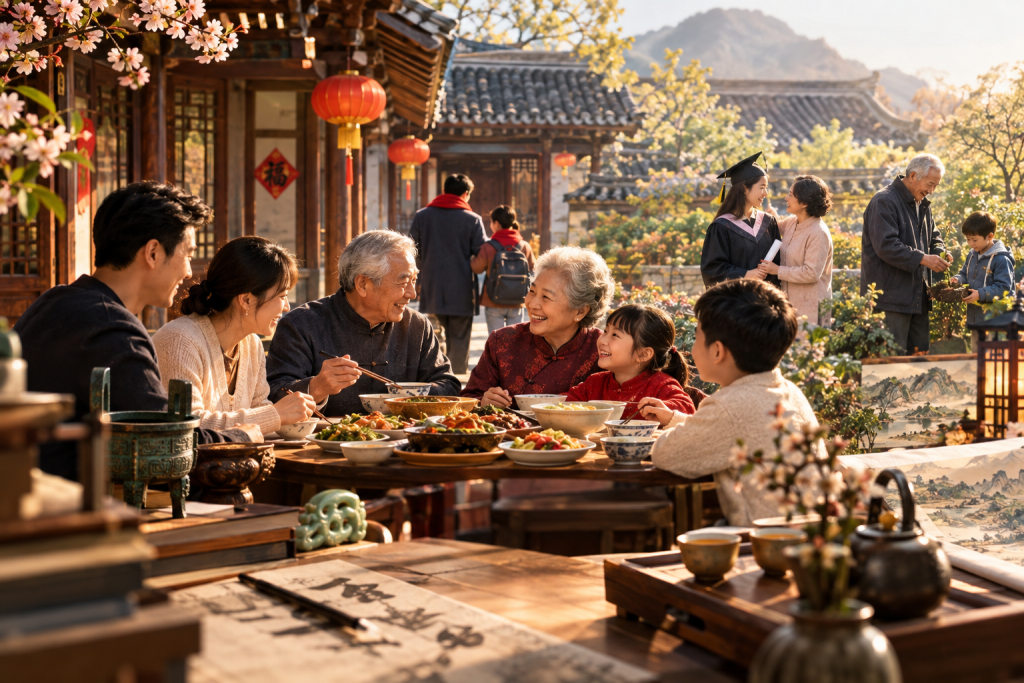
The Chinese Family Meal
The family meal is another simple but meaningful part of Chinese culture.
Traditional Chinese meals are often shared.
Several dishes may be placed in the center of the table, allowing everyone to enjoy the food together.
The meal becomes a social experience as much as a way of eating.
People talk, share stories, offer food to one another, and celebrate important occasions.
Food can also express hospitality.
When guests visit, offering them food and tea is a common way of showing welcome and respect.
The dining table therefore becomes a place where relationships are maintained.
Family and Ancestors
Traditional Chinese culture has also placed importance on remembering previous generations.
In different periods and regions, families have practiced various forms of ancestor remembrance, including visiting ancestral graves, maintaining family records, or participating in rituals.
These traditions were influenced by Confucian ideas as well as broader Chinese religious and cultural practices.
The underlying idea is one of continuity.
A family is connected to the generations that came before it.
This awareness of the past can also be seen in family names, genealogies, stories, and traditions passed from parents to children.
For some families today, these practices remain important.
For others, they have become less formal.
But the idea of remembering one’s roots continues to have cultural significance.
The Changing Chinese Family
Chinese family life has changed enormously in the modern era.
Urbanization has moved millions of people away from their hometowns.
Young adults increasingly live independently.
Women participate widely in professional life.
Smaller households have become common.
Marriage and parenting are also increasingly viewed through the lens of individual choice.
As a result, the traditional extended family is no longer the only model of Chinese family life.
Yet change does not necessarily mean that family has become less important.
Modern technology has even created new ways for families to remain connected.
A grandparent in one city can speak with a grandchild in another through a video call.
Family members separated by distance can share photographs, messages, and important moments every day.
Traditional relationships are therefore being maintained through modern forms of communication.
Tradition and Individual Choice
Perhaps one of the most interesting aspects of modern Chinese family culture is the balance between family expectations and individual choice.
Traditional values may emphasize responsibility toward parents and relatives.
Modern life places greater importance on personal independence and individual decisions.
Young people may choose their own careers, relationships, lifestyles, and places to live.
Sometimes these choices fit family expectations.
Sometimes they do not.
This tension is not unique to China. Families around the world experience differences between generations.
But in China, the long history of family-centered values gives this question a particular cultural significance.
Modern Chinese families are continually negotiating between tradition and change, responsibility and independence, and family expectations and personal choice.
Family as a Bridge Between Generations
Perhaps the most important role of the family in Chinese culture is its ability to connect generations.
The older generation carries memories and experiences from the past.
The current generation decides which traditions to continue, adapt, or leave behind.
The younger generation carries those traditions into the future.
This does not mean that everything remains unchanged.
A traditional recipe may be prepared in a modern kitchen.
A festival may be celebrated through social media.
A family living in different cities may reunite through digital communication.
Culture survives not because every detail remains the same, but because people continue to give traditions new meaning.
Looking Deeper Into Chinese Culture
The Chinese family is more than a social institution.
It is a window into some of the deeper ideas of Chinese culture.
It helps explain the importance of relationships, respect for elders, education, family reunion, shared meals, and cultural continuity.
It also shows how tradition and modern life can exist together.
The Chinese family has changed greatly over thousands of years, and it continues to change today.
But one idea remains especially important:
People are connected through relationships, responsibilities, memories, and shared experiences.
To understand those connections is to understand an important part of Chinese culture.
And sometimes, the best way to understand a culture is not to look at its grand monuments or famous traditions.
It is to sit around the family table.